Electric cars enter their most decisive generation yet
The next wave of electric vehicles is no longer defined by one spectacular statistic. From sub-€20,000 city cars to long-range saloons, seven-seat family models and electric performance flagships, the market is developing the breadth required to challenge combustion cars on their own terms.
The electric car is moving beyond novelty. A new wave of models is arriving across almost every major vehicle class, bringing lower entry prices, much longer ranges, faster charging and a more serious attempt to create character behind the wheel. The decisive contest is no longer between electricity and petrol alone. It is between electric cars that merely satisfy regulations and those that are genuinely better products.
Global electric-car sales exceeded 20 million in 2025 and represented roughly one quarter of the new-car market. The momentum has continued in 2026. Battery-electric cars secured 20.7 per cent of European Union registrations during the first half of the year, while worldwide electric-car sales are expected to approach 23 million. Those figures establish scale, but they do not guarantee success for every manufacturer. Buyers remain highly sensitive to price, charging access, insurance costs, depreciation and the quality of the ownership experience.
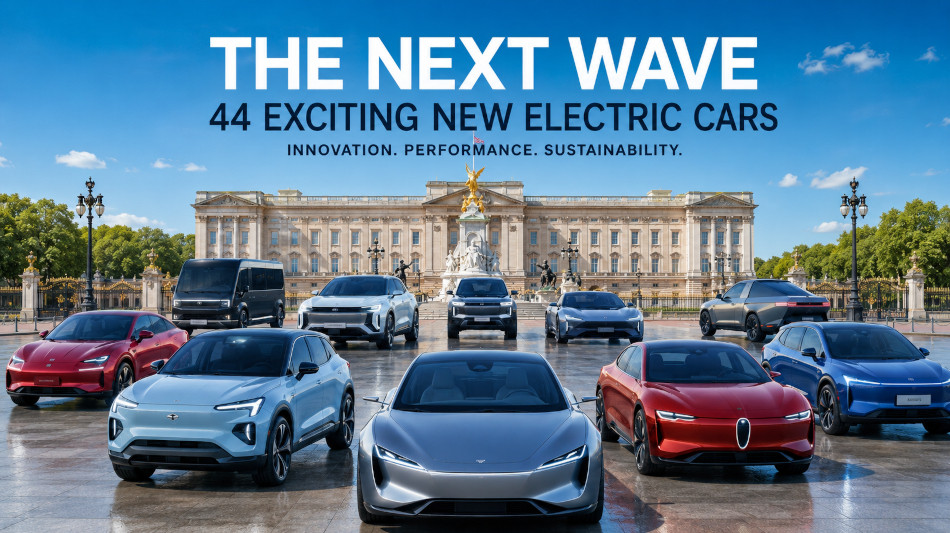
The most revealing feature of the coming model cycle is therefore not a single record-breaking specification. It is the breadth of the product pipeline. More than forty credible new or substantially renewed electric cars now stretch from compact urban hatchbacks to seven-seat family vehicles, luxury saloons, off-roaders, sporting coupés and high-performance flagships. Electrification is beginning to resemble a complete market rather than a specialist category.
Affordability returns to the centre
For mass adoption, the most consequential cars may be among the smallest. Renault has brought the Twingo E-Tech electric to market from €19,490 before national incentives. Its 27.5 kWh battery provides up to 263 kilometres of range, while sliding rear seats and five doors preserve the practicality that made the original Twingo distinctive.
Volkswagen is applying the same principle at a slightly higher level with the ID. Polo. German prices begin at €24,995, and longer-range versions can travel up to 454 kilometres under the WLTP test cycle. The model also offers a 441-litre luggage compartment, illustrating how a dedicated electric platform can create family-car space within compact external dimensions.
The Cupra Raval adds a more overtly sporting interpretation, with an Endurance version offering up to 446 kilometres of range and 155 kW of power. Hyundai’s Ioniq 3 reaches still further. Its long-range version targets 496 kilometres, while a 441-litre luggage area and an additional 119-litre storage compartment beneath the floor give it the sort of everyday utility once associated with considerably larger cars. These models matter because they address the central weakness of the European electric-car market. Premium vehicles demonstrated that battery propulsion could be fast, refined and desirable, but they did not solve the affordability problem. Smaller cars now have to deliver a persuasive combination of price, range, cabin space and charging speed without depending on heavy discounts or unusually generous subsidies.
The advertised starting price will remain only part of the story. Equipment levels, battery size, finance rates and residual values can quickly widen the gap between a headline figure and the monthly cost faced by a buyer. Even so, the arrival of several credible electric cars near or below €25,000 marks a structural change. It gives private customers a realistic alternative to the used-car market and gives manufacturers a route towards genuine volume.
Range becomes infrastructure rather than theatre
At the other end of the market, the technical argument is changing rapidly. The latest premium electric cars are no longer struggling to match the touring ability of combustion models. They are beginning to exceed the distance most drivers would sensibly cover without a substantial break. The new BMW i3 offers a WLTP range of around 900 kilometres in its most efficient form. Its 800-volt electrical system supports charging at up to 400 kW and can add roughly 400 kilometres of range in ten minutes under favourable conditions. Production has started in Munich, turning the second Neue Klasse model from a technology promise into an industrial reality.
Mercedes-Benz answers with the electric C-Class, which can travel up to 762 kilometres and recover as much as 325 kilometres of range during a ten-minute high-power charging stop. Volvo’s EX60 reaches up to 810 kilometres, with a claimed charging time from 10 to 80 per cent of 16 minutes for the fastest variants. Customer deliveries have already begun. Such numbers should be interpreted carefully. Maximum range is generally attached to a particular wheel, battery and drivetrain combination, while maximum charging performance requires a suitable charger, an appropriately conditioned battery and favourable temperatures. Yet the direction is unmistakable. The premium contest has moved from basic feasibility to efficiency, thermal control, charging curves and software that prepares the battery before arrival.
This is a more mature engineering battle than the earlier fixation on battery capacity. A very large battery can extend range, but it also adds cost, mass and embodied emissions. The better solution is a car that travels further with each kilowatt-hour, accepts high charging power for a sustained period and gives the driver an accurate estimate of what remains. Range is becoming less of a trophy and more of a system.
The family car is being rebuilt around the battery
Electric architecture is also reshaping the practical car. The Skoda Peaq demonstrates the scale of that change. The new flagship can carry up to seven people, travel more than 640 kilometres and provide as much as 935 litres of luggage space in five-seat form. Series production has now begun, confirming that large electric family vehicles are moving beyond motor-show concepts.
The same expansion is visible in electric people carriers such as the Hyundai Staria Electric and the forthcoming Mercedes-Benz VLE. These vehicles are important because they exploit the flat floor, long wheelbase and flexible packaging made possible by battery platforms. They also expose the limits of electrification more clearly than smaller cars. A large frontal area, heavy passenger load, cold weather and towing can all reduce real-world range sharply, making charging performance and route planning especially important.
Beyond the conventional family SUV, electric off-roaders are becoming a recognisable category. The Jeep Recon is intended to transfer the brand’s rugged identity into a battery-powered vehicle, while the Rivian R2 aims to make the American company’s combination of utility and software available in a smaller and less expensive format. Range Rover is preparing an electric Sport model, although complete technical details are still to follow.
The rise of estates, coupé-like crossovers and multi-purpose vehicles is equally significant. Early electric ranges were dominated by aerodynamically efficient saloons and high-riding SUVs because they were easier to package and easier to sell at premium prices. The next generation is less constrained. Customers are being offered body styles that reflect how they actually live rather than how manufacturers once needed to protect battery margins.
Performance searches for a new language
Electric power has made extreme acceleration relatively easy. It has not made a memorable performance car easy. The most interesting new sporting models acknowledge that distinction. The Peugeot E-208 GTi produces 281 horsepower and reaches 100 kilometres per hour in 5.5 seconds, yet its significance lies in the work carried out on suspension, braking, track width and control software. The related Opel Corsa GSE uses the same output and acceleration figure, while the forthcoming ID. Polo GTI is expected to combine 226 horsepower with front-wheel drive and an electronically controlled differential.
These cars revive the hot hatch as an electric proposition. Their success will depend less on a single sprint time than on steering clarity, brake feel, thermal consistency and the ability to remain engaging at legal road speeds. A compact electric performance car that feels agile and communicative could do more for enthusiasm than another two-tonne machine with supercar acceleration. Higher up the spectrum, the Genesis GV60 Magma brings 641 horsepower to the premium crossover class. Renault’s 5 Turbo 3E takes a more radical route, using 555 horsepower and rear in-wheel motors in a limited production run of 1,980 cars. It is part homage, part engineering showcase and part evidence that electric performance can be theatrical without merely imitating a combustion engine.
Ferrari’s first fully electric production model, the Luce, moves the discussion into more controversial territory. Its four-motor system develops more than 1,000 horsepower, the 122 kWh battery supports a claimed range of around 530 kilometres and acceleration to 100 kilometres per hour takes approximately 2.5 seconds. Yet the more consequential elements are its active chassis systems, tactile controls and attempt to preserve a direct relationship between driver and machine.
The central problem for every electric performance car is emotional differentiation. Instant torque is no longer rare. What matters now is how a car builds speed, how it responds when the battery becomes hot, how mass is controlled through a sequence of corners and whether the driver is invited to participate. The next great electric sports car will not be defined by silence or artificial noise alone. It will be defined by interaction.
Heritage becomes a strategic tool
Many of the strongest forthcoming electric cars carry familiar names. Twingo, Polo, GTI, i3 and Renault 5 all bring decades of recognition into a market that still feels technologically unfamiliar to some buyers. Other proposed revivals, including names such as A2 and Fiesta, show how valuable established identities have become. This is not simply nostalgia. A known badge can reduce the psychological distance between an existing customer and an unfamiliar powertrain. It tells the buyer where a model sits, what it is supposed to do and which emotional territory it occupies. Volkswagen does not have to explain the basic idea of a Polo, and Peugeot does not have to invent the meaning of GTi.
The strategy also carries risk. A celebrated name creates expectations that software, weight and price cannot satisfy by themselves. An electric successor that borrows heritage while abandoning the qualities that created it may generate attention without earning loyalty. The best revivals will reinterpret their predecessors rather than reproduce their styling as decoration.
Jaguar illustrates the importance of naming from a different direction. The radical Type 00 concept has evolved into a production four-door grand tourer called Type 01. The change establishes a distinction between the design manifesto and the first road-going model of Jaguar’s new era. Its full unveiling later in 2026 will test whether dramatic reinvention can translate into a credible luxury business.
China changes the benchmark
The competitive pressure behind this model offensive cannot be separated from China. Chinese manufacturers have developed electric vehicles at enormous scale and have accelerated expectations for battery integration, cabin technology, software updates and price. Six out of ten electric cars sold globally in 2025 were sold in China, giving domestic manufacturers a vast market in which to refine products and reduce costs. Models such as the Denza Z9 GT signal the next phase. Competition is no longer limited to inexpensive compact cars. Chinese groups are moving into premium estates, luxury saloons, sports cars and sophisticated plug-in hybrids, challenging European manufacturers on design, equipment and charging as well as price.
Europe’s response is becoming more industrially focused. The ID. Polo and Cupra Raval are part of a locally produced compact-electric family, while Renault’s new Twingo is built in Slovenia. The strategic objective is not merely to place an electric badge on an existing car. It is to shorten development cycles, simplify battery choices and produce desirable small cars at a cost structure capable of supporting sustainable margins.
Not every announcement will become a showroom success
The scale of the pipeline can create an illusion of certainty. Vehicle programmes remain vulnerable to changing demand, battery costs, regulation, software delays and the financial condition of their manufacturers. Some models are already in production, some are open for orders, some have been shown only as concepts and others remain informed expectations rather than final commitments.
Porsche’s electric 718 is a useful example. The project has been delayed, but the company continues to say that the battery-powered Boxster and Cayman successors are in development. Audi, meanwhile, is preparing a production sports car inspired by the Concept C for 2027. Both projects show the technical attraction of a low, purpose-built electric sports platform, but they also reveal how difficult it is to make such cars profitable at modest volumes.
Similar uncertainty surrounds several luxury and specialist projects. Manufacturers that once presented an uninterrupted march towards fully electric ranges are retaining hybrids and combustion models for longer, particularly in markets where charging infrastructure or demand is weaker. This is not necessarily a retreat from electrification. It is an acknowledgement that the transition will move at different speeds across regions and price classes.
The next generation will decide whether electric cars become ordinary
The most important electric cars of the coming years may not be the fastest or the most expensive. They are likely to be the models that remove friction from everyday ownership: a Twingo that is genuinely affordable, an ID. Polo that can serve as a household’s only car, an Ioniq 3 that combines compact dimensions with family space, or a Peaq that can carry seven people without turning every long journey into a charging calculation.
Premium models still play a vital role. The BMW i3, Mercedes-Benz C-Class and Volvo EX60 demonstrate technologies that will eventually move into cheaper vehicles. Performance flagships prove that electrification need not eliminate desire. Chinese competition forces established manufacturers to improve speed, software and value.
But the industry is entering a less forgiving stage. Buyers will increasingly judge an electric car by the same standards as any other car. It must be comfortable, reliable, enjoyable, sensibly priced and easy to use. Range and charging will remain important, but they will no longer excuse poor ergonomics, excessive weight or weak after-sales support.
That is the real significance of the new model wave. Electric cars are ceasing to be a technological exception. They are becoming city cars, family cars, company cars, grand tourers and objects of enthusiasm. The transition will not be won by the loudest promise. It will be won by the vehicles that make electricity feel like the obvious choice.
M.Brown