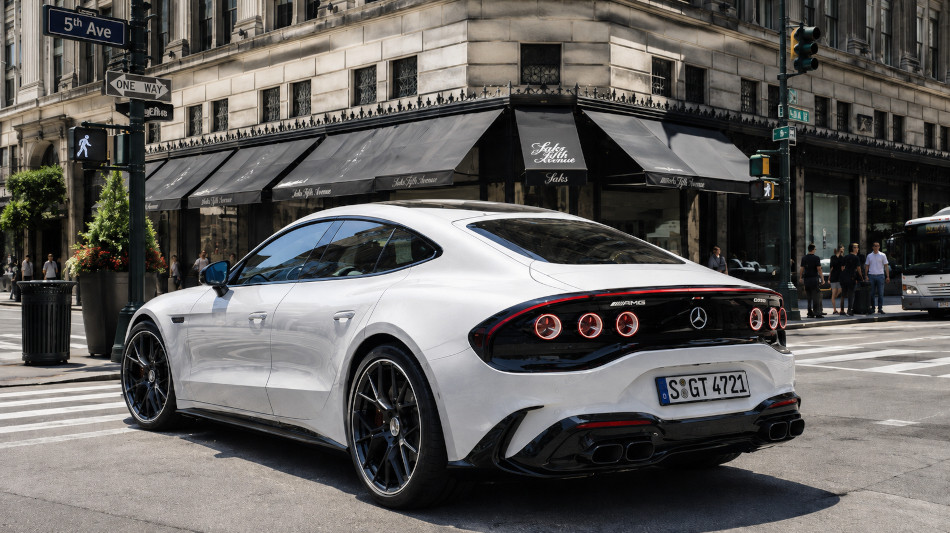
Mercedes-AMG GT 53 balances speed, range and daily usability
Mercedes-AMG’s new electric GT family was introduced with headline-grabbing output figures and a four-figure-horsepower flagship. The GT 53 takes a more measured route. As the new entry point to the 2027 AMG GT 4-Door Coupé range, it trades the three-motor architecture of the GT 55 and GT 63 for two synchronous motors, but retains the 800-volt battery system, all-wheel drive, active aerodynamics and grand-touring practicality.
That makes it less of a diluted flagship than a strategically different model. Peak output is 400 kW, equal to 536 bhp or 544 PS, with 800 Nm of torque. Those figures remain emphatically within high-performance territory, yet the GT 53’s defining claim is not outright acceleration. It is the combination of strong pace, a maximum provisional WLTP range of 809 kilometres and charging performance that could make very long electric journeys considerably less disruptive.
Performance without unnecessary excess
A permanently excited synchronous motor is fitted to each axle. The rear motor does most of the work during steady driving and is paired with a two-speed transmission. First gear uses a short 11-to-one ratio for rapid launches and urban response, while second gear adopts a five-to-one ratio to improve efficiency, refinement and performance at motorway speeds. The front motor acts as a boost unit and can be disconnected completely under light loads, allowing the car to operate primarily through the rear axle when additional traction is not required.
The combined continuous output is 270 kW, while the full 400 kW peak is available through a boost phase listed at 53 seconds. Mercedes-AMG quotes 3.9 seconds from rest to 100 km/h using a conventional measurement and 3.5 seconds with a one-foot rollout. The North American claim is 3.4 seconds to 60 mph. Standard top speed is limited to 230 km/h, or 143 mph, while the optional AMG Driver’s Package raises the ceiling to 250 km/h, or 155 mph.
These are not record-seeking numbers by the standards of the GT 63, but that is precisely the point. The GT 53 is designed to deliver performance that remains readily exploitable without carrying the cost and complexity of three axial-flux motors. Its role is closer to that of a fast, long-legged executive express than an electric supercar with rear seats.
The battery is the central engineering story
The 106 kWh usable battery operates at 800 volts and contains 2,660 cylindrical cells. Each cell is directly cooled by electrically non-conductive oil, a system intended to keep temperatures consistent during hard acceleration, sustained high-speed running and rapid charging. The tall, narrow cell format shortens the path from the cell core to its surface, while an aluminium casing, a full-tab design, an NCMA cathode and a silicon-containing anode are intended to reduce resistance and improve energy density.
The result is a claimed DC charging peak of 600 kW. Under the specified conditions, the GT 53 can accept 70 kWh in ten minutes, replenish the battery from ten to 80 per cent in 11 minutes and add up to 534 kilometres of WLTP range in ten minutes. Those numbers depend on a sufficiently powerful charger, an appropriately conditioned battery and favourable operating conditions, but they indicate the direction in which Mercedes-AMG believes performance electric cars must develop. High output alone is no longer enough. Energy must also be absorbed quickly and repeatedly. Compatibility has not been sacrificed in pursuit of the headline figure. The car can charge from 400-volt infrastructure and switches voltage modes automatically. AC charging is rated at 11 kW.
Provisional combined WLTP range varies from 682 to 809 kilometres, depending on specification, with claimed energy consumption of 15.6 to 18.5 kWh per 100 kilometres. The upper figure is just over 500 miles, although no EPA rating has yet been confirmed for the United States. Real-world range will be influenced by speed, weather, wheel choice, temperature, payload and use of the cabin systems.
Large proportions and carefully managed mass
At 5,094 millimetres long, 1,959 millimetres wide and 1,411 millimetres high, the GT 53 is a substantial car. Its 3,040 millimetre wheelbase creates the visual proportions and cabin space expected of a four-door grand tourer, while a DIN kerb weight of 2,375 kilograms makes clear the challenge facing the chassis engineers.
AMG Ride Control air suspension and adaptive damping are standard, with Comfort, Sport and Sport Plus settings. Fully variable AMG Performance 4MATIC+ distributes torque between the axles, while the low battery position should help control body movement. None of this removes the mass, but it gives the GT 53 the hardware required to reconcile high-speed stability, long-distance comfort and precise cornering.
Aerodynamics play an equally important role. The drag coefficient is listed at 0.21, unusually low for a car wearing wide performance tyres and carrying substantial cooling requirements. A standard active rear spoiler remains hidden at lower speeds and adjusts its angle as speed and longitudinal acceleration rise. An optional active rear diffuser extends the effective tail contour in defined driving situations to reduce drag and improve motorway efficiency.
The practical details reinforce the grand-touring brief. The rear hatch opens to a 415-litre luggage compartment under the VDA measuring method, and a further 41 litres are available beneath the front bonnet. Four doors, individual rear seats and generously designed footwells make the GT 53 a genuine long-distance car rather than a performance machine with token passenger accommodation.
AMG creates a digital substitute for combustion drama
The most revealing feature may be AMGFORCE Sport+. When activated, it introduces simulated shifts, deliberate interruptions in thrust, manual changes through the steering-wheel paddles and the digitally reconstructed sound of the previous AMG E 53 Coupé’s 3.0-litre inline-six engine.
The acoustic model was developed using more than 100 measurements and 16 microphone positions inside and outside the reference car. Drivers can adjust the result between restrained and forceful settings, as well as between more traditional and more futuristic sound characters. The system will inevitably divide opinion. Some customers will regard artificial shifts as unnecessary in a car whose electric motors can provide seamless acceleration. Others may welcome the rhythm, feedback and theatre that have historically separated an AMG from a conventional luxury saloon. Either way, the feature is an acknowledgement that emotional character cannot be measured only in kilowatts.
The cabin follows the same mixture of performance and digital luxury. A 14-inch central display is angled towards the driver and visually integrated with the instrument panel beneath a continuous glass surface. An additional passenger display is available, as is the segmented SKY CONTROL panoramic roof, which can change between transparent and opaque states.
Low front seating, strong lateral support, twin wireless charging trays and a dedicated Response Control dial underline the balance between driver focus and everyday convenience. The dial allows the response of the electric motors to be adjusted separately from the selected driving programme, ranging from progressive and comfort-oriented to immediate and aggressive.
A more credible challenge to the Taycan and e-tron GT
German orders are scheduled to open on 13 August 2026 at a starting price of €115,430 including VAT. That remains firmly within the luxury market, but it places the GT 53 around €39,000 below the GT 55 and gives Mercedes-AMG a more direct answer to the mainstream variants of the Porsche Taycan and Audi e-tron GT. North American pricing has not yet been announced.
The GT 53’s strongest argument is therefore not that it is the cheapest member of an expensive range. It is that its engineering priorities may be better aligned with how a high-performance electric grand tourer is actually used. Few owners need more than 1,000 horsepower, but almost every owner benefits from additional range, shorter charging stops, a compliant ride and usable luggage space.
Its position as the longest-range member of the new electric AMG GT family may also prove commercially significant. The GT 55 and GT 63 are technological statements built around maximum output and repeatable high-speed performance. The GT 53 shifts the emphasis towards efficiency, accessibility and everyday usability without abandoning the performance identity expected from Affalterbach. The real test will come when independent road and charging assessments establish how closely the car can approach its provisional efficiency and charging claims outside controlled conditions. Its styling will remain a matter of taste, and the digitally recreated six-cylinder experience may feel either engaging or contrived depending on the driver.
Even so, the GT 53 appears to be the most rational interpretation of Mercedes-AMG’s new electric platform. The GT 55 and GT 63 demonstrate what the architecture can achieve at its extremes. The GT 53 asks a more commercially important question: whether electric AMG performance can be fast, emotional and technically ambitious without becoming excessive. On paper, it is the version most likely to turn a technological showcase into a credible everyday grand tourer.
A.Lochmann