London grants first licences for supervised Uber robotaxis
London’s first licensed robotaxis are preparing to carry passengers, but the person behind the wheel is not disappearing just yet. Transport for London has authorised a small fleet of autonomous electric vehicles developed by British technology company Wayve for journeys booked through Uber. The decision moves autonomous ride-hailing beyond closed demonstrations and engineering tests, while stopping well short of approving a genuinely driverless service.
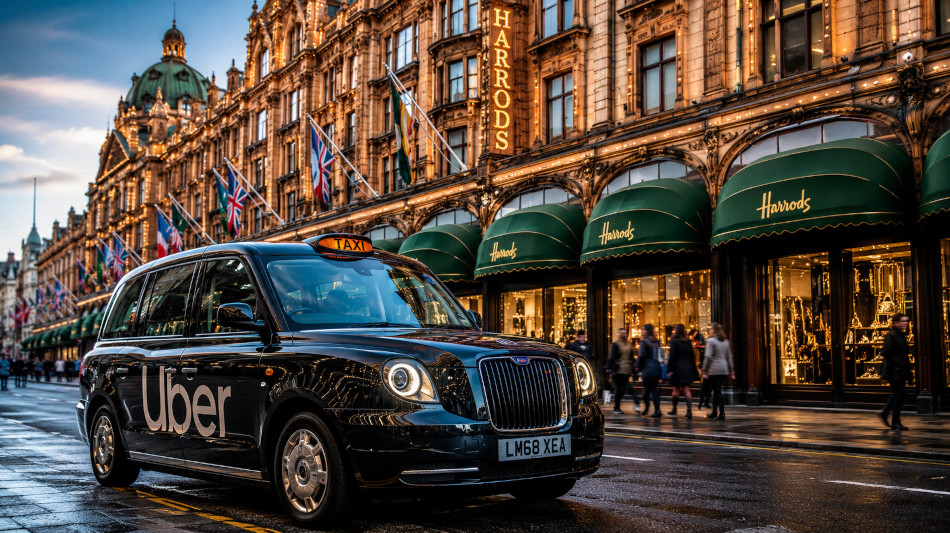
Transport for London has granted private hire vehicle licences to modified all-electric Ford Mustang Mach-E cars equipped with the Wayve AI Driver, surround-view cameras and radar. Up to 15 vehicles can be operated during the initial phase, with each licence valid for one year. Selected passengers are expected to experience the service later this summer before a broader public launch is considered.
Demand for an early ride appears substantial. More than 100,000 Londoners joined Uber’s interest list within eight weeks, demonstrating that curiosity about autonomous mobility is not confined to engineers, investors or transport policymakers. Those selected for the first journeys will travel in vehicles that control their own steering, acceleration, braking and road positioning, but a trained and licensed private hire driver will remain inside and retain responsibility for the car.
That distinction matters. London has licensed the vehicles as private hire cars operating under the existing regulatory system. It has not yet authorised them to carry passengers without a human driver. The current arrangement therefore represents supervised autonomy rather than an entirely driverless taxi service.
A regulatory milestone rather than a driverless revolution
The approval completes what Uber and Wayve describe as the private hire licensing triple lock. The operator, the driver and the vehicle must all be licensed by the same authority before a commercial journey can take place. Uber already possesses the necessary operator licence, the supervising drivers are individually licensed and the modified vehicles have now passed the relevant inspection process.
The arrangement gives London regulators a comparatively cautious route into autonomous passenger transport. The cars can collect paying customers and operate within the daily complexity of the capital, but a person remains available to intervene when road conditions, software behaviour or an unexpected incident require human judgement. Passengers will also have to opt into the autonomous service rather than being placed in one without prior knowledge. This is an important safeguard during a period in which public confidence remains fragile. A technically successful journey is only one part of the test. Riders must understand how the vehicle works, what the supervising driver is expected to do and how assistance would be provided during an emergency.
The licences should not be confused with the separate national permissions that would be required for commercial journeys without a driver. Britain is developing an automated passenger services framework alongside the wider implementation of the Automated Vehicles Act. That system is intended to establish how fully driverless taxis, private hire vehicles and bus-like services can be approved, monitored, suspended and held accountable.
Until those approvals are secured, the human driver remains legally and operationally central to every journey.
London becomes a demanding test of Wayve’s technology
For Wayve, the London launch is more than a limited fleet experiment. It is an opportunity to demonstrate that its artificial intelligence-led approach can cope with one of Europe’s most complicated urban driving environments. The company has tested autonomous technology on London roads since 2018. Its system differs from many earlier autonomous driving platforms because it is designed to learn driving behaviour from experience rather than depending primarily on highly detailed maps and vast libraries of individually programmed rules.
Wayve argues that this approach allows the system to adapt more quickly to unfamiliar streets, different vehicles, changing weather and new cities. Its technology has been demonstrated across hundreds of urban environments, but carrying ordinary passengers through London will impose a different level of scrutiny. The capital combines narrow residential roads, irregular junctions, extensive bus networks, cyclists, motorcycles, pedestrians, frequent roadworks and constant competition for limited kerb space. Pick-ups outside railway stations, hotels, shops and entertainment venues can be more difficult than the journey itself. Temporary diversions and unpredictable human behaviour routinely undermine assumptions that appear reliable in simulation.
Success will therefore be measured less by whether the cars can complete an impressive demonstration route and more by whether they can deliver thousands of uneventful, repeatable journeys. The most convincing autonomous vehicle is not the one that attracts attention, but the one whose behaviour becomes reassuringly ordinary.
Uber is betting on the platform rather than the driving system
The London project also illustrates Uber’s broader strategy in autonomous transport. The company is no longer attempting to develop every component of a driverless vehicle internally. Instead, it is positioning its application, customer base and dispatch network as the commercial platform through which vehicles from several autonomous technology providers can reach passengers.
In London, Wayve supplies the driving intelligence and modified vehicles, while Uber supplies the booking system, passenger relationship, pricing infrastructure and demand network. Similar partnerships are allowing Uber to work with autonomous vehicle developers in several international markets.
This platform model reduces the need for Uber to select one technological winner. Human drivers and autonomous vehicles could operate alongside each other, with the system allocating journeys according to availability, location, vehicle capability and passenger preference.
The economic case, however, remains unproven. A supervised robotaxi still carries the labour cost of a licensed driver while adding expensive sensors, computing equipment, engineering support and specialised maintenance. The first London fleet is therefore unlikely to produce a meaningful cost advantage over a conventional electric private hire vehicle.
Its value lies in the information it can generate. Uber and Wayve will be able to study passenger acceptance, booking behaviour, difficult collection points, intervention rates, charging requirements, vehicle utilisation and the practical demands of running autonomous cars as part of a commercial fleet. Removing the safety driver would transform the economics, but it would also create new costs. Driverless fleets require cleaning, charging, maintenance, remote support, incident management, customer assistance and secure places to park when demand falls. Automation does not eliminate fleet operations. It changes where the work occurs and which organisations carry the responsibility.
Safety will be judged in the difficult moments
Supporters of autonomous vehicles argue that machines do not become tired, distracted, intoxicated or impatient. Government policy is based partly on the expectation that automation could reduce collisions associated with human error. The legal framework is intended to require self-driving vehicles to perform at least as safely as careful and competent human drivers.
That standard will be difficult to measure in practice. Regulators will need more than aggregate mileage figures or a small number of successful passenger journeys. They will need reliable information about near misses, disengagements, emergency interventions, software failures and situations in which the vehicle behaves cautiously but creates danger or obstruction for others.
London also presents challenges that cannot be reduced to conventional collision statistics. Autonomous vehicles must interact safely with ambulances, police cars, road workers and traffic officers. They must recognise informal instructions, temporary hand signals and streets whose normal markings have been obscured. They must cope with passengers who leave doors open, change destinations or need assistance entering and leaving the vehicle. Cybersecurity and data protection will become equally important. Autonomous cars continuously observe their surroundings and depend on software, sensors and communications infrastructure. Regulators will have to ensure that operational information is protected while remaining accessible to investigators after a serious incident.
Transparency will be essential. Public confidence is unlikely to survive a system in which companies publish favourable safety figures but treat the underlying incident data as commercially confidential.
Drivers fear that a limited trial could become a structural shift
The strongest opposition is likely to come from people whose livelihoods depend on London’s taxi and private hire market. Driver representatives have warned that autonomous fleets could eventually remove large numbers of jobs and weaken the human service that experienced drivers provide.
A fleet of no more than 15 vehicles will not materially alter employment across the capital. The concern is what follows if supervised trials lead to thousands of cars operating without drivers.
Autonomous ride-hailing could reduce operating costs and extend services into periods or areas where conventional taxis are less readily available. It could also offer greater independence to some older and disabled passengers. Yet these benefits are not automatic. A vehicle without a driver may improve mobility for one passenger while making a journey more difficult for another person who requires physical assistance, reassurance or help identifying a safe destination.
The transition will therefore require more than a technical safety certificate. Policymakers will have to consider accessibility standards, employment disruption, training opportunities and how economic gains are distributed. Government forecasts suggest that autonomous transport could create tens of thousands of skilled jobs and contribute billions of pounds to the British economy, but those opportunities may emerge in engineering, software, fleet management and maintenance rather than among the drivers whose work is most immediately exposed.
London becomes a global proving ground
The decision gives Uber and Wayve an early regulatory advantage, but they will not have London to themselves. Alphabet-owned Waymo is preparing for a British launch and has already begun testing in the capital with trained specialists inside its vehicles. China’s Baidu is also pursuing London trials through its Apollo Go autonomous ride-hailing platform.
The prospect of British, American and Chinese autonomous driving systems competing on the same streets gives London unusual strategic importance. The city could become an international benchmark for how different technologies respond to the same road conditions, regulatory expectations and passenger demands.
It also raises questions about control over transport data and critical urban infrastructure. A city that becomes dependent on proprietary foreign platforms may find it difficult to switch providers or independently assess how automated decisions are made. Supporting domestic innovation must therefore be balanced with open safety standards, effective competition and meaningful regulatory access to operational data.
Wayve’s British origins give the London project considerable symbolic value. A successful launch would strengthen the argument that Britain can produce commercially relevant artificial intelligence rather than merely regulate technology developed elsewhere. Failure, particularly after a preventable safety incident, would have consequences extending well beyond one company.
The beginning of the evidence, not the end of the debate
London’s first robotaxi licences are significant precisely because they are limited. They do not prove that fully driverless taxis are ready for unrestricted use, nor do they establish that autonomous fleets will be cheaper, safer or more accessible than the transport services they may eventually replace.
They create a controlled route through which those questions can begin to be answered with paying passengers and real journeys.
For the moment, London’s autonomous future will arrive with a licensed professional still sitting behind the wheel. The decisive test will come later, when the technology is expected to operate without that final human safeguard. By then, the novelty of a car steering itself will matter far less than its ability to behave safely, consistently and predictably on an ordinary working day.
A.Lochmann