BMW iX3 Flow Edition brings animated bodywork closer to reality
BMW has spent several years exploring the idea that a vehicle’s exterior need not remain a permanently fixed surface. With the iX3 Flow Edition, presented at Auto China 2026 in Beijing, that vision has taken a decisive step away from experimental spectacle and towards something that could eventually be engineered, manufactured and offered on a series-production vehicle.
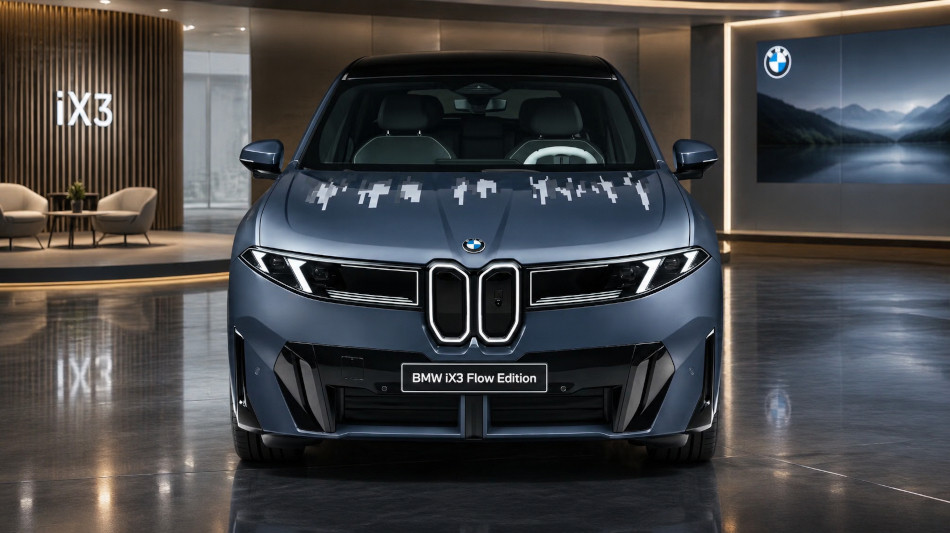
The defining feature of the concept is an E Ink surface integrated directly into the bonnet. At the touch of a button, the panel can display eight carefully developed animations, ranging from restrained graphical movements to more expressive sequences inspired by prominent Chinese buildings. The result is a vehicle whose visual identity can change without conventional paint, adhesive graphics or mechanically moving components.
It is an arresting effect, but the importance of the iX3 Flow Edition lies less in the animation itself than in the way the technology has been incorporated. Earlier BMW experiments relied on specially developed wraps or numerous individually shaped electronic-paper segments applied across the body. The new concept embeds E Ink Prism technology into the structure of a large exterior component. That distinction makes the iX3 Flow Edition considerably more relevant to future production than its theatrical appearance might initially suggest.
From experimental wrapping to an integrated body component
BMW’s first major public demonstration of colour-changing bodywork arrived with the iX Flow in 2022. That vehicle used millions of microscopic capsules containing electrically charged black and white pigments. By applying an electrical field, the pigments could be moved towards the surface, altering the vehicle’s appearance between different shades.
The i Vision Dee followed in 2023 and expanded the idea with a multi-colour exterior assembled from hundreds of individually controlled sections. BMW later used the technology as an artistic medium on the i5 Flow Nostokana, demonstrating that a vehicle’s surface could become an animated composition rather than merely a painted shell. Those projects proved the visual potential of electronic ink, but they also exposed the difficulties involved in adapting it to the automotive industry. A road vehicle must withstand heat, frost, rain, road salt, pressure washing, vibration, ultraviolet radiation and minor impacts. It must also remain repairable, reproducible and sufficiently robust for years of everyday use.
The iX3 Flow Edition addresses those challenges by concentrating the technology in one substantial body panel rather than covering the entire vehicle. Integrating the system into the bonnet provides a more controlled route towards industrialisation. It reduces the number of interfaces, simplifies the surface geometry and allows the component to be tested as a complete automotive assembly.
The technology has undergone BMW’s quality evaluation for automotive engineering and everyday operation. That does not mean the Flow Edition is ready to enter showrooms in its present form, but it indicates that electronic body surfaces are no longer being treated solely as fragile exhibition technology.
A digital surface rather than a conventional display
The bonnet is not a traditional screen and does not operate like an LED panel. E Ink is reflective rather than continuously illuminated, using ambient light to make its patterns visible. Electrical energy is primarily required when the displayed image changes. Once a design has been selected, it can remain visible without a permanent flow of power. This characteristic makes the technology particularly relevant to electric vehicles, where every additional energy-consuming system is scrutinised. The power required for a brief graphical transition is modest compared with the continuous demand of a conventional digital display.
The current Flow Edition is restricted to monochrome patterns. Its eight animations include stylised architectural outlines and moving graphic sequences designed specifically for the presentation in China. The designs can appear subtle against the vehicle’s dark bonnet or become more conspicuous as larger white areas emerge across the surface.
For the moment, the system is primarily an instrument of personalisation. A future owner could theoretically select different exterior themes for formal occasions, leisure journeys or particular environments. Manufacturers could also develop model-specific designs, seasonal collections or limited digital editions without changing the underlying body component.
That possibility creates a new relationship between automotive design and software. Exterior styling has traditionally been decided at the time of purchase and altered only through repainting, wrapping or replacement parts. A programmable surface would allow part of the vehicle’s appearance to be updated throughout its life.
Practical applications could extend beyond personalisation
Dynamic bodywork may eventually serve purposes that are more functional than decorative. A vehicle could display temporary warning symbols, charging information or highly visible markings while stationary. Emergency vehicles, service fleets and public transport operators could use changeable surfaces to communicate different roles without maintaining several permanently marked vehicles.
A light exterior surface can also reflect more sunlight than a dark one, potentially reducing heat absorption in warm conditions. Conversely, a darker surface can absorb more solar energy in colder weather. A complete colour-changing body could therefore reduce part of the heating or cooling demand placed on an electric vehicle, although the limited bonnet area of the present concept would offer only a small contribution.
There are nevertheless significant questions that must be resolved before dynamic exterior graphics become commonplace. Regulators will need to determine which patterns may be displayed on public roads and whether animations should be restricted to stationary vehicles. Manufacturers must prevent graphics from imitating emergency markings, road signs or official symbols. Repair costs will also be important. A conventional bonnet can be repainted or replaced using established workshop procedures. An electronic bonnet containing a specialised surface, electrical connections and control hardware would be more complex. Insurers, repair networks and parts suppliers would need suitable processes before the technology could be offered on a large scale.
Cybersecurity is another consideration. Any programmable exterior connected to a vehicle’s software architecture would require strict safeguards against unauthorised images or manipulation. The greater the level of customisation, the more carefully manufacturers would need to control what can be displayed.
The Chinese debut carries strategic significance
BMW chose Beijing for the presentation at a time when China is becoming increasingly important to the development of its next generation of vehicles. The iX3 Flow Edition appeared alongside the long-wheelbase iX3 developed specifically for the Chinese market and other models incorporating Neue Klasse technology.
The production-oriented Chinese iX3 uses the sixth generation of BMW’s electric drive system, cylindrical battery cells and an 800-volt electrical architecture. BMW states that the long-wheelbase model can exceed 900 kilometres under the Chinese test cycle and accept a peak charging rate of 400 kilowatts. Under suitable conditions, enough energy for as much as 400 kilometres of additional driving can be transferred in ten minutes.
These figures belong to the long-wheelbase production model rather than the Flow Edition concept, but they provide important context. BMW is presenting innovative bodywork not as an isolated design experiment, but as part of a broader technological transformation involving batteries, charging, software, artificial intelligence and digital personalisation.
China’s electric vehicle market is highly competitive and increasingly influenced by digital features. Domestic manufacturers have shortened development cycles and introduced cabins built around connectivity, entertainment and software-based services. Traditional premium brands can no longer rely exclusively on engine refinement, materials and established prestige. In that environment, the Flow Edition operates as both an engineering demonstrator and a statement of intent. Its Chinese architectural motifs make the technology locally relevant, while its integration into the Neue Klasse design language suggests that BMW views digital surfaces as a potential element of its future brand identity.
Production-ready does not mean available to order
BMW has not announced a sales date, price or confirmed production model for E Ink exterior technology. The iX3 Flow Edition remains a concept vehicle, and its designation should not be interpreted as confirmation of an imminent customer edition. The term production-ready instead describes the maturity of the underlying technology. The electronic surface has progressed from a customised wrap towards an integrated component capable of meeting automotive engineering requirements. Further development will still be required in manufacturing cost, repairability, certification and long-term durability before it can become a commercial option.
The most plausible first application would be a limited surface rather than an entire colour-changing body. A bonnet, roof panel, interior trim element or selected decorative section would allow BMW to introduce the feature gradually, monitor its performance and control replacement costs. Premium vehicles are also the natural starting point because customers in that segment are more likely to pay for advanced personalisation. As production methods improve, similar technology could later reach broader vehicle categories or specialised commercial fleets.
The iX3 Flow Edition therefore matters not because it promises an immediately available colour-changing car, but because it changes the character of the discussion. The question is no longer whether electronic ink can be attached to an automobile for a demonstration. The question is whether customers will value it sufficiently once it can be integrated into a genuine production component.
BMW has not yet provided the commercial answer. Technically, however, the animated bonnet suggests that the static vehicle exterior may eventually become another configurable part of the digital driving experience.
U.Sellmer