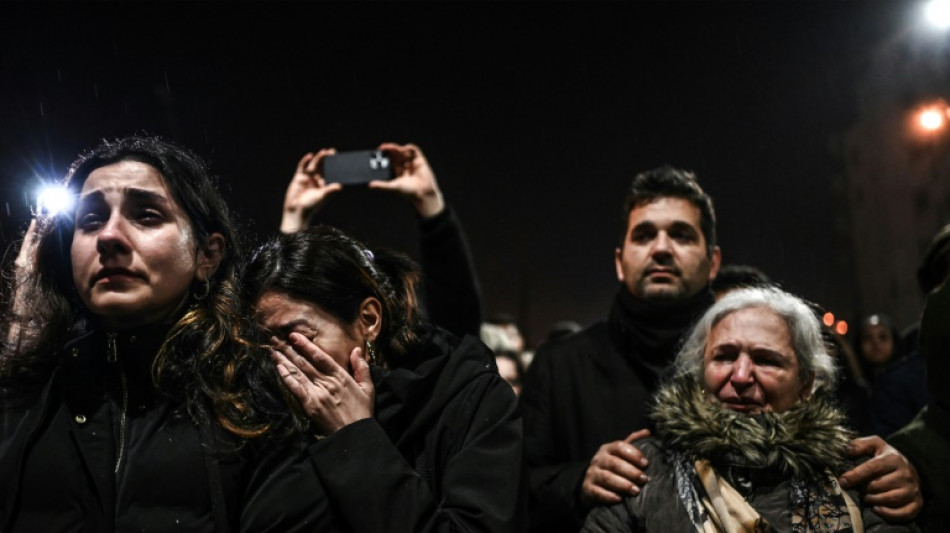
'Feels like yesterday': Turkey grieves on first quake anniversary / Photo: Ozan KOSE - AFP
Ravaged by grief, bearing torches and holding up portraits of their lost families, thousands of earthquake survivors gathered in the pre-dawn hours Tuesday for the first anniversary of Turkey's worst disaster of modern times.
At 4:17 am, the moment the first 7.8-magnitude shake set off a calamity that claimed more than 53,000 lives in Turkey and nearly 6,000 in Syria, those affected by the quake gathered in the ruins of Antakya, an ancient city transformed into deserted wasteland.
The night before, many of them had listened to the local symphony orchestra play a memorial concert in a central square, surrounded by vast empty spaces where bustling neighbourhoods once stood.
Last year's February 6 disaster flattened swathes of cities across 11 southeastern Turkish provinces and parts of Syria, becoming the earthquake-prone region's worst catastrophe in centuries.
It displaced millions and forced hundreds of thousands to move into container camps, where they have spent the past year haunted by the past.
The trauma and bouts of anger spilled over when people briefly scuffled with the police, who tried to stop one Antakya procession with barrier fences, according to AFP reporters at the scene.
But the overall mood was much the same as it was when disaster first struck -- overwhelming grief and lingering disbelief.
The survivors embraced, placing candles where their loved ones were crushed to death in their sleep.
"It doesn't feel like it was a year ago. For me, it feels like it was yesterday," said Eda Boz, 44, who was forced to move to the capital Ankara and returned to Antakya for the commemorations.
"My childhood friends and classmates lived in this building," Eda said through tears. "We all knew each other."
- 'Millions of our neighbours gone' -
Gulhan Baklavaci, a 58-year-old who came to listen to the local symphony orchestra play a memorial concert on a deserted square the night before, said the scale of the disaster -- and people's grief -- was difficult to quantify.
"In the past, someone would die, and we would mourn them for years," Baklavaci said.
"Now, millions of our neighbours are gone," she said, referring also to the people who have been displaced.
Around the same time, a similar gathering was taking place further to the northeast in the city of Kahramanmaras, a provincial capital lying just 50 kilometres (30 miles) from the epicentre of the first big shake.
The initial quake lasted 65 seconds, followed by thousands of aftershocks including a particularly frightening 7.5-magnitude one later that first fateful day.
A social media message urging people to attend the Kahramanmaras event called them "65 seconds which were worth an eternity".
Turkish President Recep Tayyip Erdogan, who was expected in Kahramanmaras later Tuesday, posted a social media message around 4:17 am, saying the tragedy "continues to burn our hearts as fresh as the first day".
Erdogan survived initial criticism about rescuers being slow to respond to the gravest emergency of his two-decade rule, winning re-election less than four months after the quake.
- 'Still in ruins' -
Erdogan has been pledging to rebuild the region and urging national unity, a message he repeated on Tuesday.
"Such great disasters and great sufferings are also turning points in which the strength of the unity, solidarity and brotherhood of nations is tested," Erdogan said in his social media post.
But Esat Gul, 19, said he no longer believed the president.
"A year has passed, and the city is still in ruins," Gul said.
"I no longer have much hope for the future. Many young people my age are looking to leave the country."
E.Cerny--TPP