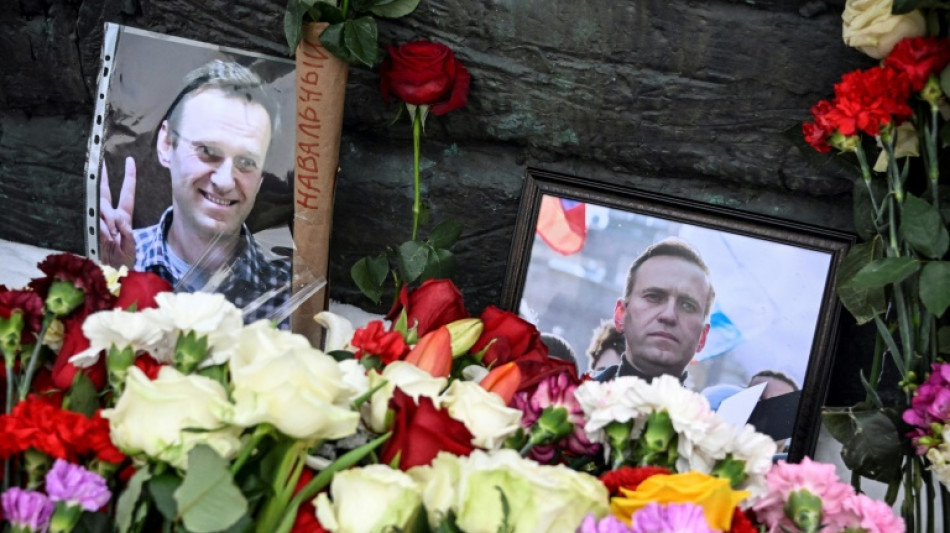
Navalny's Moscow funeral takes place under shadow of repression / Photo: Alexander NEMENOV - AFP
The funeral of late Russian opposition leader Alexei Navalny is scheduled to be held in Moscow on Friday, with mourners braving the risk of arrest to come and pay their respects.
The ceremony will take place two weeks after Navalny died in an Arctic prison, amid pressures denounced by his team who accuse Russian President Vladimir Putin of murdering his top critic.
Putin, who famously never said Navalny's name in public, has not commented on the death, which sparked outrage among Western leaders and the Russian opposition.
The religious service will be held at the Mother of God Quench My Sorrows church in Maryino at 2:00 pm (1100 GMT) on the outskirts of Moscow.
In line with Orthodox practices, the body of Navalny -- who had embraced Christianity -- will be displayed in an open casket.
Two hours later, the burial is set to take place at the Borisovo cemetery, a short walk from the banks of the river Moskva.
Details of the funeral and how many mourners will be allowed to attend are still unclear.
Authorities have not commented on how they will handle the event, which could turn into an embarrassing show of support for Navalny.
Around a dozen police officers already patrolled the cemetery on the eve of the burial, which supporters fear may be disturbed by the Kremlin.
- Hopes for peaceful ceremony -
They have reasons for concern: 400 mourners have been detained at memorials for Navalny since his death, rights organisation OVD-Info said.
The dissident's widow, Yulia Navalnaya, feared the funeral could be disrupted by further arrests.
"I'm not sure yet whether it will be peaceful or whether the police will arrest those who have come to say goodbye to my husband," Navalnaya told the European Parliament.
She has directly blamed Putin for his death.
Putin's spokesman, Dmitry Peskov, has criticised statements by Navalny's wife and Western leaders blaming the Russian leader for the death as "vulgar".
Navalny had shot to prominence through his anti-corruption campaigning, exposing what he said was rampant graft at the top of Putin's administration.
He was arrested in January 2021 when he returned to Russia after being treated in Germany for a poisoning attack.
"Alexei was tortured for three years," Navalnaya told lawmakers in Brussels.
"He was starved in a tiny stone cell, cut off from the outside world and denied visits, phone calls, and then even letters."
"And then they killed him. Even after that, they abused his body," she said.
- 'Chance to say goodbye' -
His body was held for eight days, which his team believed to be a bid to cover up responsibility for his death.
Navalny's family and his team have also accused authorities of trying to prevent him from having a dignified public burial due to fears it could turn into a flashpoint for dissent.
The team alleged local investigators had threatened to bury him on the prison grounds if his mother did not agree to a "secret" funeral.
Once the body was released, allies struggled to find a funeral place that would agree to hold the ceremony.
And on Thursday they said hearse drivers were refusing to take the body from the morgue.
"What a disgrace. Now the hearse drivers refuse to take Alexei from the morgue," said Ivan Zhdanov, an exiled ally who managed Navalny's Anti-Corruption Foundation.
Navalny's spokeswoman Kira Yarmysh said funeral directors had received threatening calls from "unknown people" warning them not to transport Navalny's body anywhere.
And a civil ceremony allowing the general public to pay their respects to the body -- common in Russia -- has not been allowed.
Navalnaya said the family "did not want a special treatment -- just to give people the chance to say goodbye".
She has vowed to continue his life's work.
M.Jelinek--TPP