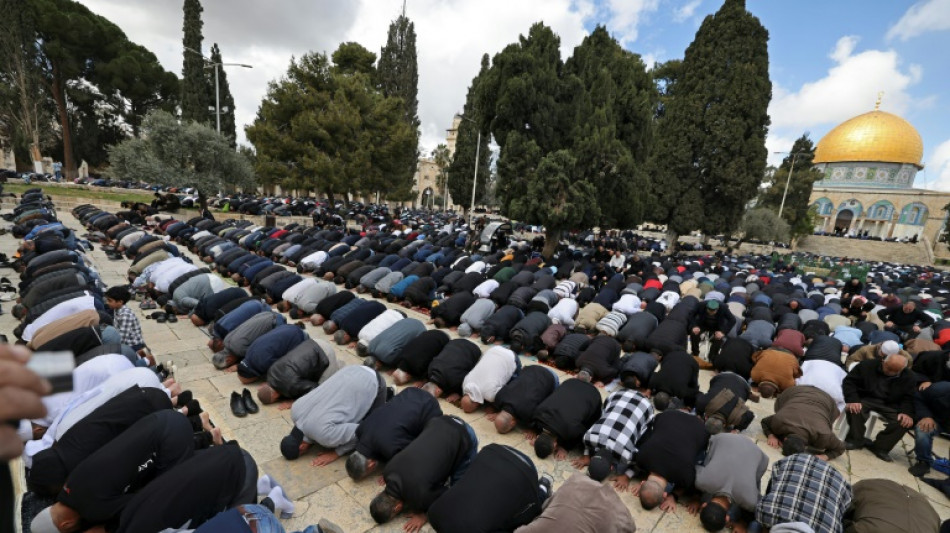
'Difficult' Friday prayers at Jerusalem's Al-Aqsa mosque / Photo: AHMAD GHARABLI - AFP
Under a heavy police presence, tens of thousands of Muslims attended the first Friday prayers of Ramadan in east Jerusalem's Al-Aqsa mosque compound, a gathering weighed down by the war in Gaza.
Old men leaning on canes, veiled women and smartly dressed children flowed through the gates of the Israeli-annexed Old City for the midday prayer, which unfolded peacefully, though some younger men were turned away by police conducting security checks.
"It's random. They decide who they let in, who they don't let in, and you don't know why," said Amjad Ghalib, a 44-year-old carpenter from the Mount of Olives who described relief at being granted access.
"I have to be honest, we are afraid," he said, a prayer mat resting on his shoulder.
"It's the first year I see so many forces (police), and their eyes, their look... Two years ago I could argue with them, but now... they're giving us no chance."
The Al-Aqsa mosque compound is Islam's third holiest site and Judaism's most sacred, known to Jews as the Temple Mount.
The site has been a flashpoint for violence during the Muslim fasting month of Ramadan in past years, and thousands of police officers were deployed on Friday, some of them heavily armed.
"There are so many soldiers. Wherever you go, you find them. They make it difficult," said Ezzat Khouis, a 75-year-old tour guide, referring to the police.
"Why do they do this?... This is not good for us, not good for the future, for the peace and for the people to live together."
- 'Sad all day' -
The war in Gaza was triggered by Hamas's unprecedented attack on southern Israel on October 7 that resulted in the deaths of about 1,160 people, mostly civilians, according to an AFP tally of Israeli official figures.
Israel's retaliatory campaign against Hamas has killed at least 31,490 people, according to the health ministry in Hamas-run Gaza.
Violence in the occupied West Bank has flared to levels unseen in nearly two decades, according to the health ministry in Ramallah.
Israeli troops and settlers have killed at least 430 Palestinians in the West Bank since the Gaza war began, the ministry says.
For security reasons, Palestinians trying to access Al-Aqsa from the West Bank were expected to face some restrictions this year, police said in a statement earlier this week.
Only men aged 55 and over and women older than 50 would be allowed to enter the mosque compound from the territory, government spokesperson Ofir Gendelman said.
Prime Minister Benjamin Netanyahu's office has said that, despite the restrictions, worshippers would be allowed to enter the mosque "in similar numbers" to past years.
But those assurances meant little to some young men who were denied entry to the Old City on Friday.
"It's unfair. When they refuse to let in young boys, it hurts me very, very much," says Fida Absiya, who stood at the entrance to the Old City collecting money for orphans and the less fortunate.
"Since the first day of (the war) we knew that we would have very difficult days," a man who declined to give his name told AFP.
Other West Bank worshippers were unable to reach Jerusalem, including Umm al-Abd who attempted to cross at the Qalandia checkpoint to its north.
"Today they did not allow me to enter. I am sad. I will be sad all day."
T.Musil--TPP