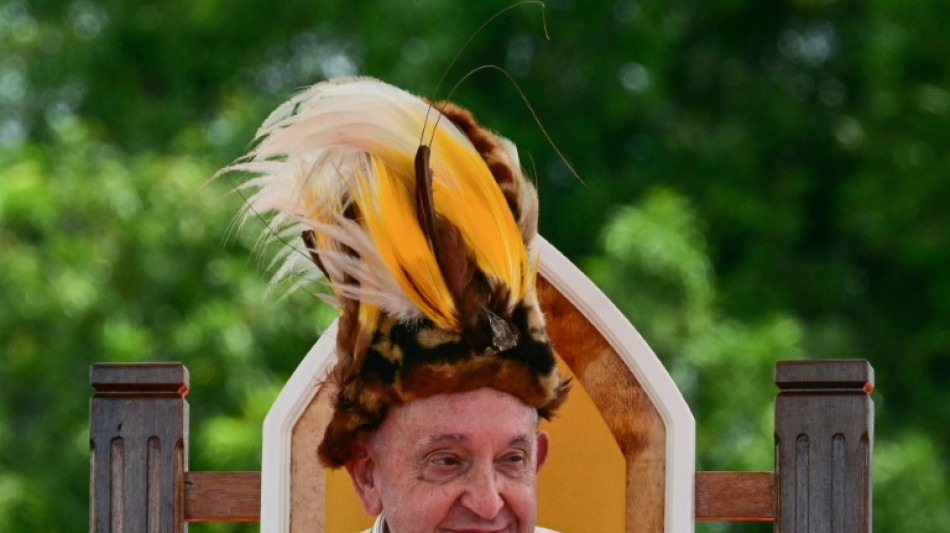
Sporting a feathered headdress, Pope finds 'Eden' in Papua New Guinea / Photo: Tiziana FABI - AFP
Pope Francis visited a remote jungle-flanked community in Papua New Guinea Sunday, where he urged an end to violence, and "superstition and magic" that tarnishes a place he likened to Eden.
The 87-year-old pontiff touched down in Vanimo, a coastal town a few degrees south of the equator, as he marked the halfway point of a gruelling 12-day tour of the Asia-Pacific.
Donning a traditional Bird of Paradise feathered headdress despite the stiffing tropical heat, the pope drove home his pledge to embrace people and places on "the periphery".
He described Vanimo as a "grandiose spectacle of nature bursting forth with life, all evoking the image of Eden".
He was greeted as a guest of honour by bare-chested Walsa tribesmen with body paint, ornate headdresses and bands made of feathers, shells and grass, who performed a ceremonial dance.
The pope thanked the assembled thousands, some of whom had walked or sailed for days to come and see him, and praised the "contagious smiles and your exuberant joy" of local children.
But he also painted this as a troubled paradise.
He urged the faithful and a handful of local missionaries to help "overcome divisions -- personal, family and tribal" and "to drive out fear, superstition and magic from people's hearts".
- Religion alongside local beliefs -
These and other evils, he said, "imprison and take away the happiness of so many of our brothers and sisters, even in this country".
More than 90 percent of Papua New Guinea's 12 million residents call themselves Christian, and about quarter of those are Catholic.
But the religion sits alongside a panoply of local beliefs, customs and rites -- some of which spark bloody zeal.
Pockets of Papua New Guinea are plagued by tribal violence and deeply rooted beliefs about the existence of witchcraft.
Village mobs routinely round up those falsely accused of black magic, usually women, murdering them in gruesome ordeals.
Australian researchers have estimated about 3,000 deaths in over the last 20 years.
The pope urged his flock to tackle such social ills head on, and to remake the image of their nation.
"Make Papua New Guinea famous not only for its variety of plant and animal life, its enchanting beaches and clear sea, but famous above all for the good people you meet here," he said.
It is a message that has resonated with Papua New Guineans, many of whom hope the pope's visit can transform their nation.
Earlier Sunday, the pope held a mass for 35,000 people in the capital, Port Moresby.
Margaret Clive, an elderly street vendor in the capital, said that many people had complained about the pope's visit, asking what it would bring them.
"I am happy Pope is here" she said. "He is a world religious leader bringing the message of peace."
"There is a lot of violence against women and children, here in the city, the youth are snatching bags from mothers who market."
"Christian principles are hidden while our sinful ways are transparent, we need change."
There he will encounter a resolutely Catholic nation, but one in which the clergy has been beset by child abuse scandals.
D.Dvorak--TPP