The Prague Post - Thailand lifts ban on afternoon alcohol sales

EUR -
AED 4.365408
AFN 76.656446
ALL 96.267651
AMD 448.667829
ANG 2.127496
AOA 1089.847591
ARS 1668.886736
AUD 1.665652
AWG 2.139286
AZN 2.017508
BAM 1.952363
BBD 2.394274
BDT 145.413977
BGN 1.995919
BHD 0.448043
BIF 3511.995292
BMD 1.188492
BND 1.500758
BOB 8.214537
BRL 6.172862
BSD 1.188702
BTN 107.73332
BWP 15.574579
BYN 3.409697
BYR 23294.452699
BZD 2.390781
CAD 1.611525
CDF 2644.395875
CHF 0.915019
CLF 0.025729
CLP 1015.911743
CNY 8.216346
CNH 8.21016
COP 4365.380436
CRC 587.962333
CUC 1.188492
CUP 31.495051
CVE 110.408784
CZK 24.256185
DJF 211.218998
DKK 7.472189
DOP 74.429353
DZD 153.949032
EGP 55.586995
ERN 17.827387
ETB 184.632599
FJD 2.595608
FKP 0.869828
GBP 0.87063
GEL 3.197284
GGP 0.869828
GHS 13.073218
GIP 0.869828
GMD 87.94868
GNF 10429.021291
GTQ 9.116948
GYD 248.701079
HKD 9.290862
HNL 31.495087
HRK 7.53433
HTG 155.795699
HUF 379.506451
IDR 19953.600325
ILS 3.657104
IMP 0.869828
INR 107.765784
IQD 1557.519401
IRR 50065.246103
ISK 145.19816
JEP 0.869828
JMD 185.992533
JOD 0.842657
JPY 181.694947
KES 153.314957
KGS 103.933606
KHR 4789.624194
KMF 492.505949
KPW 1069.642127
KRW 1715.921902
KWD 0.364689
KYD 0.990656
KZT 586.527333
LAK 25522.876347
LBP 101675.532165
LKR 367.712588
LRD 221.802401
LSL 18.968773
LTL 3.509309
LVL 0.718907
LYD 7.481526
MAD 10.835517
MDL 20.08364
MGA 5272.152625
MKD 61.604439
MMK 2495.731539
MNT 4240.768103
MOP 9.571208
MRU 47.424603
MUR 54.289836
MVR 18.362449
MWK 2063.223156
MXN 20.438315
MYR 4.652911
MZN 75.947082
NAD 18.968018
NGN 1606.556752
NIO 43.641137
NOK 11.257633
NPR 172.372787
NZD 1.961832
OMR 0.456983
PAB 1.188707
PEN 3.990363
PGK 5.09269
PHP 69.224967
PKR 332.481126
PLN 4.216581
PYG 7850.178609
QAR 4.327598
RON 5.087578
RSD 117.334577
RUB 91.65202
RWF 1728.068073
SAR 4.457328
SBD 9.577049
SCR 16.775892
SDG 714.945776
SEK 10.555857
SGD 1.498909
SHP 0.891677
SLE 28.93995
SLL 24922.092286
SOS 679.226189
SRD 44.897625
STD 24599.394876
STN 24.839493
SVC 10.401686
SYP 13144.221646
SZL 18.967999
THB 36.893189
TJS 11.1623
TMT 4.171609
TND 3.382426
TOP 2.861604
TRY 51.858085
TTD 8.061772
TWD 37.253891
TZS 3078.378607
UAH 51.146649
UGX 4202.600705
USD 1.188492
UYU 45.57975
UZS 14624.399825
VES 457.32051
VND 30900.804601
VUV 141.865896
WST 3.217312
XAF 654.804121
XAG 0.014086
XAU 0.000234
XCD 3.211961
XCG 2.142428
XDR 0.8149
XOF 654.261993
XPF 119.331742
YER 283.247473
ZAR 18.861828
ZMK 10697.860837
ZMW 22.616181
ZWL 382.694095
  • RYCEF

    -0.4800

    16.93

    -2.84%

  • CMSC

    -0.0216

    23.67

    -0.09%

  • RIO

    2.0100

    99.25

    +2.03%

  • VOD

    0.4050

    15.655

    +2.59%

  • NGG

    1.9800

    90.74

    +2.18%

  • BTI

    0.4700

    60.66

    +0.77%

  • AZN

    10.8050

    204.205

    +5.29%

  • BCE

    -0.0850

    25.745

    -0.33%

  • BP

    1.6350

    38.605

    +4.24%

  • RBGPF

    0.1000

    82.5

    +0.12%

  • GSK

    -0.4300

    58.39

    -0.74%

  • CMSD

    -0.0380

    24.042

    -0.16%

  • BCC

    -1.0000

    88.73

    -1.13%

  • JRI

    0.2500

    13.03

    +1.92%

  • RELX

    -1.3450

    27.945

    -4.81%

Thailand lifts ban on afternoon alcohol sales
Thailand lifts ban on afternoon alcohol sales / Photo: Lillian SUWANRUMPHA - AFP

Thailand lifts ban on afternoon alcohol sales

Thailand on Wednesday relaxed decades-old alcohol sales restrictions, allowing consumers to buy wine, beer and spirits during previously prohibited afternoon hours in a six-month trial.

Text size:

The predominantly Buddhist country still maintains strict alcohol laws, limiting sales to specific hours and banning them on religious holidays.

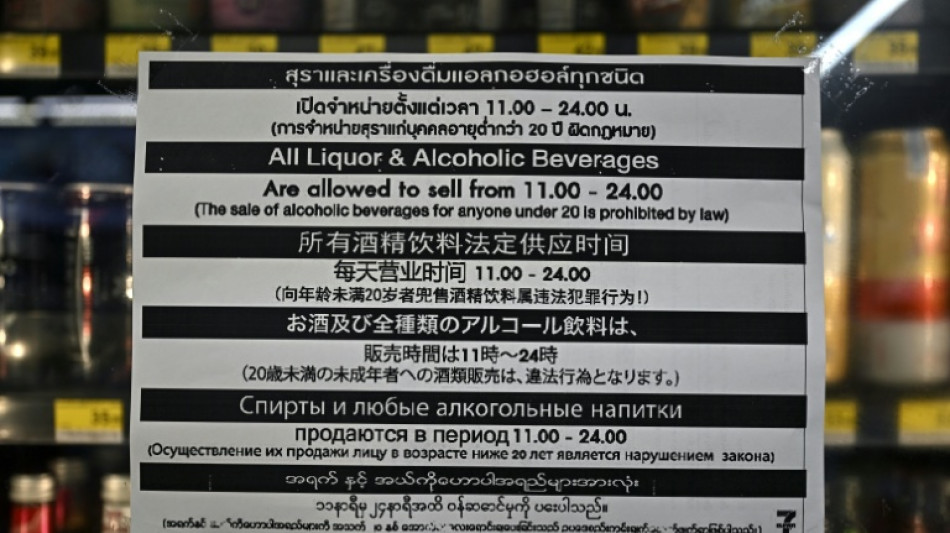
Liquor stores, bars and other purveyors were previously banned from selling alcohol from 2:00-5:00 pm, but the eased rules permit sales from 11:00 am to midnight during the trial while a committee studies its impacts.

Officials last month reviewed the long-standing 2:00-5:00 pm sales ban, a rule originally introduced to prevent government employees from drinking alcohol during work hours and often puzzling foreign visitors.

"In the past, there were concerns that government employees would sneak out to drink, but it's a different time now," deputy prime minister Sophon Saram told reporters last month.

Health Minister Pattana Promphat said the move was "appropriate to the present situation", according to a statement in the Royal Gazette published on Tuesday.

Despite its reputation as a tourism and nightlife hub, Thailand's alcohol laws remained rooted in Buddhist teachings that view imbibing as a moral transgression.

The country has some of the highest alcohol consumption rates in Asia, according to the World Health Organization (WHO), with locals typically reaching for the ubiquitous Chang, Singha and Leo beers.

Thailand ranked 16th out of nearly 200 countries for the most road traffic deaths per capita in 2021, WHO data shows.

Nearly 33,000 people were killed in drunk driving incidents in the country from 2019 to 2023, according to public health ministry figures.

- 'Good for tourists' -

In central Bangkok on Wednesday afternoon, several businesses told AFP journalists they had yet to notice a shift on the first day of the relaxed sales rules.

"There haven't been many people because customers still don't know about the new law," said a shop assistant at Gourmet Wine Cellar who declined to give their name.

Shoppers at a 7-Eleven opted for soda over alcoholic beverages, despite signs posted on refrigerator doors noting the extended sales hours.

At a nearly empty beer garden where a few customers were ordering pints, a server told AFP that she had heard of the rule change on TikTok.

But, she said, "There's almost no change because we usually don't get any customers during this time."

Apple, a Thai marathon-runner, told AFP the loosened restrictions were "good for tourists".

"Tourists like to drink a lot. But for Thai people, maybe not, as we don't normally drink at that time anyway," she said.

Matthew, a 23-year-old British traveller, said he hadn't heard about the long-time sales ban or it being lifted.

"Sounds like it would be terrible for the economy. So many tourists come here. Why would they do that? Religious reasons?"

E.Soukup--TPP