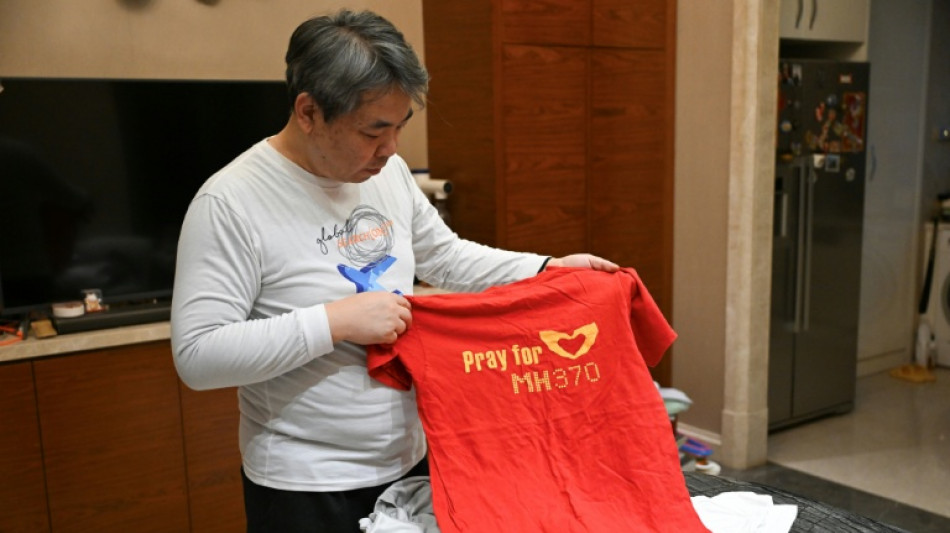
Son of MH370 flight victim seeks answers after 11 years / Photo: Pedro PARDO - AFP
Jiang Hui remembers his mother waving him goodbye as she left for her Malaysia Airlines flight, a bag slung across her shoulder and promising to return with souvenirs from her trip.
Jiang Cuiyun, then a 72-year-old retiree, was one of 239 people aboard flight MH370 when it vanished from radar screens on March 8, 2014, en route from Kuala Lumpur to Beijing.
Despite the largest search in aviation history, the plane has not been found, and its enduring mystery remains a source of lasting pain for the victims' loved ones.
"Who would have imagined that something so improbable would happen to their own family?" Jiang Hui, 52, told AFP at his home in Beijing.
He has spent more than a decade seeking answers alongside the relatives of other Chinese victims, who made up two-thirds of the passengers.
The Malaysian government recently announced that the search for the missing plane will resume at the end of December.
And a Beijing court ordered the airline this week to pay over 2.9 million yuan ($411,000) in compensation to some of the passengers' families.
But Jiang and other victims' relatives remain frustrated by what they say is a lack of "openness" from the Malaysian government and the airline.
Jiang now runs a social media group where the families share news on MH370 developments and offer each other support.
They have asked for information including the coordinates of the new search area and the kinds of equipment and vessels being used, he told AFP.
"But we have still not received any response so far," he said.
He added some families feel that the search may be "just for show and wouldn't yield any results".
- Years of anguish -
Jiang has campaigned around the world for investigation efforts to resume, in hopes of one day finding out what happened to his mother.
When the search for the plane was suspended in 2017, "that period, I believe, was the hardest of all", he said.
His home is littered with reminders of the tragedy.
Books on the disaster line his shelves, along with a model of the Boeing 777 he said helped him understand the structure of the plane his mother was on when she disappeared.
Jiang showed AFP his trove of old T-shirts he wore at MH370 family gatherings over the past decade, and a collection of documents including letters to China's foreign ministry, court records and maps.
"All these are historical records," he said, gesturing at his files.
There are no ongoing legal cases in Malaysia, which lost 50 people, including 12 crew members, in the disaster.
- 'Inhumane' -
This week's compensation ruling in Beijing applies to each of the families of eight passengers legally declared deceased.
But 23 cases, including Jiang's, are still pending because the families of some passengers have not made similar declarations, the court said.
Jiang said the court statement implies that if he does not do that, he will not receive a payout.
"I feel that this is asking me to declare my mother deceased without any evidence, which is very difficult for me to accept," he said.
"I find it quite inhumane."
He remains set on searching for answers.
"Finding the plane, finding my loved one, and finding the truth -- I believe this is something I must do in my life," he told AFP.
He is driven by the bond he shared with his mother, an ordinary but strong woman who he said worked hard for her family.
"I imagined that when the children were older, we, as a family, would travel together, and she would be able to enjoy her later years," he said.
"I feel that finding her and uncovering the truth is the greatest way I can show my respect for her now."
X.Kadlec--TPP