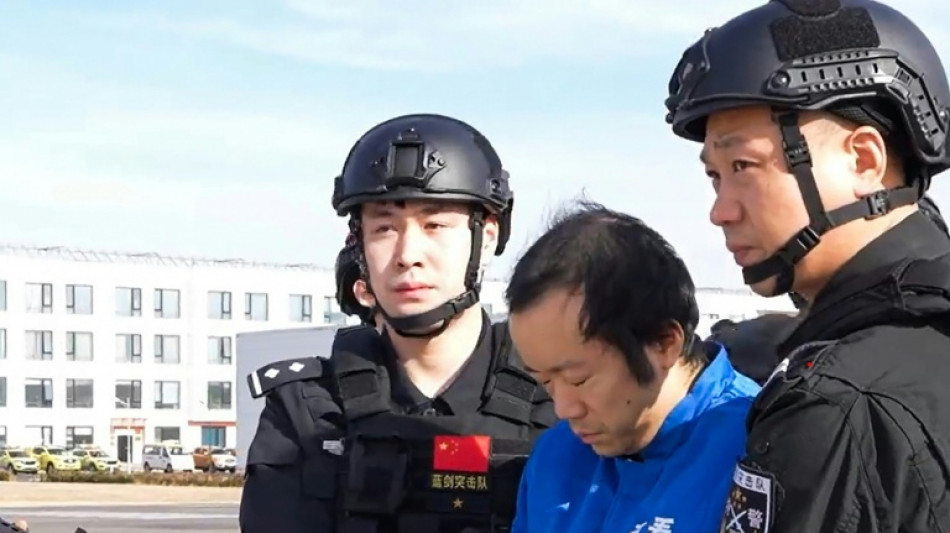
'Sever the chain': scam tycoons in China's crosshairs / Photo: Handout - CHINA'S MINISTRY OF PUBLIC SECURITY/AFP
China is moving against the cyberscam tycoons making fortunes in Southeast Asia, driven by mounting public pressure and Beijing's desire to keep control of judicial processes, analysts say.
Across Southeast Asia, scammers lure internet users globally into fake romantic relationships and cryptocurrency investments.
Initially largely targeting Chinese speakers -- from whom they have extracted billions, prompting rising public anger -- the scammers have expanded their operations into multiple languages to steal vast sums from victims around the world.
Those conducting the scams are sometimes willing volunteers, sometimes trafficked foreign nationals who have been trapped and forced to work under threat of torture.
Last year, a series of crackdowns largely driven by Beijing -- which wields significant economic and diplomatic influence in the region -- saw thousands of workers released from scam centres in Myanmar and Cambodia and repatriated to their home countries, many of them to China.
Now Beijing has turned its focus to the bosses at the apex of the criminal pyramids, netting its biggest player so far with the arrest and extradition of Chen Zhi from Cambodia this week.
The arrests were "almost certainly a result of Chinese pressure... coordinated behind closed doors", according to Jason Tower, senior expert at the Global Initiative Against Transnational Organized Crime.
Chen, a Chinese-born businessman, was indicted in October by US authorities, who said his Prince Group conglomerate was a cover for a "sprawling cyber-fraud empire".
Phnom Penh said it detained him following a request from Beijing, and after "several months of joint investigative cooperation" with Chinese authorities.
Analysts say Phnom Penh's inaction became intolerable to Beijing, which also wanted to avoid the embarrassment of Chen going on trial in the US.
Jacob Sims, a transnational crime expert and visiting fellow at Harvard University's Asia Center, added that Chen "has a number of reported ties to Chinese government officials".
"China acted in order to prevent him from being extradited to the US given the political sensitivities," he told AFP.
- 'Cut off the flow' -
Beijing made a show of the tycoon's extradition, with video released by China's public security ministry on Thursday showing the 38-year-old in handcuffs with a black bag over his head being escorted off a plane with black-clad armed security forces waiting on the runway.
The sudden extradition of Chen from Cambodia –- where he had close ties to political elites before his naturalised citizenship was revoked by the Southeast Asian nation last month –- follows China scooping up other wanted fugitives abroad to mete out justice on its own soil.
In November, She Zhijiang -- the Chinese-born founder of Yatai Group, which allegedly built a notorious scam hub on the Thai-Myanmar border –- boarded a flight to China in handcuffs after spending three years behind bars in Bangkok.
The same month Beijing held talks with law enforcement agencies from Thailand, Myanmar, Cambodia, Laos and Vietnam agreeing to "intensify joint efforts against transnational telecom and online fraud".
China earlier publicly handed down death sentences to over a dozen members of powerful gang families with fraud operations in northern Myanmar, with their confessions of grisly crimes broadcast on national television.
There could be more high-profile arrests to come: weeks ago the public security ministry issued arrest warrants for 100 more fugitives seen as the scam industry's key financial backers, pledging Thursday to "cut off the flow", "pull out the nails", and "sever the chain".
But while the alleged leaders of some major scam groups have been arrested, Sims said the status quo for the wider industry was unlikely to change without sustained and "extremely high" pressure from the international community.
"The vast majority of Cambodia's hundreds of scam compounds are operating with strong support from the Cambodian government," he said.
Cambodian officials deny allegations of government involvement and say authorities are cracking down. Authorities had said in July that the tally of arrests had already reached 2,000.
While in prison, She Zhijiang claimed to have previously acted as a spy for Beijing's intelligence agency before he and his Myanmar urban development project were "betrayed" by the Chinese Communist Party.
His lawyer told AFP that he had been pleading for Thai authorities to allow him to face trial in the US and said he feared "he will be deprived of due process" and "ultimately disappeared".
Some analysts pointed to limitations in China's justice system that might prevent the full extent of the cyberscam schemes from being brought to light.
"China is not an open society where investigation will reveal the true nature of things," said Cambodian academic and former ambassador Pou Sothirak.
burs-sjc/slb/sco/ceg/abs
D.Kovar--TPP