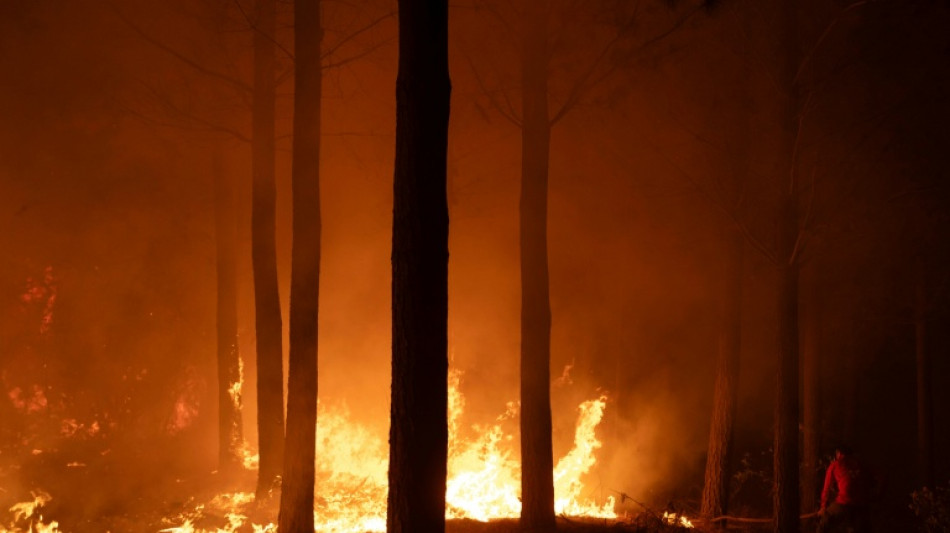
Climate change fuels disasters, but deaths don't add up / Photo: Raul BRAVO - AFP
Climate change is turbocharging heatwaves, wildfires, floods and tropical storms, but how deadly have extreme weather events become for people in their path?
Annual climate reports released last week show the last three years have been the hottest since the pre-industrial era, with no let-up in sight as the world continues to burn fossil fuels.
Experts warn that rising global temperatures are bringing hotter summers, more frequent flooding, stronger storms and increasingly devastating wildfires and droughts.
But what about deaths? The maths are not simple.
Overall, mortality from extreme weather disasters has fallen over recent decades.
But the picture varies by hazard and region: heatwaves have become deadlier, while people in low-income nations are far more at risk than elsewhere.
More than 2.3 million people died from weather-related events between 1970 and 2025, according to an AFP analysis of EM-DAT, a global disaster database run by the Belgium-based Centre for Research on the Epidemiology of Disasters (CRED).
The death toll between 2015 and 2025 reached 305,156, down from 354,428 in the previous decade, the analysis showed.
"It's not because the events haven't become more dangerous. It's because we have become a lot better at coping with them," Marina Romanello, executive director of the Lancet Countdown, a climate-health monitoring programme, told AFP.
- Heatwaves: 'silent killer' -
Heat is called a "silent killer" in part because it can take months or longer to calculate the death toll, with the sick and elderly particularly vulnerable to its effects.
Last year, half the planet experienced more days than average with at least strong heat stress, or a "feels-like" temperature of 32C or above, the EU's Copernicus Climate Change Service said last week.
It is "very clear" that extreme heat is becoming deadlier, said Theodore Keeping, researcher at Imperial College London.
He said that for extreme heat events, there are robust scientific studies and models that can attribute additional deaths to the specific increase in temperature caused by climate change.
Almost 61,800 people died from heatwaves around the world in 2022, with the toll falling to around 48,000 in 2023 and rising again to 66,825 in 2024, according to the EM-DAT database.
But the figures are much higher than in previous years as data on heat-related deaths, especially from Europe, became more accessible after the Covid-19 pandemic, CRED senior researcher Damien Delforge told AFP.
There is still a year-long delay for CRED to add heatwave deaths to its database, he said.
Heat-related deaths are also underreported.
According to the Lancet Countdown, global heat-related mortality reached an estimated 546,000 deaths on average per year between 2012-2021, up 63 percent from 1990-1999.
- Better prepared -
While a flood or cyclone can cause massive casualties, countries are better prepared with early warning systems, storm barriers and improved building codes.
Floods killed 55,423 people between 2015 and 2025, down from 66,043 in the previous decade, according to the EM-DAT database.
The death toll from storms totalled 36,652 in 2015-2025 compared to 184,237 in the preceding decade.
"We have these early warning systems that can protect lives, but the peril stays, of course, very, very, very high," chief climate scientist at German reinsurer Munich Re, Tobias Grimm, told AFP.
Discerning an annual pattern is tricky, as a single disaster can make one year much deadlier than another.
In an annual report last week, Munich Re said deaths from floods, storms, wildfires and earthquakes rose to 17,200 last year, distinctly higher than the 11,000 fatalities recorded in 2024.
Thousands of deaths from major earthquakes in Myanmar and Afghanistan caused the death toll to spike year-on-year.
But the Munich Re figure was below the 10-year average of 17,800 deaths and 30-year average of 41,900 fatalities. The data excludes droughts and heatwaves.
There is "no clear trend" when it comes to deaths from natural disasters, Grimm said.
"What we do know for a fact is that the weather events are becoming more frequent, more intense, depending on the type of event," the Lancet Countdown's Romanello said.
"While so far we have managed to bend the curve on mortality in many cases through outstandingly better infrastructure... there's a limit to how effective that could be when these events happen one after the other and you don't offer time to recover between one and the next," she said.
A.Stransky--TPP