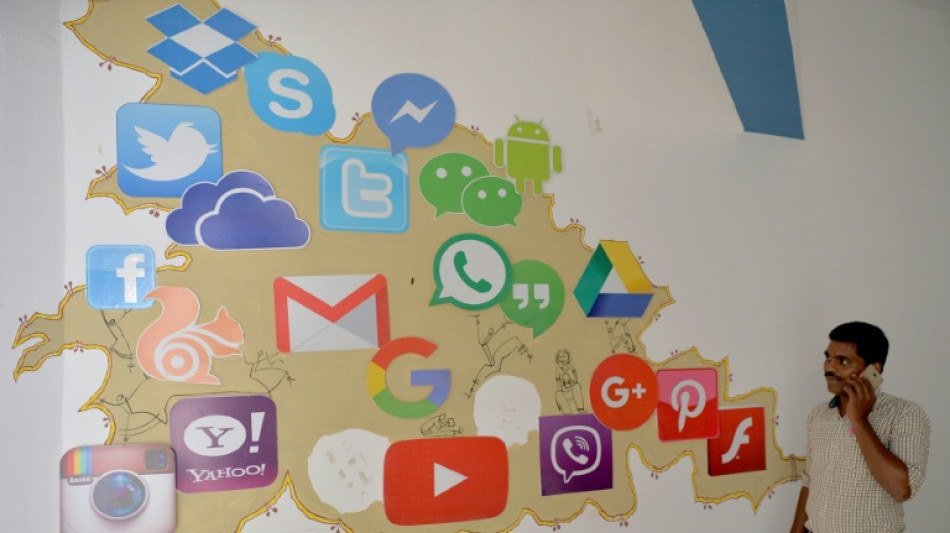
India's tougher AI social media rules spark censorship fears / Photo: Manjunath KIRAN - AFP/File
India has tightened rules governing the use of artificial intelligence on social media to combat a flood of disinformation, but also prompting warnings of censorship and an erosion of digital freedoms.
The new regulations are set to take effect on February 20 -- the final day of an international AI summit in New Delhi featuring leading global tech figures -- and will sharply reduce the time platforms have to remove content deemed problematic.
With more than a billion internet users, India is grappling with AI-generated disinformation swamping social media.
Companies such as Instagram, Facebook and X will have three hours, down from 36, to comply with government takedown orders, in a bid to stop damaging posts from spreading rapidly.
Stricter regulation in the world's most populous country ups the pressure on social media giants facing growing public anxiety and regulatory scrutiny globally over the misuse of AI, including the spread of misinformation and sexualised imagery of children.
But rights groups say tougher oversight of AI if applied too broadly risks eroding freedom of speech.
India under Prime Minister Narendra Modi has already faced accusations from rights groups of curbs on freedom of expression targeting activists and opponents, which his government denies.
The country has also slipped in global press freedom rankings during his tenure.
The Internet Freedom Foundation (IFF), a digital‑rights group, said the compressed timeframe of the social media take-down notices would force platforms to become "rapid-fire censors".
- 'Automated censorship' -
Last year, India's government launched an online portal called Sahyog -- meaning "cooperate" in Hindi -- to automate the process of sending takedown notices to platforms including X and Facebook.
The latest rules have been expanded to apply to content created, generated, modified or altered through any computer resource" except material changed during routine or good‑faith editing.
Platforms must now clearly and permanently label synthetic or AI‑manipulated media with markings that cannot be removed or suppressed.
Under the new rules, problematic content could disappear almost immediately after a government notification.
The timelines are "so tight that meaningful human review becomes structurally impossible at scale", said IFF chief Apar Gupta.
The system, he added, shifts control "decisively away from users", with "grievance processes and appeals operate on slower clocks", Gupta added.
Most internet users were not informed of authorities' orders to delete their content.
"It is automated censorship," digital rights activist Nikhil Pahwa told AFP.
The rules also require platforms to deploy automated tools to prevent the spread of illegal content, including forged documents and sexually abusive material.
"Unique identifiers are un-enforceable," Pahwa added. "It's impossible to do for infinite synthetic content being generated."
Gupta likewise questioned the effectiveness of labels.
"Metadata is routinely stripped when content is edited, compressed, screen-recorded, or cross-posted," he said. "Detection is error-prone."
- 'Online hate' -
The US-based Center for the Study of Organized Hate (CSOH), in a report with the IFF, warned the laws "may encourage proactive monitoring of content which may lead to collateral censorship", with platforms likely to err on the side of caution.
The regulations define synthetic data as information that "appears to be real" or is "likely to be perceived as indistinguishable from a natural person or real-world event."
Gupta said the changes shift responsibility "upstream" from users to the platforms themselves.
"Users must declare if content is synthetic, and platforms must verify and label before publication," said Gupta.
But he warned that the parameters for takedown are broad and open to interpretation.
"Satire, parody, and political commentary using realistic synthetic media can get swept in, especially under risk-averse enforcement," Gupta said.
At the same time, widespread access to AI tools has "enabled a new wave of online hate "facilitated by photorealistic images, videos, and caricatures that reinforce and reproduce harmful stereotypes", the CSOH report added.
In the most recent headline-grabbing case, Elon Musk's AI chatbot Grok sparked outrage in January when it was used to make millions of sexualised images of women and children, by allowing users to alter online images of real people.
"The government had to act because platforms are not behaving responsibly," Pahwa said.
"But the rules are without thought."
E.Cerny--TPP