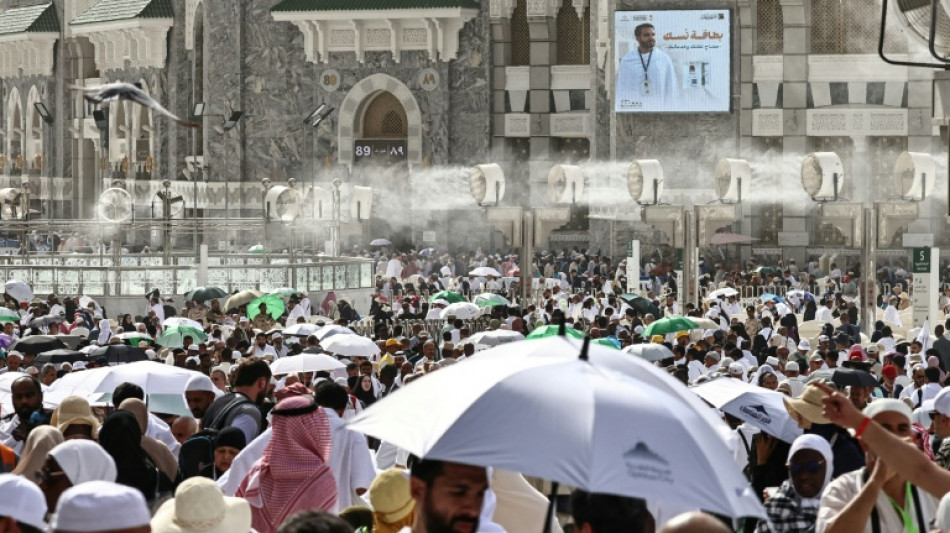
Pilgrims kick off hajj as Mideast peace deal hangs in the balance / Photo: Zain JAAFAR - AFP
Over 1.5 million Muslims began filling a vast tent city in the holy city of Mecca on Monday for an annual hajj pilgrimage carried out against the backdrop of hopes for an end to the war in the Middle East.
The white-robed pilgrims on buses or on foot arrived at the sprawling encampment in Mina after performing the "tawaf" -- walking seven times around the Kaaba, the giant black cube at Mecca's Grand Mosque.
As pilgrims arrived in Mina in waves, temperatures hit 45C in the area as Saudi health authorities called on hajj participants to use umbrellas and reduce sun exposure to prevent heat exhaustion.
The start of the hajj came as US President Donald Trump continued to send mixed signals over a possible agreement to extend an uneasy ceasefire with Iran and a deal to reopen the Strait of Hormuz.
Trump later took to his social media platform Truth Social to declare: "The deal with Iran will either be a great and meaningful one, or there will be no deal."
This year's rites, drawing Muslim worshippers from across the world, including Iran, follow waves of Iranian attacks on targets in Saudi Arabia and its Gulf neighbours.
Saudi officials have been keen to keep conflict far from the minds of visitors, many of whom have travelled long distances for one of the world's largest annual pilgrimages.
Despite the uncertainty triggered by the conflict, Saudi officials noted over the weekend that more pilgrims had travelled from abroad to participate in this year’s hajj than in 2025.
But amid the spiritual euphoria experienced by the pilgrims in the days ahead of the hajj, authorities in the kingdom signalled their readiness.
A video posted on social media by the Saudi defence ministry showed advanced air defence batteries positioned on the outskirts of Mecca.
"The air defence forces are responsible for protecting the skies over the holy sites and dealing with all aerial threats, ensuring the safety and peace of mind of the guests," read the post.
Many pilgrims who spoke to AFP expressed their hope that peace would prevail soon.
"The war in Iran has affected the entire world. Nobody wants wars or harm to countries and peoples," said Mohammed Chahada, an Egyptian in his 50s, as he walked through a crowd exiting the Grand Mosque.
- Rituals -
The hajj, one of the five pillars of Islam, must be performed at least once by all Muslims with the means.
During the hajj, men wear a seamless shroud-like white garment that emphasises unity among believers regardless of their social status or nationality.
Women must wear loose dresses, exposing only their faces and hands.
The first ritual of the Hajj requires walking seven times around the Kaaba, the large black cubic structure at the centre of Mecca's Grand Mosque.
Pilgrims next walk seven times between the two hills of Safa and Marwa.
They then move on to Mina, around five kilometres (three miles) away, ahead of the main rite of the pilgrimage at Mount Arafat.
On Tuesday, the climax of the hajj is the gathering on Mount Arafat, about 10 kilometres from Mina, where it is believed the Prophet Mohammed delivered his final sermon.
The arduous, outdoor pilgrimage will be held against the backdrop of geopolitical tensions but also under punishing heat, with temperatures forecast to top 40C for much of the week.
Despite the heat and the uncertainty over the war, pilgrims in Mecca were ecstatic.
"I have wanted to perform the pilgrimage my entire life, for 40 or 50 years," said Jreish Mohammed, a 68-year-old decked out in the traditional attire from his native Morocco.
"And this year, my dream came true."
W.Urban--TPP