The Prague Post - New dyeing method could help jeans shrink toxic problem

EUR -
AED 4.323676
AFN 77.104824
ALL 96.287764
AMD 449.15478
ANG 2.107633
AOA 1079.477459
ARS 1707.495805
AUD 1.759762
AWG 2.119225
AZN 2.003851
BAM 1.951182
BBD 2.37018
BDT 143.798434
BGN 1.954902
BHD 0.443857
BIF 3484.464116
BMD 1.177184
BND 1.512121
BOB 8.160754
BRL 6.522541
BSD 1.17681
BTN 105.552074
BWP 15.48934
BYN 3.414319
BYR 23072.802934
BZD 2.366818
CAD 1.614096
CDF 2589.804341
CHF 0.92915
CLF 0.027232
CLP 1068.306359
CNY 8.273835
CNH 8.262824
COP 4416.205113
CRC 581.93256
CUC 1.177184
CUP 31.195371
CVE 110.655632
CZK 24.296959
DJF 209.209217
DKK 7.469843
DOP 73.515042
DZD 152.77371
EGP 55.879863
ERN 17.657757
ETB 182.875653
FJD 2.695162
FKP 0.874802
GBP 0.873765
GEL 3.160759
GGP 0.874802
GHS 13.519978
GIP 0.874802
GMD 87.698773
GNF 10285.637991
GTQ 9.015662
GYD 246.199383
HKD 9.156194
HNL 31.018902
HRK 7.535266
HTG 154.216309
HUF 390.799143
IDR 19723.538379
ILS 3.75072
IMP 0.874802
INR 105.322342
IQD 1542.110808
IRR 49588.868474
ISK 148.008015
JEP 0.874802
JMD 188.184602
JOD 0.83466
JPY 184.020902
KES 151.731269
KGS 102.94477
KHR 4720.507339
KMF 493.240471
KPW 1059.419541
KRW 1744.810203
KWD 0.361595
KYD 0.980679
KZT 599.466266
LAK 25468.371642
LBP 105475.670196
LKR 364.286254
LRD 208.879243
LSL 19.694379
LTL 3.475918
LVL 0.712066
LYD 6.386223
MAD 10.757988
MDL 19.805125
MGA 5353.239254
MKD 61.553828
MMK 2471.903888
MNT 4183.016448
MOP 9.427766
MRU 46.80498
MUR 54.32737
MVR 18.199431
MWK 2044.768154
MXN 21.11072
MYR 4.784072
MZN 75.222206
NAD 19.694049
NGN 1718.958914
NIO 43.307683
NOK 11.83211
NPR 168.883718
NZD 2.019322
OMR 0.452615
PAB 1.176825
PEN 3.96299
PGK 5.003326
PHP 69.156603
PKR 329.788094
PLN 4.221728
PYG 8018.02282
QAR 4.286248
RON 5.090165
RSD 117.421394
RUB 91.817268
RWF 1709.270911
SAR 4.41527
SBD 9.590221
SCR 17.754871
SDG 708.078758
SEK 10.811668
SGD 1.513417
SHP 0.883193
SLE 28.311399
SLL 24684.960493
SOS 672.764891
SRD 45.109294
STD 24365.328414
STN 25.015156
SVC 10.29663
SYP 13015.998434
SZL 19.66487
THB 36.651626
TJS 10.826567
TMT 4.120143
TND 3.407962
TOP 2.834377
TRY 50.411954
TTD 8.005121
TWD 37.028198
TZS 2909.673566
UAH 49.552718
UGX 4251.954468
USD 1.177184
UYU 45.961218
UZS 14129.150506
VES 335.610168
VND 30996.427247
VUV 143.076622
WST 3.277261
XAF 654.408137
XAG 0.016621
XAU 0.000263
XCD 3.181398
XCG 2.120898
XDR 0.815546
XOF 657.454588
XPF 119.331742
YER 280.759227
ZAR 19.657616
ZMK 10596.068584
ZMW 26.59528
ZWL 379.052711
  • RYCEF

    0.0300

    15.53

    +0.19%

  • RBGPF

    0.0000

    80.22

    0%

  • SCS

    0.0200

    16.14

    +0.12%

  • CMSD

    -0.0800

    23.12

    -0.35%

  • NGG

    0.8000

    77.21

    +1.04%

  • VOD

    0.1500

    13.03

    +1.15%

  • BCC

    -0.8500

    73.38

    -1.16%

  • CMSC

    0.0332

    23.17

    +0.14%

  • RIO

    0.8850

    80.985

    +1.09%

  • JRI

    0.0450

    13.415

    +0.34%

  • RELX

    -0.0250

    40.955

    -0.06%

  • BCE

    -0.0580

    22.672

    -0.26%

  • GSK

    0.1750

    48.765

    +0.36%

  • BTI

    0.1850

    56.955

    +0.32%

  • AZN

    0.5900

    92.14

    +0.64%

  • BP

    0.3300

    34.47

    +0.96%

New dyeing method could help jeans shrink toxic problem
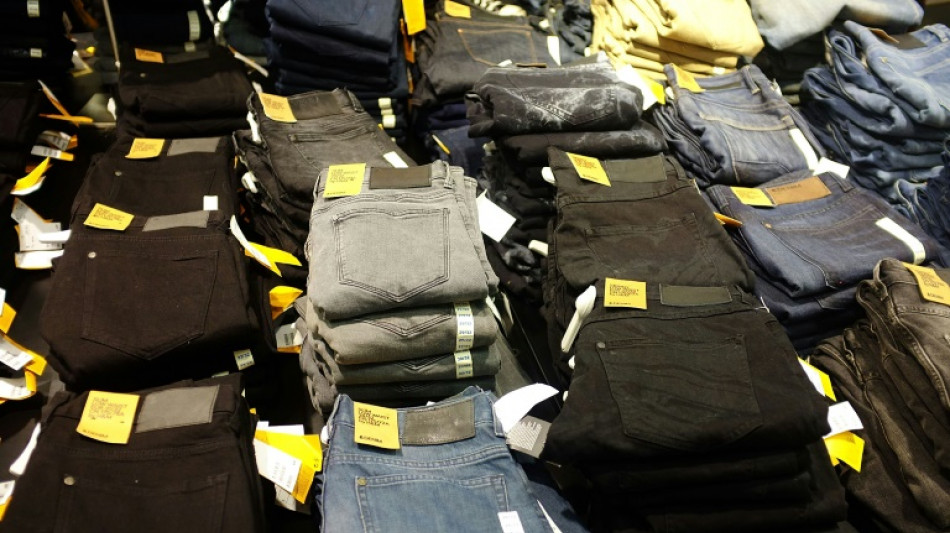
New dyeing method could help jeans shrink toxic problem / Photo: SPENCER PLATT - GETTY IMAGES NORTH AMERICA/AFP/File

New dyeing method could help jeans shrink toxic problem

Can the multi-billion-dollar denim industry keep producing blue jeans in every shape, size and silhouette, while shrinking oversized levels of hazardous pollution? Research published Tuesday suggests a new dye could be a step in the right direction.

Text size:

Scientists have been searching for ways to make a more sustainable form of indigo, used for centuries to colour textiles, but which in its modern synthetic form needs toxic chemicals, large quantities of water and is linked to substantial carbon dioxide emissions.

But a study published in the journal Nature Communications suggests ditching the classic dye altogether.

Using Indican -- a colourless compound also derived form indigo-producing plants -- could reduce the environmental and societal impacts associated with dying jeans by around 90 percent because it does not need toxic chemicals, researchers said.

"It's been known for some years that indigo could be replaced by this other chemical called indican, because you can use it without any strong chemicals," study author Ditte Hededam Welner, a researcher at the Novo Nordisk Foundation Center for Biosustainability Enzyme Engineering and Structural Biology, told AFP.

The researchers engineered a variant of an enzyme found in the indigo-producing plant that could produce indican on an industrial scale.

While they said production of indican would still require polluting petrochemicals, so would not be significantly better than producing synthetic indigo, the benefits come when the dye is put to use.

Indican in powdered form can be dissolved in water then used on fabric and activated with either an enzyme or exposure to light.

The study found light-driven dyeing could cut the environmental damage of traditional indigo dyeing by 73 percent, while using the enzyme could slash the impacts by up to 92 percent.

In both cases, the classic blue jean colour turns up the same as when conventional indigo is used.

Researchers suggest that, if indican were to replace indigo to dye the nearly four billion jeans traded annually, there would be a significant reduction in production of toxic waste and global CO2 emissions.

The authors, who have a published patent for their study, acknowledged limitations to their work, including a lack of facilities to simulate indican production at scale.

Indican could also be slightly more expensive than traditional dye, they said.

But the study said growing consumer demand for sustainable clothing could still make indican "a commercially viable route".

J.Simacek--TPP