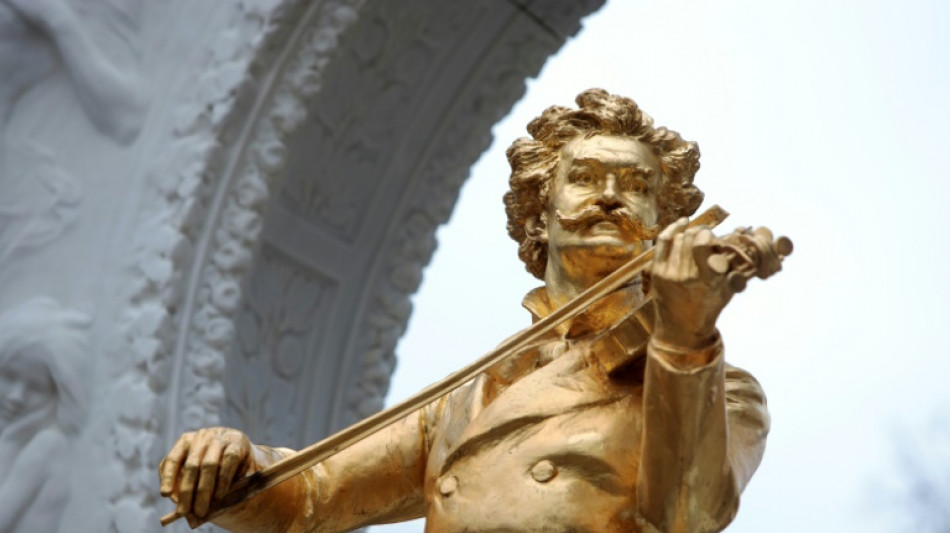
Austria celebrates 200 years of 'waltz king' Johann Strauss II / Photo: Alex HALADA - AFP
Even 200 years after the birth of Austria's world-famous "waltz king" Johann Strauss II -- widely revered like a modern-day pop star during his lifetime -- his music has lost none of its magic.
Best known for his rousing waltz "The Blue Danube", which became Austria's unofficial national anthem, many of his 500 dance pieces live on in Vienna's roaring ball season.
Strauss's persistent popularity lies in the catchy tunes he composed to cheer up people, his great-grand-nephew Eduard Strauss told AFP.
"He simply created music that touches everyone, regardless of their background," he said.
But his fame was rooted in much more than his hits: just like today, selling music meant marketing the star's image.
"One could say that he was actually the first pop star in the modern sense," said Strauss museum guide Clara Kaufmann.
Vienna is marking the bicentenary with special events, concerts and exhibitions, and even an Austrian Airlines aeroplane emblazoned with a portrait of Strauss and his violin.
Strauss "symbolises music for all", said British dentist Helen Foster, who visited one of Vienna's Strauss museums, adding that his appealing waltz tunes have been "popular with everyone over the ages".
- Impressive stage shows -
Strauss was born in the suburbs of Vienna in 1825 into a family of famous musicians, but despite his father being a household name, Strauss junior's success did not come easily.
Defying his father's explicit wish that he would not follow in his footsteps, he secretly took violin lessons with the support of his mother.
After his father abandoned the family for another woman, Strauss's mother Anna became a driving force behind the career of her eldest son, who kept "churning out music" to make a living.
"Unlike today, there was no insurance, no pension scheme or anything like that," Eduard Strauss told AFP.
"Life had to be earned," said the retired judge, 69.
Johann made his debut at the age of 18, becoming his father's direct rival.
Perfecting his father's simpler waltzes, he elevated them into refined concert works, with the light-hearted, energetic dance music helping many to forget about the hardships they faced in 19th-century imperial Vienna.
He put on impressive shows on stage, playing the violin with great panache and conducting the orchestra with his bow while frantically jumping up and down.
Admired for his impeccable looks, his coiffure was styled "with hair irons before every performance to make it stand up", said Kaufmann. As he aged, he dyed his hair and beard to maintain his youthful appearance.
- 'Mama's boy' -
Marketed as a womaniser, the workaholic was a completely different person off-stage, plagued by insecurities and self-doubt, his great-grand-nephew said.
"He had many phobias –- including travel phobia –- and had difficulties with women. He was a mama's boy," he said.
When his father died in 1849, the younger Strauss took over his orchestra as well as the up-scale entertainment establishments in the city.
Despite suffering a nervous breakdown due to exhaustion, he kept performing and composing at an impressive pace.
In 1866, he wrote what is arguably the world's most famous waltz, "The Blue Danube", which is featured in the prestigious Vienna New Year's concert every year.
Although Strauss despised travelling, he regularly toured across Europe, entertaining Russian nobility for more than a decade.
While initially struggling to compose operettas, he wrote several of them, including a few hits like "Die Fledermaus".
"People still dance to Strauss waltzes, but you can also hear them in concert halls, and that was his special achievement," musicologist Thomas Aigner said about the legacy of the revered composer, who died in 1899.
A.Slezak--TPP