The Prague Post - 'Immense' collection of dinosaur footprints found in Italy

EUR -
AED 4.135003
AFN 74.312152
ALL 91.998807
AMD 407.29472
ANG 2.015836
AOA 1032.483179
ARS 1716.910796
AUD 1.624961
AWG 2.029499
AZN 1.91856
BAM 1.955775
BBD 2.262771
BDT 138.128209
BGN 1.895446
BHD 0.423495
BIF 3389.456062
BMD 1.125935
BND 1.437881
BOB 13.498825
BRL 5.867029
BSD 1.123485
BTN 108.843589
BWP 15.531799
BYN 3.383956
BYR 22068.333923
BZD 2.259471
CAD 1.604402
CDF 2600.911191
CHF 0.934977
CLF 0.028256
CLP 1115.712356
CNY 7.548891
CNH 7.557396
COP 3725.451706
CRC 514.793327
CUC 1.125935
CUP 26.96265
CVE 110.263571
CZK 24.454533
DJF 200.057407
DKK 7.479143
DOP 67.07913
DZD 150.570048
EGP 58.768238
ERN 16.889031
ETB 183.500221
FJD 2.530259
FKP 0.850378
GBP 0.852303
GEL 2.933107
GGP 0.850378
GHS 13.194829
GIP 0.850378
GMD 82.760588
GNF 9882.871886
GTQ 8.585889
GYD 235.006954
HKD 8.83567
HNL 30.162609
HRK 7.540056
HTG 147.118093
HUF 368.676725
IDR 20141.295479
ILS 3.436727
IMP 0.850378
INR 108.456295
IQD 1471.780921
IRR 1966490.662268
ISK 137.285738
JEP 0.850378
JMD 177.857694
JOD 0.798333
JPY 177.718077
KES 145.82811
KGS 98.463484
KHR 4556.940927
KMF 493.160101
KPW 1013.342222
KRW 1512.705907
KWD 0.347723
KYD 0.936188
KZT 504.773457
LAK 25235.672864
LBP 100605.895823
LKR 371.535184
LRD 192.10751
LSL 18.784656
LTL 3.324595
LVL 0.681068
LYD 7.194907
MAD 11.161855
MDL 20.07674
MGA 4963.935651
MKD 61.574202
MMK 2364.29564
MNT 4049.170136
MOP 9.080782
MRU 44.894418
MUR 54.214216
MVR 17.407387
MWK 1948.074747
MXN 20.447892
MYR 4.599338
MZN 71.951471
NAD 18.784656
NGN 1498.384001
NIO 41.339464
NOK 10.829927
NPR 174.149742
NZD 2.004693
OMR 0.432034
PAB 1.123485
PEN 3.89325
PGK 5.087934
PHP 70.464983
PKR 311.170466
PLN 4.386363
PYG 6572.914794
QAR 4.095147
RON 5.339077
RSD 117.478477
RUB 93.798784
RWF 1663.878431
SAR 4.214702
SBD 9.095387
SCR 15.468899
SDG 677.254284
SEK 11.304508
SGD 1.439625
SHP 0.850115
SLE 27.702139
SLL 23610.293318
SOS 642.091676
SRD 42.573311
STD 23304.589613
STN 24.499682
SVC 9.829873
SYP 14639.412412
SZL 18.780757
THB 37.722942
TJS 10.341466
TMT 3.940774
TND 3.347757
TOP 2.710982
TRY 55.314396
TTD 7.617901
TWD 35.829296
TZS 2960.361624
UAH 50.551445
UGX 4482.941887
USD 1.125935
UYU 45.279413
UZS 13250.828227
VES 974.472491
VND 29257.994447
VUV 134.641697
WST 3.139796
XAF 655.957
XAG 0.018651
XAU 0.000271910232
XCD 3.042897
XCG 2.024774
XDR 0.796095
XOF 655.957
XPF 119.331742
YER 266.062577
ZAR 18.752511
ZMK 10134.773796
ZMW 22.075714
ZWL 362.550741
SSP 6432.009051
MXV 2.313642
  • GSK

    -0.1500

    47.03

    -0.32%

  • AZN

    -0.8000

    156.9

    -0.51%

  • CMSD

    0.0900

    20.43

    +0.44%

  • NGG

    0.7900

    76.12

    +1.04%

  • RIO

    1.3400

    94.21

    +1.42%

  • BCC

    0.2900

    74.99

    +0.39%

  • BTI

    0.2849

    52.64

    +0.54%

  • BCE

    -0.1900

    19.73

    -0.96%

  • CMSC

    0.0800

    20.24

    +0.4%

  • RBGPF

    0.0900

    65.09

    +0.14%

  • BP

    0.2900

    44.79

    +0.65%

  • RYCEF

    0.1200

    19.42

    +0.62%

  • RELX

    -0.0700

    33.42

    -0.21%

  • VOD

    0.4400

    16.82

    +2.62%

  • JRI

    0.1300

    10.9

    +1.19%

'Immense' collection of dinosaur footprints found in Italy
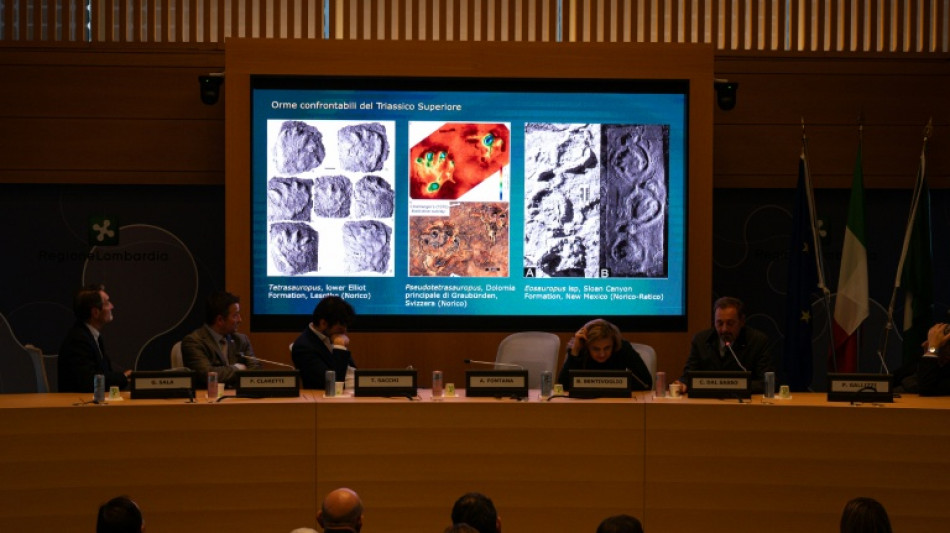
'Immense' collection of dinosaur footprints found in Italy / Photo: Piero CRUCIATTI - AFP

'Immense' collection of dinosaur footprints found in Italy

Hundreds of metres of dinosaur tracks with toes and claws have been found in the Italian Alps in a region that will host the 2026 Winter Olympics, authorities said Tuesday.

Text size:

"This set of dinosaur footprints is one of the largest collections in all of Europe, in the whole world," Attilio Fontana, head of the Lombardy region in northern Italy, told a press conference.

The tracks, which are over 200 million years old, were discovered in the Stelvio National Park, in an area between the towns of Bormio and Livigno, which host part of the games.

Nature photographer Elio Della Ferrera first spotted the imprints in September in an almost vertical rocky slope.

Some measured up to 40 centimetres (16 inches) in diameter.

The collection "extends for hundreds of metres and also represents a series of animal behaviours, because in addition to seeing animals walking together, there are also places where these animals meet", Fontana said.

Della Ferrera called in palaeontologist Cristiano Dal Sasso from Milan's Natural History Museum, who assembled a team of Italian experts to study the site.

"It's an immense scientific heritage," Dal Sasso said in the region's press release.

"The parallel walks are clear evidence of herds moving in synchrony, and there are also traces of more complex behaviours, such as groups of animals gathered in a circle, perhaps for defence."

- Sharp claws -

The tracks, currently covered by snow and off the beaten track, are preserved in Upper Triassic dolomitic rocks, dating back approximately 210 million years.

Most of the footprints are elongated and made by bipeds. The best-preserved ones bear traces of at least four toes.

That suggests they belong to prosauropods, herbivorous dinosaurs with long necks and small heads, which are considered the ancestors of the large sauropods of the Jurassic period like the Brontosaurus, the experts said.

Prosauropods had sharp claws, and adults could reach up to 10 metres in length.

There may also be tracks of predatory dinosaurs and archosaurs, the ancestors of crocodiles, the press release said.

The prints are on an almost-vertical slope due to the formation of the Alpine chain.

But when the dinosaurs walked through the area, it was formed of tidal flats that stretched for hundreds of kilometres, and the environment was tropical.

"The tracks were made when the sediments were still soft and saturated with water, on the broad tidal flats surrounding the Tethys Ocean," ichnologist Fabio Massimo Petti said, referring to a prehistoric ocean.

"The plasticity of those very fine calcareous muds, now transformed into rock, has in areas preserved truly remarkable anatomical details, such as impressions of the toes and even the claws," he said.

The footprints were then covered by sediments which protected them, but with the uplift of the Alps and the erosion of the mountainside, they have been brought back into view.

"As the layers containing the tracks are diverse and overlapping, we have a unique opportunity to study the evolution of animals and their environment over time," geologist Fabrizio Berra said.

"Like reading the pages of a stone book."

E.Cerny--TPP