The Prague Post - World's oldest cave art discovered in Indonesia

EUR -
AED 4.199348
AFN 73.181572
ALL 93.876793
AMD 420.372184
ANG 2.047251
AOA 1049.119899
ARS 1708.398165
AUD 1.649988
AWG 2.061084
AZN 1.94663
BAM 1.954276
BBD 2.303704
BDT 141.030021
BGN 1.933451
BHD 0.431264
BIF 3402.146925
BMD 1.143458
BND 1.476049
BOB 7.920823
BRL 5.929862
BSD 1.143808
BTN 108.968024
BWP 15.42697
BYN 3.318612
BYR 22411.782757
BZD 2.300406
CAD 1.62506
CDF 2568.207165
CHF 0.919387
CLF 0.026768
CLP 1053.513356
CNY 7.763056
CNH 7.758596
COP 3826.777602
CRC 521.093639
CUC 1.143458
CUP 30.301645
CVE 110.17908
CZK 24.191915
DJF 203.681165
DKK 7.474278
DOP 67.757161
DZD 152.493082
EGP 56.395134
ERN 17.151875
ETB 183.41277
FJD 2.584731
FKP 0.85633
GBP 0.856685
GEL 3.012999
GGP 0.85633
GHS 12.993867
GIP 0.85633
GMD 82.894538
GNF 10031.177448
GTQ 8.729193
GYD 239.253424
HKD 8.968379
HNL 30.614126
HRK 7.532988
HTG 149.603336
HUF 353.467544
IDR 20578.819096
ILS 3.428831
IMP 0.85633
INR 108.87444
IQD 1498.331565
IRR 1573341.453286
ISK 144.007743
JEP 0.85633
JMD 181.068798
JOD 0.810755
JPY 184.729692
KES 147.986065
KGS 99.992801
KHR 4580.428073
KMF 492.830105
KPW 1029.112874
KRW 1757.369039
KWD 0.354804
KYD 0.953257
KZT 540.908187
LAK 25826.859598
LBP 102425.725974
LKR 383.111241
LRD 207.59811
LSL 18.552532
LTL 3.376335
LVL 0.691667
LYD 7.331283
MAD 10.696359
MDL 20.11931
MGA 4849.218464
MKD 61.586973
MMK 2401.129041
MNT 4096.036573
MOP 9.239795
MRU 45.648402
MUR 53.799243
MVR 17.678157
MWK 1983.453256
MXN 19.990213
MYR 4.655365
MZN 73.078368
NAD 18.552532
NGN 1566.114609
NIO 42.087179
NOK 11.249461
NPR 174.349038
NZD 2.006644
OMR 0.441036
PAB 1.143808
PEN 3.892065
PGK 5.025081
PHP 70.283773
PKR 318.000316
PLN 4.292245
PYG 6954.576655
QAR 4.181239
RON 5.227321
RSD 117.285538
RUB 88.095632
RWF 1674.494189
SAR 4.294571
SBD 9.214606
SCR 15.397992
SDG 686.643948
SEK 11.03186
SGD 1.477342
SHP 0.853707
SLE 27.843319
SLL 23977.753094
SOS 653.690237
SRD 42.95509
STD 23667.278258
STN 24.480909
SVC 10.008195
SYP 126.388845
SZL 18.549535
THB 38.019579
TJS 10.602832
TMT 4.013539
TND 3.375767
TOP 2.753174
TRY 53.533742
TTD 7.751955
TWD 36.525475
TZS 3002.28474
UAH 50.941275
UGX 4174.744435
USD 1.143458
UYU 46.004125
UZS 13702.314608
VES 730.55925
VND 30068.37956
VUV 135.993314
WST 3.171015
XAF 655.445868
XAG 0.018287
XAU 0.000274
XCD 3.090253
XCG 2.061392
XDR 0.815164
XOF 655.445868
XPF 119.331742
YER 271.057067
ZAR 18.572553
ZMK 10292.499464
ZMW 21.016611
ZWL 368.193107
  • CMSD

    -0.0300

    22.15

    -0.14%

  • CMSC

    0.0400

    21.99

    +0.18%

  • NGG

    2.6700

    82.85

    +3.22%

  • BCC

    0.4500

    75.93

    +0.59%

  • GSK

    2.3600

    53.66

    +4.4%

  • AZN

    11.2900

    195.15

    +5.79%

  • BCE

    0.4000

    21.42

    +1.87%

  • RIO

    1.0700

    94.42

    +1.13%

  • BTI

    1.2100

    61.77

    +1.96%

  • RELX

    0.5500

    31.93

    +1.72%

  • RBGPF

    2.5400

    68.15

    +3.73%

  • BP

    1.2500

    37.4

    +3.34%

  • JRI

    0.0600

    13

    +0.46%

  • VOD

    0.1400

    13.15

    +1.06%

  • RYCEF

    0.5400

    19.68

    +2.74%

World's oldest cave art discovered in Indonesia
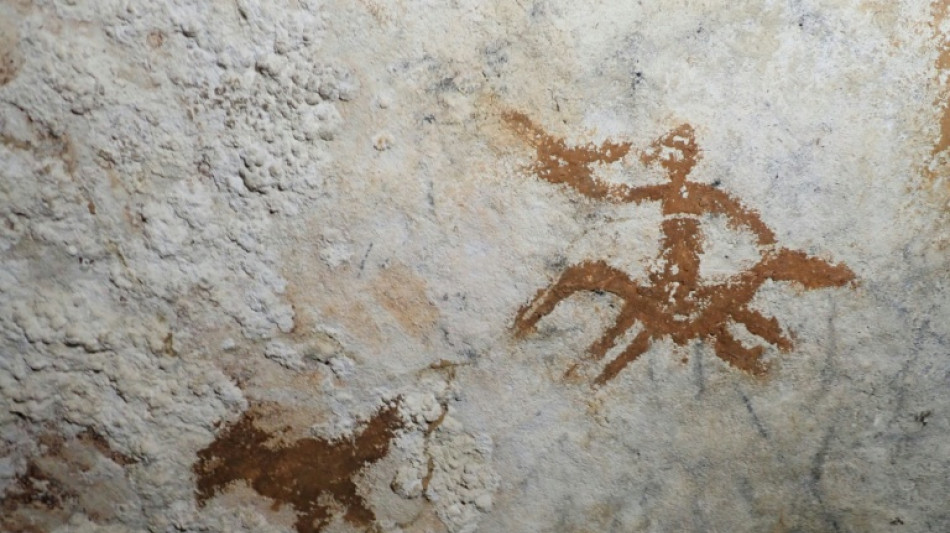
World's oldest cave art discovered in Indonesia / Photo: Maxime AUBERT - GRIFFITH UNIVERSITY/AFP

World's oldest cave art discovered in Indonesia

A red stencil of a hand pressed against the wall of an Indonesian cave is the oldest rock art ever discovered, scientists said Wednesday, and sheds light on how humans first migrated to Australia.

Text size:

The cave art dates back at least 67,800 years, according to research published in the journal Nature by a team of Indonesian and Australian archaeologists.

"We have been working in Indonesia for a long time," study co-author Maxime Aubert of Australia's Griffith University told AFP.

This time they ventured to caves on the island of Muna in the Sulawesi province on the advice of Indonesian archaeologist Adhi Agus Oktaviana, the study's lead author.

There they found "handprints in negative, stencilled, probably using red ochre," Aubert said.

The fingers of one of the hands were "retouched to become pointed like claws -- a style of painting only seen in Sulawesi," the Canadian archaeologist added.

To determine the art's age, the team took five-millimetre samples from "cave popcorn", which are small clusters of calcite that form on the walls of limestone caves.

Then they zapped the layers of rock with a laser to measure how the uranium decayed over time, compared to a more stable radioactive element called thorium.

This "very precise" technique gave the scientists a clear minimum age for the painting, Aubert explained.

At 67,800 years old, the Indonesian stencil is more than a thousand years older than other hand stencils found in a Spanish cave which has been attributed to Neanderthals. However the dating of that cave art "has been controversial," the study cautioned.

The new discovery is also more than 15,000 years older than previous art found in the Sulawesi region by the same team.

The scientists also established that the Muna caves had been used for rock art many times over a long period.

Some of the ancient art was even painted over up to 35,000 later, Aubert said.

- A fork in the road -

Beyond setting a new record, the art also offers clues for a long-running historical mystery.

Scientists have been divided about how Homo sapiens first journeyed from Asia to Australia.

They could have taken the northern route, travelling by boat through Indonesia islands including Sulawesi to Papua New Guinea.

These ancient humans could then have walked the rest of the way -- at the time, Papua New Guinea and Australia were both part of a supercontinent called Sahul.

Or the migrants could have taken the southern route, travelling through the islands of Sumatra, Java and Bali before heading for Timor. Then a boat ride was required to finally make it to Australia.

"These paintings provide the first evidence that modern humans were on these Indonesian islands at that time," Aubert said.

The discovery also "reinforces the idea that people arrived in Australia via Papua, perhaps around 65,000 years ago", he said.

But it could not be ruled that other people were also making their way to Australia via the southern route at the same time, he added.

The researchers also said that the paintings were very likely created by people closely linked to the ancestors of Indigenous Australians.

R.Krejci--TPP