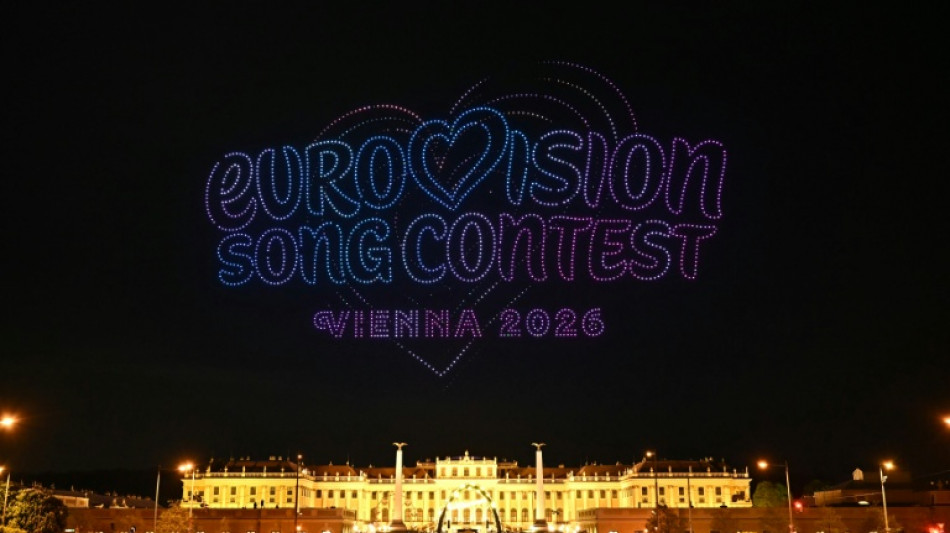
Eurovision: how it works / Photo: Joe Klamar - AFP
The rules of the Eurovision Song Contest -- the biggest live televised music event -- have evolved to keep pace with technological, artistic and geopolitical changes over the past 70 years.
Here is a look at how the competition is put together, how artists are chosen and how the voting system works in 2026:
- Organisers -
Eurovision is an international co‑production by public broadcasting services that are members of the European Broadcasting Union (EBU), the world's biggest public service media alliance.
Held in May, the annual competition is hosted by the broadcaster of the country that won the previous edition.
Since the EBU has 113 member organisations in 56 countries, the contest is open to countries from outside the continent, and it is presented in both English and French.
- Who takes part and who doesn't? -
Each country can send one song, selected through national processes by the participating broadcasters.
This year 35 countries are taking part.
France, Germany, Italy, Spain and the United Kingdom have a guaranteed place in the final, due to their larger financial contribution, as does the host country.
But Spain has decided to boycott this year's edition, together with several other countries, in protest at Israel's participation, over its war in Gaza.
The participating countries compete, after a random draw, in two semi‑finals.
In each semi‑final, 10 of them qualify for the grand final.
- The rules -
The winner is determined by the votes of national juries appointed by the participating broadcasters and by the public vote, cast by text message or online.
Viewers are not allowed to vote for their own country, and international audiences outside the participating countries can also cast their votes online.
The song that receives the highest combined score from the public vote and the national juries is declared the winner.
The songs have to be original and must not exceed three minutes.
All performers must be at least 16 years old and a maximum of six performers may appear live on stage at the same time.
"Political statements, gestures, or actions during the event, including any instrumentalisation of the contest for political or other purposes are prohibited," the EBU says on its website.
Failure to comply with the rules may result in disqualification.
- Last 10 Eurovision winners -
2025: Austria -- JJ, "Wasted Love"
2024: Switzerland -- Nemo, "The Code"
2023: Sweden -- Loreen, "Tattoo"
2022: Ukraine -- Kalush Orchestra, "Stefania"
2021: Italy -- Maneskin, "Zitti E Buoni"
2019: Netherlands -- Duncan Laurence, "Arcade"
2018: Israel -- Netta, "TOY"
2017: Portugal -- Salvador Sobral, "Amar Pelos Dois"
2016: Ukraine -- Jamala, "1944"
2015: Sweden -- Mans Zelmerlow, "Heroes"
The contest did not take place in 2020 due to the coronavirus pandemic.
- Wins per country -
7 -- Ireland, Sweden
5 -- Britain, France, Luxembourg, Netherlands
4 -- Israel
3 -- Austria, Denmark, Norway, Italy, Switzerland, Ukraine
2 -- Germany, Spain
1 -- Azerbaijan, Belgium, Estonia, Finland, Greece, Latvia, Monaco, Portugal, Russia, Serbia, Turkey, Yugoslavia
H.Vesely--TPP