Japan doctor-turned-author moots amputations to ease care crunch / Photo: Behrouz MEHRI - AFP/File
Like the protagonist in his taboo novel, former doctor-turned-author Yo Kusakabe believes chopping off elderly patients' useless limbs could help prevent a potential collapse of super-ageing Japan's overstressed care industry.
Now his extraordinary ideas are on display on the big screen, with the book's film adaptation attracting huge controversy since its release last month in Japan.
But "Haiyoshin (Useless Body)" -- which sees a young doctor advocate for "A-care (Amputation Care)" -- has also focused attention on the struggling care sector in a country with the world's second-oldest population.
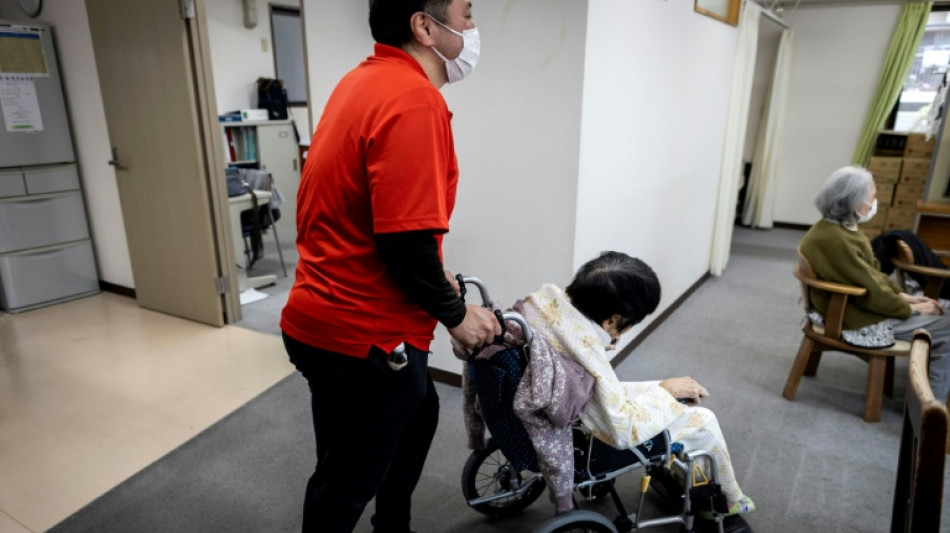
Kusakabe, a former geriatric specialist from Osaka, explained to AFP the thinking behind his shocking proposition, saying removing paralysed limbs would make patients lighter and "reduce the burden on caregivers" in case the care industry reaches crisis point.
He sees it as a potential game changer, provided patients in the real world give consent.
He argues that patients' immobile arms and legs are nothing but an impediment to caregiving: they dangle like dumbbells, get stuck in pyjamas and require more bathing.
"If you cut them off, a female carer would have less difficulty lifting a hefty male patient or suffer less back pain," the 70-year-old said.
Kusakabe's 2003 novel features unstinting depictions of carer shortages, overburdened family members and abused elderly patients.
The topic feels even more relevant in present-day, greyer Japan, where almost one in three people are aged 65 or older.
The government estimates a shortfall of about 570,000 carers by 2040.
"Japan's caregiving industry isn't collapsing yet -- but with (the number of) elderly people requiring care predicted to keep increasing, it is heading toward breaking point," Kusakabe said.
In Japan, homicides by overwhelmed, desperate carers are common enough that the term "kaigo satsujin (caregiving murders)" often makes it into the news. One investigation by public broadcaster NHK in 2016 revealed that such a tragedy was taking place roughly once every two weeks.
If abuse or homicides further increase, Kusakabe said, "I think it's possible that chopping off useless limbs would emerge as an option."
- 'Unfilmable' -
Kusakabe says his novel was deemed "unfilmable" when it first came out more than two decades ago.
Now the story is finally in cinemas, reviewers online have labelled it everything from "shocking" and the year's "most controversial film", to "terrifying madness".
But other critiques were more nuanced.
"Some may say (the amputation) is ruthless and unethical, but honestly I thought it had a point," one wrote on cinema information website eiga.com.
In "Haiyoshin", patients are also portrayed as benefitting -- at least initially -- from A-care.
Kusakabe recalls that some of his patients yearned to be rid of their crippled arms and legs that did nothing but throb, hinder movement and at times convulse unexpectedly.
No longer in pain, amputees in the film are shown relishing their newfound agility, tossing balloons with what remained of their bodies and deftly manoeuvring wheelchairs.
The film poses the question: what truly constitutes end-of-life dignity?
"Is it to try to put your immobile arms through sleeves with great pain, or not to suffer pain at all?" Kusakabe asks.
"If someone desires amputation, and that makes caregiving easier for their family, and the family accepts that, then I don't think it's anyone's business to interfere."
But such a "rational" pursuit of quality of life doesn't necessarily guide elderly care in Japan, he adds.
Feeding tubes and intravenous drips for those aged 75 or older are heavily covered by insurance and are often used to keep alive those bedridden.
Families, too, "simply cannot bear the thought of doing nothing" for their dying parents or spouses, oblivious to the possible suffering such treatment is causing them, Kusakabe says.
That contrasts with Scandinavian countries like Sweden and Denmark where palliative care best practice often dictates elderly patients not be fed if they stop eating.
"Japan blindly believes that even those clearly better off being left to die must be kept alive and that's the absolute right thing to do," even as the toll on caregivers continues to snowball, the doctor says.
"This inability to take a bold, rational approach probably makes something as radical as A-care a poor fit for Japan after all."
In "Haiyoshin," the initial hype about elective amputation winds up brutally deflated by a tragedy that ultimately shatters the main character's confidence about its efficacy.
"People tend to assume medical procedures are completely safe and they demand only the positive effect," Kusakabe says.
The novel's shocking twist is "my way of pushing back against those excessive expectations society has for medicine".
J.Marek--TPP