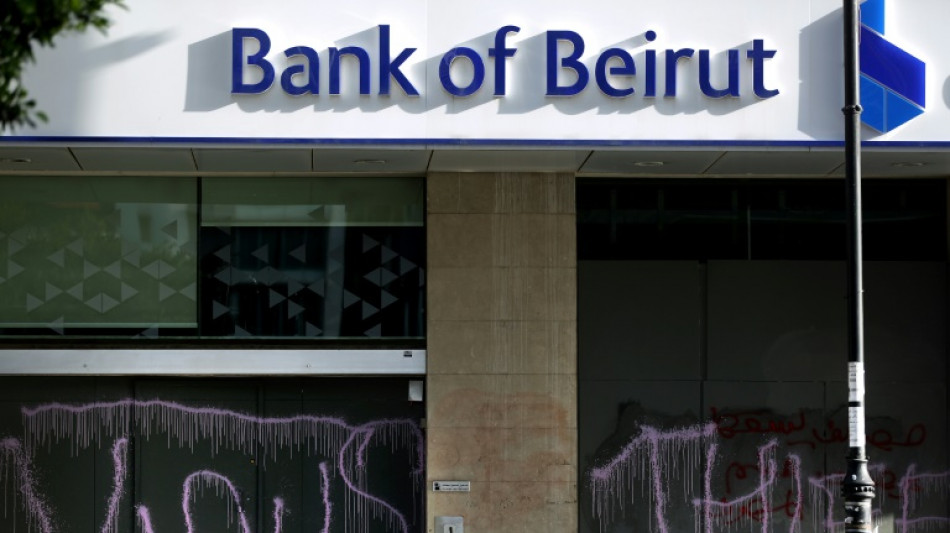
Lebanon's 'zombie banks' downsize to weather crisis
Once the economy's crown jewel, Lebanon's banks are shutting branches and laying off employees in droves, resizing to the bleak reality of a crisis they are widely blamed for.
Before the onset in 2019 of a financial collapse deemed one of the world's worst since the 1850s by the World Bank, the small Mediterranean country had an oversized but prosperous banking sector.
The capital Beirut was a booming regional financial hub, attracting savers keen to profit from high interest rates and banking secrecy laws.
But more than two years into the crisis, the reputation of Lebanese lenders has been shredded.
A dizzying currency collapse, coupled with banks imposing strict withdrawal limits and prohibiting transfers abroad, has left ordinary depositors watching on helplessly as their savings evaporate.
And yet bankers stand accused of bypassing those exact same capital controls -- stoking the crisis by helping the political elite squirrel billions of dollars overseas.
Their trust destroyed, citizens now keep new income well away from the banks, which in turn are deprived of money they could lend.
"The whole banking system today is made up of zombie banks," said economic analyst Patrick Mardini.
"They don't work as banks anymore -- they don't give loans, they don't take new deposits."
- 'Abandoned country' -
As a result, the industry has been forced to scale back its operations.
In 2019, Lebanon ranked second in the region for bank branches per 100,000 people, according to the World Bank, and held a total of around $150 billion in deposits.
Deposits by Arab investors and Lebanese expatriates propelled the banking sector to peak at three times the value of national economic output.
But more than 160 branches have closed since the end of 2018, leaving a total of 919 branches operating across the country, according to the Association of Banks in Lebanon (ABL).
The number of employees has dropped by around 5,900, reducing the sector's workforce to roughly 20,000 late last year.
"Lebanon is an abandoned country," ABL chief Salim Sfeir told AFP, referring to negligence by the nation's authorities.
The association claims the sector has been "forced to adapt to the contraction of the economy," even as others blame the banks for overall economic activity plunging by more than half since 2019.
The Lebanese pound, officially pegged at 1,507 to the greenback since 1997, has lost more than 90 percent of its value on the black market.
The slide has prompted banks to adopt a plethora of exchange rates for transactions even though the official rate remains unchanged.
Those who hold dollar accounts have mostly had to withdraw cash in Lebanese pounds and at a fraction of the black market rate.
"If we apply international accounting standards, almost all Lebanese banks are insolvent," investment banker Jean Riachi said.
- 'Exit the market' -
Lebanon's government defaulted on its foreign debt in 2020, stymying the country's hopes of quickly securing new international credit or donor money to stem the crisis.
The ruling elite, beset by internal rifts that have repeatedly left the country without a government, has yet to agree on an economic recovery plan with international creditors.
Disagreements between the government, the central bank and commercial banks over the scale of financial sector losses have dogged talks with the International Monetary Fund that first started nearly two years ago.
In December, the government of Prime Minister Najib Mikati set financial sector losses at around $69 billion in a crucial step towards advancing IMF talks.
But while the global lender said early this month that efforts to agree on a rescue package have progressed, it made clear more work was needed, especially in terms of "restructuring of the financial sector".
The analyst Mardini said bank restructuring proposals have been discussed by several governments.
Central bank chief Riad Salameh has said banks that are unable to lend must "exit the market".
But meaningful progress on restructuring has been impeded by a political elite who maintain large shares in some of the main banks, according to Mardini.
For out-of-pocket depositors, the details of any restructuring arrangements are a secondary concern.
"I just want to recover my savings," said Hicham, a businessman who asked to use his first name only over privacy concerns.
"All the parties concerned must assume their responsibilities."
W.Cejka--TPP