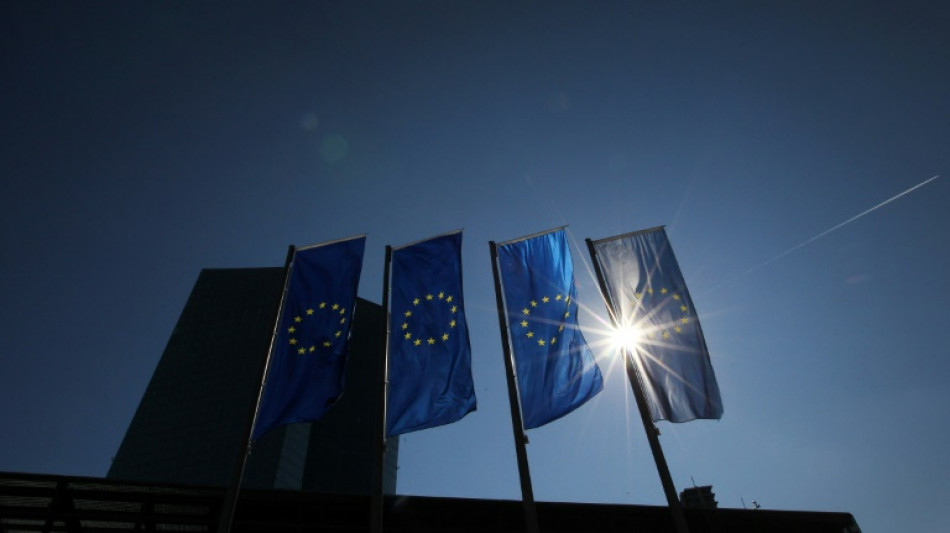
Ukraine crisis, inflation risks loom over ECB meeting
European Central Bank governors meet Thursday to ponder record-high inflation and fresh economic uncertainty caused by the war in Ukraine, with policymakers signalling a willingness to take action sooner rather than later.
At its last meeting in March, the ECB said it would accelerate the winding down of its bond-buying stimulus, with a view to ending the scheme in the third quarter.
An interest rate hike -- the ECB's first in over a decade -- would follow "some time" after that, it said.
But since then prices have continued to spiral, with costs for energy, commodities and food surging in the wake of the war in Ukraine, adding to fears that the conflict will stunt a post-Covid recovery.
The US Federal Reserve and the Bank of England have already announced their first rate hikes to combat price pressures, leaving the ECB looking out of step.
Inflation jumped to a record 7.5 percent in the euro area last month, well beyond the ECB's two-percent target.
Although no major policy changes are expected on Thursday, ECB chief Christine Lagarde's press conference will be scoured for clues of the bank shifting into more aggressive inflation-fighting mode.
"In our view, policymakers are likely to bring forward their plans to raise interest rates," said Capital Economics in a client note, "as inflation continues to surprise to the upside".
Lagarde tested positive for Covid-19 last week but is still set to chair the meeting and take part in the virtual press conference afterwards.
- 'Too late' -
Central bankers use interest rate rises as a tool to tame inflation, but pulling the trigger too soon risks hurting economic growth.
The ECB's dilemma has been complicated by Russia's invasion of Ukraine and Western sanctions against Moscow, as the fallout from the upheaval to international trade and energy markets remains difficult to predict.
Minutes from the last ECB meeting revealed that many members of the 25-member governing council wanted "immediate further steps" to tackle inflation despite the darkening economic picture.
Some governors called for ending the bond purchases in the summer, opening the door to a rate hike in the third quarter.
The minutes showed that the ECB "has become more hawkish", said ING bank economist Carsten Brzeski, describing those advocating for a tightening of monetary policy.
Joachim Nagel, the head of Germany's powerful Bundesbank central bank, is among several ECB members who have said they expect the first rate rises this year.
He has cautioned against "acting too late".
- Gloomy consumers -
The ECB has for years maintained an ultra-loose monetary policy, pushing interest rates to historic lows to stoke growth and drive up below-target inflation.
It even set a negative deposit rate of minus 0.5 percent, meaning banks pay to park excess cash at the ECB.
It has also hoovered up billions of euros in government and corporate bonds each month to keep credit flowing in the 19-nation currency club. The massive stimulus is now being phased out, a move the ECB always said would come before any interest rate changes.
Capital Economics analysts said they now expect the ECB to raise the deposit rate as early as July, followed by two more hikes before the end of the year.
Lagarde recently warned that higher energy costs as a result of Europe's reliance on Russian oil and gas would worsen Europe's cost-of-living squeeze.
Households were becoming more pessimistic, she said, and could cut back further on spending.
"The longer the war lasts, the higher the economic costs will be and the greater the likelihood we end up in more adverse scenarios," she said.
Lagarde, a former French finance minister, has urged European governments to help cushion the blow through fiscal policy.
France, Spain, Germany and other countries have already moved to ease the burden on households and companies, including through fuel tax cuts or subsidies for heating.
P.Benes--TPP