The Prague Post - Philippines' Duterte blocks bill to register social media users

EUR -
AED 4.326546
AFN 75.93488
ALL 95.560713
AMD 440.716876
ANG 2.108277
AOA 1081.298091
ARS 1597.513603
AUD 1.64534
AWG 2.120192
AZN 1.998086
BAM 1.954579
BBD 2.371119
BDT 144.740201
BGN 1.964831
BHD 0.444122
BIF 3493.604602
BMD 1.177884
BND 1.497471
BOB 8.134918
BRL 5.885414
BSD 1.177265
BTN 109.844851
BWP 15.7952
BYN 3.351606
BYR 23086.53075
BZD 2.367731
CAD 1.614161
CDF 2716.200921
CHF 0.92345
CLF 0.026543
CLP 1044.645792
CNY 8.034997
CNH 8.036162
COP 4257.544972
CRC 539.063268
CUC 1.177884
CUP 31.213932
CVE 110.544405
CZK 24.329432
DJF 209.333917
DKK 7.473145
DOP 70.673296
DZD 155.771697
EGP 60.972116
ERN 17.668263
ETB 183.818376
FJD 2.609484
FKP 0.868074
GBP 0.870568
GEL 3.167857
GGP 0.868074
GHS 13.02153
GIP 0.868074
GMD 85.985119
GNF 10341.823051
GTQ 9.003376
GYD 246.316136
HKD 9.217427
HNL 31.274464
HRK 7.534685
HTG 154.093744
HUF 364.649985
IDR 20212.964402
ILS 3.530272
IMP 0.868074
INR 109.570736
IQD 1542.236625
IRR 1555985.057295
ISK 143.996593
JEP 0.868074
JMD 185.903873
JOD 0.835136
JPY 187.490308
KES 152.123519
KGS 103.005735
KHR 4729.20477
KMF 493.533215
KPW 1060.10731
KRW 1742.591332
KWD 0.363383
KYD 0.981091
KZT 555.285492
LAK 25973.775201
LBP 105422.94642
LKR 371.837728
LRD 216.614689
LSL 19.307221
LTL 3.477986
LVL 0.71249
LYD 7.44638
MAD 10.878851
MDL 20.119518
MGA 4887.946691
MKD 61.662181
MMK 2473.988538
MNT 4230.064844
MOP 9.490072
MRU 46.877916
MUR 54.430137
MVR 18.198101
MWK 2045.390612
MXN 20.335703
MYR 4.657292
MZN 75.331603
NAD 19.30714
NGN 1579.743074
NIO 43.322938
NOK 11.030121
NPR 175.751215
NZD 2.000901
OMR 0.452922
PAB 1.177265
PEN 4.05037
PGK 5.101835
PHP 70.722557
PKR 328.30622
PLN 4.241119
PYG 7504.31235
QAR 4.291883
RON 5.097413
RSD 117.344359
RUB 89.959411
RWF 1724.130322
SAR 4.418648
SBD 9.480299
SCR 16.336103
SDG 707.908703
SEK 10.835404
SGD 1.499399
SHP 0.87941
SLE 29.034962
SLL 24699.638676
SOS 672.782595
SRD 44.172997
STD 24379.825255
STN 24.484705
SVC 10.300609
SYP 130.188206
SZL 19.302942
THB 37.732369
TJS 11.166272
TMT 4.128484
TND 3.418664
TOP 2.836063
TRY 52.725054
TTD 7.997005
TWD 37.190286
TZS 3071.335632
UAH 51.438287
UGX 4350.282549
USD 1.177884
UYU 46.990846
UZS 14321.114953
VES 563.008481
VND 31017.814158
VUV 139.541959
WST 3.199075
XAF 655.550286
XAG 0.01502
XAU 0.000246
XCD 3.183291
XCG 2.121684
XDR 0.813879
XOF 655.541943
XPF 119.331742
YER 281.047667
ZAR 19.337714
ZMK 10602.374585
ZMW 22.514936
ZWL 379.278239
  • BCC

    -0.1800

    78.73

    -0.23%

  • JRI

    0.0300

    12.91

    +0.23%

  • RIO

    1.1600

    99.72

    +1.16%

  • CMSC

    -0.1200

    22.59

    -0.53%

  • CMSD

    -0.1300

    22.9

    -0.57%

  • BCE

    0.3450

    24.165

    +1.43%

  • RBGPF

    -13.5000

    69

    -19.57%

  • NGG

    -0.3100

    87.55

    -0.35%

  • BP

    1.5100

    47.63

    +3.17%

  • GSK

    -0.6600

    57.15

    -1.15%

  • RYCEF

    -0.8000

    16.8

    -4.76%

  • BTI

    -0.5350

    56.145

    -0.95%

  • RELX

    0.5350

    36.215

    +1.48%

  • AZN

    -0.7470

    200.463

    -0.37%

  • VOD

    0.1100

    15.7

    +0.7%

Philippines' Duterte blocks bill to register social media users
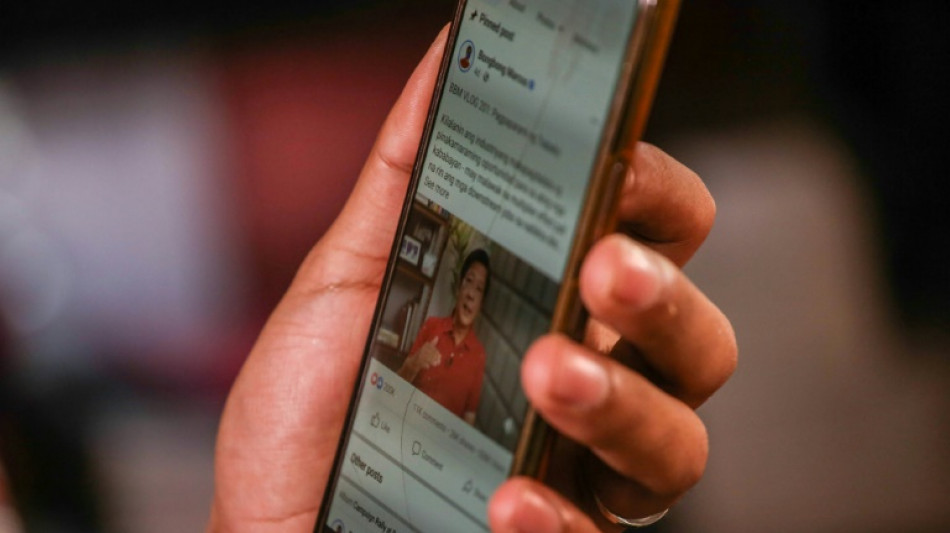
Philippines' Duterte blocks bill to register social media users / Photo: Jam STA ROSA - AFP

Philippines' Duterte blocks bill to register social media users

Philippine President Rodrigo Duterte has rejected a proposed law requiring social media users to register their real names and phone numbers, citing threats to free speech and privacy, his spokesman said Friday.

Text size:

The legislation, designed to combat fake news, online abuse, text scams and militant bombings, also required mobile phone users to provide their personal details when buying SIM cards.

It was approved by both houses of Congress in February, but critics said it was a form of state surveillance.

While supporting efforts to tackle cybercrime and other online offences, Duterte said he opposed the inclusion of social media user registration in the bill.

He called for "a more thorough study" of the provision, citing concerns it could lead to "dangerous state intrusion and surveillance threatening many constitutionally protected rights" such as individual privacy and free speech, presidential spokesman Martin Andanar said in a statement.

Filipinos rank among the world's heaviest users of social media, and the country has become a key battleground for misleading or fake news.

Renato Reyes, secretary-general of leftist alliance Bayan, welcomed the veto, saying SIM card and social media registration created a "chilling effect" for users and would "not deter crime".

"A big part of the problem is government itself, as it benefits directly and indirectly from nefarious online activities," Reyes said in a statement.

"We should start with demanding the government stop weaponizing social media and attacking people online."

Duterte's election victory in 2016 was underpinned by social media campaigning at a time when online misinformation was on the rise.

Critics accused the Duterte camp of employing online trolls to praise him while attacking dissenters -- even issuing death threats. Duterte has denied the allegations.

Since taking power, the authoritarian firebrand has been accused of harassing or even jailing opponents and shutting down media outlets critical of his policies.

Duterte's decision to block the bill comes as a torrent of misinformation floods Facebook, YouTube, TikTok and Twitter ahead of the May 9 national elections.

Ferdinand Marcos Junior is leading the race for the presidency, while his running mate and first daughter Sara Duterte is the top contender for vice president.

Senate president and vice presidential candidate Vicente Sotto, who had supported the legislation, responded sarcastically to the veto.

"Great! Bombings and blackmail and scams will continue using prepaid sims," Sotto tweeted.

Many mobile phone users in the Philippines use pre-paid SIM cards that they buy over the counter without giving their names and addresses to providers.

Militant groups fighting the government in the country's south are known to favour the use of mobile phones to remotely detonate improvised explosive devices, leaving police with one less way to track the perpetrators.

The proposed measure can still become law if legislators can muster a two-thirds vote in each chamber to override the presidential veto, but that is unlikely to happen before the polls.

K.Pokorny--TPP