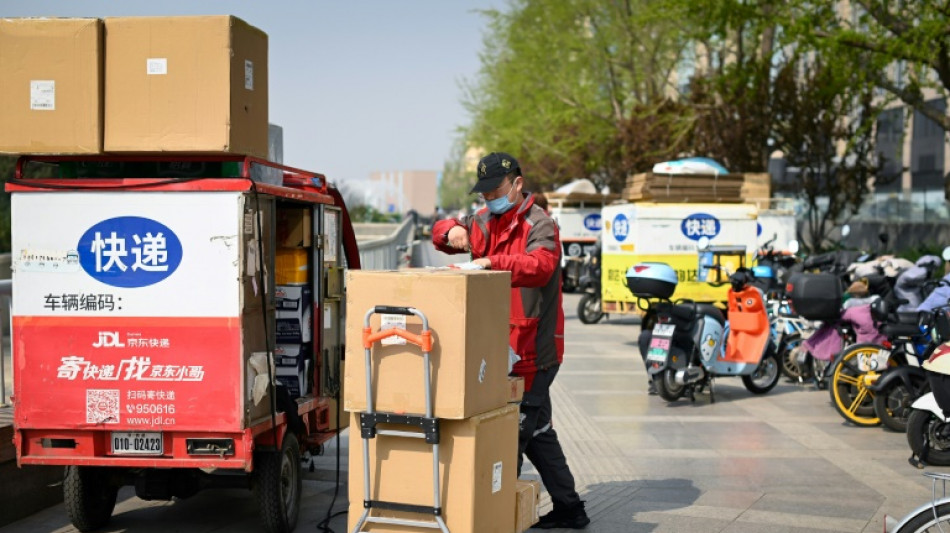
China's economic growth under threat as virus takes hold / Photo: WANG Zhao - AFP
The mounting cost of China's zero-Covid policy threatens to derail Beijing's ambitious GDP target, analysts say, as supply chains snarl, ports face delays and Shanghai remains mired in lockdown.
Growth in the world's second-largest economy was already slowing in the latter half of last year with a property market slump and regulatory crackdowns, leading policymakers to set their lowest annual GDP target in decades for 2022.
But analysts told AFP the figure of 5.5 percent would be tough to achieve with stay-at-home orders halting production and stunting consumer spending in key cities.
Experts from 12 financial institutions polled by AFP forecast GDP growth of 5.0 percent for the full year.
They expect a figure of 4.3 percent for the first quarter, just above the 4.0 percent recorded in the three months prior.
Official first-quarter data will be published Monday.
"China's economy saw a good start in January and February with less energy constraints, domestic demand recovery... fiscal stimulus, and resilient exports," said Gene Ma, head of China research at the Institute of International Finance.
But surging virus cases in March and lockdowns have "severely disrupted supply chains and industrial activities", he added.
The analysts predicted the coronavirus outbreak would reverse the gains made earlier in the year.
Carmakers this week warned of severe disruption to supply chains and possibly even halting production completely if a lockdown in business hub Shanghai continues.
Premier Li Keqiang said this week that state support should be stepped up and tools including cuts to the reserve requirement ratio for banks could be tapped to help virus-hit sectors.
Other major cities struck by Covid outbreaks include southern tech powerhouse Shenzhen, which went into full lockdown for almost a week in March.
"The hit to retail sales could be even bigger, as dining-out services -- around 10 percent of retail sales -- were temporarily suspended in a few provinces," Goldman Sachs said in a recent report.
But economists expect bigger consequences of the lockdowns to surface in April data and bog down growth.
- 'Lesson' -
With infections found in dozens of cities, Beijing has dug in its heels on the zero-Covid approach, which involves stamping out clusters as they emerge while conducting mass testing and isolating positive cases.
This has resulted in strict movement curbs in Shanghai for around two weeks now as the financial hub logs tens of thousands of cases daily -- most asymptomatic.
The city is home to the world's busiest container port and while operations are running, intercity travel restrictions and a shortage of truck drivers have snarled the passage of goods.
The daily flow of freight vehicles along highways has "weakened sharply" since the start of April, Capital Economics senior China economist Julian Evans-Pritchard said in a recent report.
Shanghai authorities have come under fire for allowing cases to spike and for failing to ensure supplies of fresh food reach all residents.
"Shanghai is a lesson, and local governments from other parts of China may become more sensitive to domestic flare-ups," said Tommy Xie, head of Greater China research at OCBC Bank.
"If they want to lock down, they will try to lock down earlier rather than later," he told AFP.
More short-term disruptions from Covid will likely arise, he added.
Controls in other coastal cities will also remain tight, said Dan Wang, chief economist at Hang Seng Bank China.
"It is not impossible for us to see maybe dozens or even more than 30 cities on lockdown at the same time," she said.
"The economic cost is very high."
G.Kucera--TPP