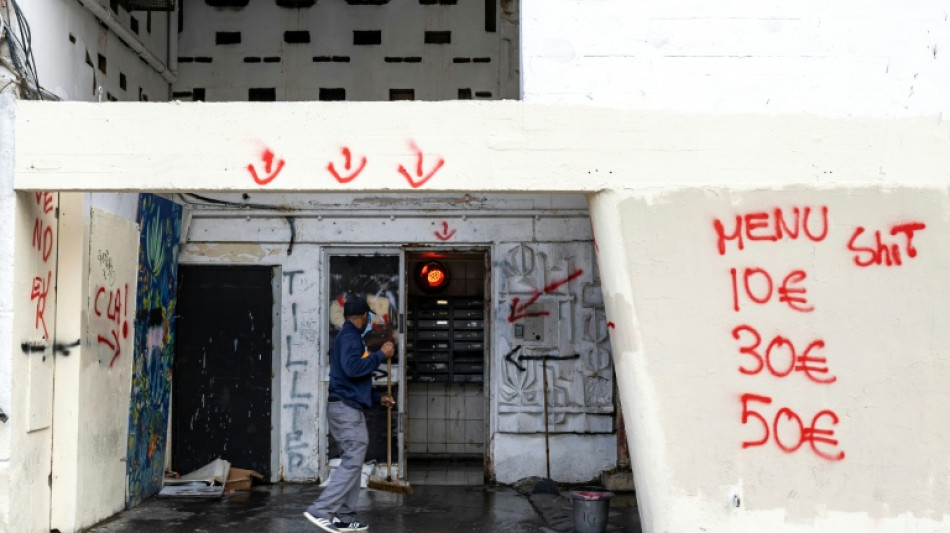
Shift in battle to tackle teens trapped in Marseille drug 'slavery' / Photo: Miguel MEDINA - AFP/File
They work as drug dealers, but the notes they slip to customers in drug baggies begging for help -- and their pleas to the police -- tell a very different story.
Hundreds of teenagers, often estranged from their families, have been ensnared by violent drug gangs in Marseille, France's second-largest city.
After being recruited through social media from across the country to act as look-outs or street corner dealers, they soon find themselves trapped.
Authorities in the southern port city have struggled to stem the flow of young people into gangs where they are exploited and abused, a pattern that emerged shortly before Covid.
"We often see minors who have been severely beaten, held captive and who can no longer get out of these networks," said Marseille's public prosecutor, Nicolas Bessone, who now openly refers to the practice as human trafficking as authorities shift their approach.
Cases that lead to prosecution are rare, as victims almost never file complaints.
"There's a code of silence, no one reports it," said Bessone.
The climate of fear has been further deepened by the assassination last month of Mehdi Kessaci, a 20-year-old who wanted to be a police officer, who was likely killed to silence his older brother Amine, an anti-drug campaigner.
- 'Exploitation' -
Hakim -- not his real name -- travelled south from the Paris region at the end of 2020 when he was 15 thinking to make a fast buck, but things quickly went wrong.
His phone was taken away, and he was forced to sleep at the home of a woman who provided only a bowl of water to wash and a single cookie to share between him and another person, he told investigators.
He worked as a lookout, but was accused of failing to warn other ring members police were coming. He was threatened with a knife by the boy in charge of the turf -- barely older than Hakim -- and raped.
Hakim was made to believe he had been filmed to shame him into silence.
Just days after arriving in Marseille, he threw himself at the mercy of police officers, begging them to get him out of there.
"They make it seem like a dream job, but 100 euros to keep watch from 10 am to midnight at an hourly rate, that's exploitation," said a community activist who wished to remain anonymous for fear of reprisal.
Isabelle Fort, who heads the organised crime division at the Marseille prosecutor's office, said young people were on the "front line" of gang wars that have been raging in the city, "disposable like tissues".
At the height of the violence in 2023, she said, "they came willingly saying, 'I'm going to join a network', and then very quickly became disillusioned, because they were really treated like slaves."
- 'We need help' -
Another case will come to court in February involving two 15-year-olds who escaped a gang in 2022 by leaping from the second floor of a building after they scribbled notes in baggies of drugs asking for help.
"Hello, we're being held captive by the drug ring. Please call the police, they've been forcing us to sell for free for a month and beating us with bars. Please call the police, we need help," the desperate pleas read.
France's justice system is undergoing a shift in approach to tackle the problem.
It was a retired juvenile court judge, Laurence Bellon, who began to speak about the issue in terms of human trafficking.
"These teenagers are trapped in a cycle that we currently address only in terms of reoffending, even though it also involves coercion and subjugation to very violent networks," she told AFP in 2023.
Human trafficking is usually confined to cases of pimping or forced begging, with no discussion of forced criminality in France, though it is gaining ground.
The UN children's agency UNICEF warned in July that "it is contrary to international law for children who are victims of criminal exploitation to still face prosecution and criminal penalties in France, instead of being recognised and supported as victims."
- 'Paradigm shift' -
The Marseille prosecutor's office has opened around ten investigations that include a human trafficking component targeting drug networks, it told AFP.
And in January, Justice Minister Gerald Darmanin recommended they "consider handling cases from the perspective of repressing human trafficking".
But not everyone is convinced.
Celine Raignault, deputy prosecutor in charge of minors and families, said "a paradigm shift" was needed.
But she warned against "completely removing responsibility from young people who might seek out Marseille's sunshine because there is more money to be made" in the drug trade.
"In cases of human trafficking, we need to be dealing with victims, one hundred percent," said Sebastien Lautard, the Marseille police number two.
"But we're not ready," he said. "There's a real ambiguity on how to handle these young people," particularly without "a pathway (for them) to get out of the drug trade", he added.
A director of a juvenile offenders institution, who asked to remain anonymous, said the only hope was to remove the young people from criminal environments "and take care of them".
"They should be taken to the countryside and treated as children again," he said.
Frederic Asdighikian, a children's rights specialist, recalled a client -- a minor on the run -- who was "tortured in a basement for three days" and came back with blowtorch burns along his side, his wound untreated.
"This is truly modern-day slavery," said the lawyer.
"We need to try to think differently."
W.Urban--TPP