China's rare earths El Dorado gives strategic edge / Photo: Hector RETAMAL - AFP
Buried in the reddish soil of southern China lies latent power: one of the largest clusters of crucial rare earths is mined around the clock by a secretive and heavily guarded industry.
The hills of Jiangxi province are home to most of China's rare earth mines, with the materials used in a wide range ofproducts including smartphones and missile guidance technology.
The flourishing industry is closely protected by Chinese authorities and media access is seldom granted.
In a rare visit to the region last month, AFP journalists were trailed and monitored by minders who declined to identify themselvesCompanies did not accept requests for interviews.
Business has been booming: the number of rare earth processing points in China observed by the US Geological Survey jumped from 117 in 2010 to 2,057 by 2017. Most of the 3,085 nationwide recorded by the USGS today are clustered in the hills of Jiangxi.
Locals there told AFP thatone rare earths mine was maintaining near-constant operations.
"It's busy 24 hours a day, seven days a week," a resident in the town of Banshi said.
Nearby, construction work was getting started for the day on a vast new industrial park housing facilities including rare earth processing sites.
The bustling mining region is the result of a decades-long push by Beijing to build up its might in the strategic sector.
Those efforts paid off this year, with a tentative truce in a trade war with the United States reached when China relaxed stringent export controls on rare earths.
Washington is now racing to establish alternative supply chains, but experts warn such efforts will take years.
In a sign of deepening concern among other Western governments, the European Union announced new measures this month to reduce the bloc's dependence on China for securing the critical minerals.
The bloc said it would earmark nearly three billion euros ($3.5 billion) to support projects in mining, refining and recycling vital materials, and proposed the creation of an EU supply hub -- the European Centre for Critical Raw Materials.
- Heavy metal -
"The Middle East has oil, China has rare earths," former Chinese leader Deng Xiaoping said in a 1992 speech.
Since then, China has taken advantage of its natural reserves -- the largest of any country -- to dominate processing and innovation in the field.
The country's rare earths industry is concentrated in two main hubs.
One is the Inner Mongolia region's Bayan Obo mining district on the edge of the Gobi Desert, which is rich in "light" rare earths used for magnets in everyday items.
The other hub, around the city of Ganzhou in Jiangxi, specialises in "heavy" rare earths -- harder to extract but more valuable because of their use in heat-resistant magnets, fighter jet engines, missile guidance systems and lasers.
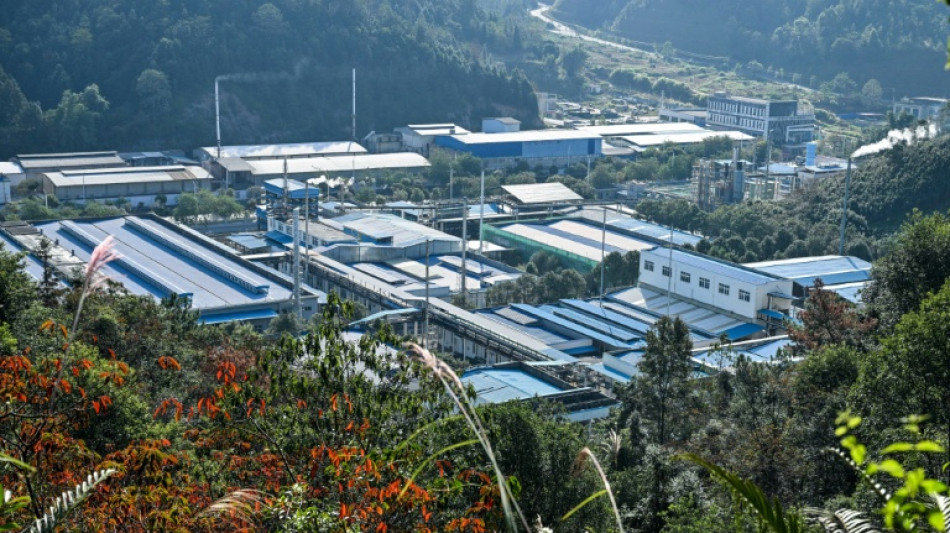
The rugged hills surrounding Ganzhou are home to the world's largest mining and processing operations of the strategic "heavy" elements, including dysprosium, yttrium and terbium.
And in the county-level district of Longnan alone, USGS counted 886 such locations, accounting for 31.5 percent of Jiangxi's total.
An AFP team in Longnan saw rows of large rare earths processing plants in an industrial district adjacent to that dense smattering of extraction sites.
- 'Moving mountains' -
Heavy rare earths are formed over millions of years, as rainfall weathers igneous rocks, breaking them down and leaving elements concentrated near the surface.
Jiangxi's gentle slopes, high rainfall and natural stone make it a prime location for such elements.
Mining methods in the region have evolved throughout the decades.
Authorities have criticised highly destructive approaches and cracked down on what they call "chaotic extraction" since the early 2010s.
One method -- termed "moving mountains" -- was described in 2015 by China's top industry and technology regulator as "first cutting down trees, then clearing weeds and finally stripping away the topsoil, causing irreparable damage".
Unlicensed mining has been drastically reduced over time.
Large signs in rural areas now warn against illegal extraction of rare earth resources. Others offer cash rewards for reporting such actions.
The industry has been largely consolidated into two huge state-owned companies.
On a Ganzhou street dubbed "Rare Earth Avenue", construction workers bustled to complete a sprawling new headquarters for one of those giants, China Rare Earth Group.
But the province's hills still bear the scars of bygone mining practices, with bare patches of red soil visible where vegetation has struggled to regrow.
K.Dudek--TPP