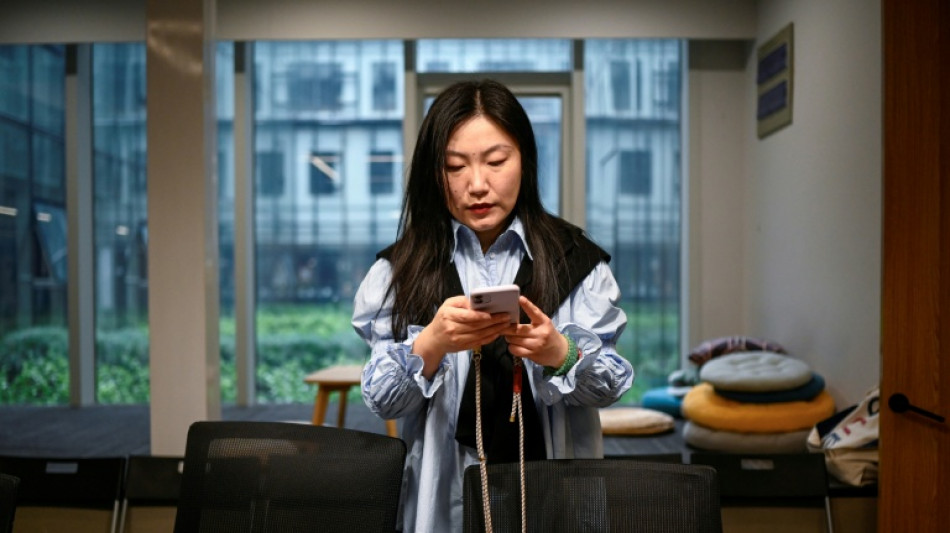
Young Chinese use AI to launch one-person firms over job anxiety / Photo: Jade GAO - AFP
Young Chinese, many who fear age discrimination in their workplace after turning 35, are increasingly starting "one-person companies" that have artificial intelligence do most of the work.
Smaller startups are already in vogue in Silicon Valley and elsewhere, with rapidly advancing AI tools seen as a welcome teammate even as they threaten layoffs at existing firms.
More young people in China are subscribing to the model, as cities pledge millions of dollars in funding and rent subsidies for such ventures, in alignment with Beijing's political goal of "technological self-reliance".
"The one-person company is a product of the AI era," said Karen Dai, founder of Shanghai-based SoloNest, which hosts weekend events for solo entrepreneurs.
In the past, it was very difficult to run a business on your own, she said, but the range of tasks that AI can help with has "lowered the entry barrier".
On a Sunday in Shanghai, around 20 people in their 20s and 30s packed into a conference room for Dai's 134th iteration of a three-hour ideas swap on going it alone.
One attendee, Wang Tianyi, now earns up to 40,000 yuan ($5,800) per month making AI-generated commercials for businesses.
The 26-year-old, who quit his product manager job at an internet company last year, predicts that people flying solo will become a "major trend".
"Because of the technological empowerment brought on by AI, (one-person companies) have an efficiency advantage," he told AFP.
- 'Invisible line' -
On Chinese social media, people have lamented for years the so-called "curse of 35" -- widespread age discrimination in tech, government and other competitive sectors.
"At 35 years old, there's like this invisible line," said Dai, who is 38.
"People might face some challenges in the workplace. The company might re-evaluate who is more fit to stay."
But young people, who witnessed a decade of rapid economic expansion in China, have a hunger to grow, said Dai, also author of the book "One Person Company".
"When you're 30 or even younger, you'll ask yourself: when I reach that invisible line of 35, what preparations should I make?" she said.
Shanghai resident Wei Xin, 34, knew her job as a document reviewer at a foreign consulting firm would be replaced by AI before it actually happened.
So she signed up for a course on Google's Gemini and dabbled in creating an AI-generated digital version of herself, before turning to social media content creation.
"There's a bit of AI anxiety," said Wei, who returned to China last year after completing a degree in the United States.
"If I don't use it, don't approach it, I might soon be eliminated."
- Government 'carrots' -
Chinese municipalities are rolling out policies to support AI-powered one-person companies, using the initials "OPC" -- a rare use of English in official policy.
In November, the eastern city of Suzhou vowed to cultivate "more than 10,000 OPC talents" by 2028 and funnel around 700 million yuan ($100 million) towards sectors including AI robotics, healthcare and smart transportation.
Southwestern Chengdu also last month promised subsidies of up to 20,000 yuan for graduates to establish AI-driven one-person firms.
These measures are "carrots to help these startups get off the ground and be successful", said Brookings fellow Kyle Chan, an expert on China's technology development.
Sponsoring OPCs is a new, cheap way to tackle high youth unemployment in China -- where one in six people between the ages of 16 and 24 are jobless.
"The cost of doing this, from the local governments, for an OPC, is very low," Chan said.
Wang, the former product manager, said many of his friends were opting to work on independent projects instead of vying for corporate jobs.
But "the important thing in the future will be how to sell it", he said, with new companies often struggling to turn a profit.
Young Chinese are investing in back-up plans while "asking themselves, 'can I, with my own two hands, helped by the convenience of AI, explore the things I say I want to do?'" Dai said.
"There is a sense of control, of creativity."
V.Sedlak--TPP