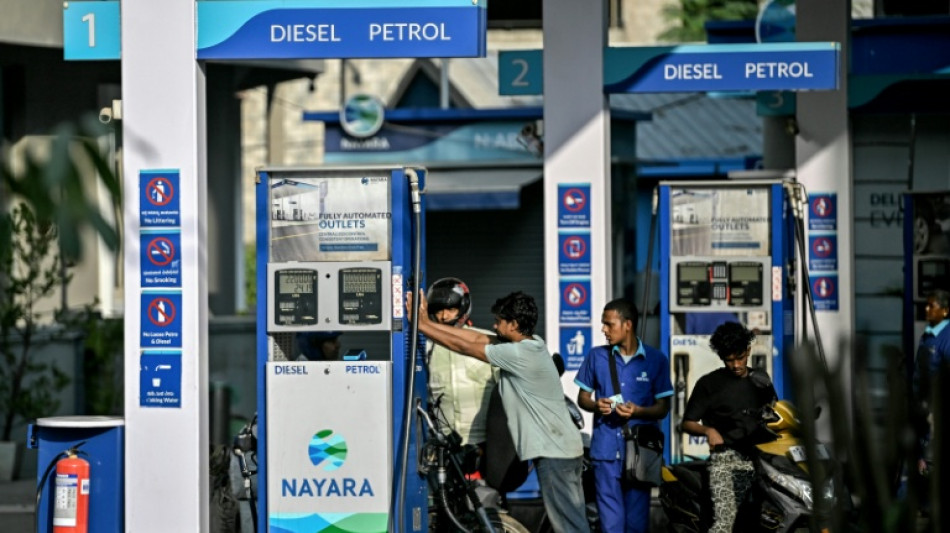
India plugs oil gap as Middle East supplies sink / Photo: Idrees MOHAMMED - AFP/File
India has ramped up purchases of Russian oil and revived alternate supplies from Africa, Iran and Venezuela to blunt a sharp crude shortfall from the crisis-ridden Middle East, analysts say.
India, the world's third-largest oil buyer, normally sources about half of its crude through the Strait of Hormuz, a vital waterway that has seen only a trickle of traffic since the United States and Israel launched attacks on Iran on February 28.
India's heavy import dependence, combined with modest oil reserves compared with major consumers like China, has prompted analysts to warn that India could be among the most vulnerable to a sudden oil price hike.
But while India is grappling with disruptions to cooking gas supplies, it has so far avoided the petrol shortages that have hit some neighbouring nations.
Ship‑tracking and import data show that India has partially plugged the gap by turning to old allies, expanding promising ties and reviving suppliers it had not tapped in years.
The biggest backstop has been Russian crude -- a fuel source New Delhi spent much of the past year trying to pivot away from under stiff US tariffs.
Indian refiners imported an average of nearly 1.98 million barrels per day (bpd) from Russia in March, according to trade intelligence firm Kpler -- a sharp jump from the previous two months.
Analysts say the surge was likely aided by a temporary US waiver granted in March covering Russian oil already at sea.
"Imports rose from approximately one million bpd in January and February," said Nikhil Dubey, an analyst at Kpler.
"This near‑doubling suggests that this additional volume was likely contracted following the sanction waiver," he told AFP.
- Useful purchase -
India likely purchased an additional 60 million barrels of Russian oil that will be delivered through April, two trade analysts said.
Washington's exemptions have drawn criticism from Ukrainian President Volodymyr Zelensky, who says they complicate efforts to choke off Russia's revenues more than four years into its full-scale invasion of Ukraine.
But Kyiv gained little leverage after US President Donald Trump last week extended the waiver on Russian seaborne oil by another month.
"The extension gives Indian refiners the runway they urgently needed," said Rahul Choudhary, vice‑president at Rystad Energy.
"Indian refiners will likely move quickly to lock in the additional barrels the extension unlocks before the May 16 deadline."
Other markets have also aided India.
Imports from Angola averaged 327,000 bpd in March, data from Kpler shows, nearly three times what India received in February.
Industry watchers say African crude purchases were made before the United States struck Iran and have proven to be useful.
"A lot of the uptick you're seeing from Angola in March or Nigeria in April comes because we were (already) looking at sources other than Russia," an official at a state‑run refiner told AFP, requesting anonymity because they were not authorised to speak with journalists.
"It's now come in handy because shipments from Iraq and most of the Middle East have fallen heavily."
According to Kpler, crude from both Iran and Venezuela began arriving this month.
Imports from Iran averaged 276,000 bpd as of mid‑April, while shipments from Venezuela stood at around 137,000 bpd, preliminary data from Kpler shows.
The purchases have proven to be a fortuitous windfall for refiners who largely steered clear of both suppliers previously to avoid US ire.
- Higher prices -
Despite the diversification, the road ahead looks difficult.
India's overall crude imports fell in March, sliding to 4.5 million bpd from 5.2 million in February, according to Kpler.
Analysts also cautioned that oil from the African nations has limits as a substitute.
"In a prolonged Iran conflict scenario, African crudes can partially backfill supply. However, they are unlikely to fully replace Middle Eastern barrels on a structural basis due to crude slate mismatches," said Dubey, explaining Indian refineries were configured for different grades than what comes from the African countries.
Higher prices are also a problem.
"The era of cheap oil is over for now, but access has been preserved. Either way, India doesn't have the luxury of walking away," said Choudhary, noting that April barrels were secured at between $5 and $15 above the Brent global oil benchmark.
State‑run retailers have yet to raise pump prices, with the government instead cutting excise duties on fuel.
Some analysts warn prices could rise by as much as 28 rupees (30 cents) per litre once voting in key state elections ends later this month.
The oil ministry acknowledged Thursday that government‑owned fuel companies were incurring losses but denied that a price hike was imminent.
"India is the only country where petrol and diesel prices haven't increased in the last four years," it said.
The government and state oil firms "have taken relentless steps in order to insulate Indian citizens from steep increases in international prices".
D.Kovar--TPP