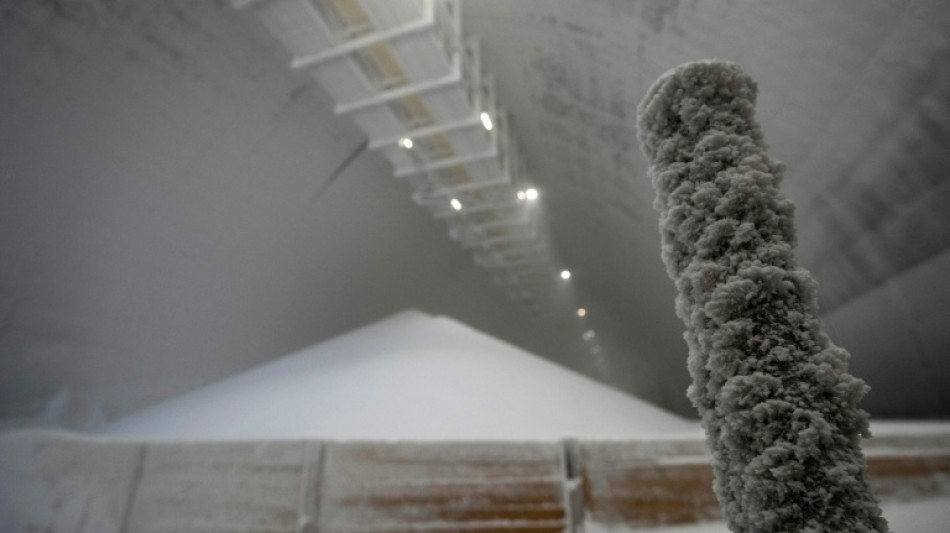
German fertiliser makers and farmers struggle with Iran war fallout / Photo: John MACDOUGALL - AFP
As Iran's closure of the Strait of Hormuz roils the global economy, one German town has been scrambling to help make up the shortfall in essential supplies of fertilisers.
Wittenberg, better known to many as a cradle of the Protestant Reformation, is also home to a chemical plant founded in 1915, in the midst of World War I.
At that time the aim was to produce nitrogen for explosives and fertilisers to circumvent a blockade which prevented certain raw materials being imported from Chile.
More than a century later, the closure of the Strait of Hormuz "shows that it's still the same thing today -- sea routes can collapse", Christopher Profitlich, spokesman for the SKW company, which took over the site in 1993, told AFP.
A third of the world's fertilisers normally pass through the Strait of Hormuz and the World Trade Organization (WTO) has warned that the blockade there threatens global food security, particularly in Africa and South Asia.
"That's why it makes so much sense to have production in Europe," Profitlich said.
- Domino effect -
At SKW's sprawling 220-hectare site, a 23-kilometre rail network transports urea, ammonia and finished fertilisers, destined for sites across Germany and elsewhere in Europe.
SKW is Germany's largest producer of urea, an essential component of fertilisers. In one of its warehouses, a mountain of acrid-smelling white powder rises several metres high.
The plant has been running at full capacity to try to make up the shortfall in supply from the Hormuz blockade.
The company expects an increase in revenue this year of between 10 and 20 percent, but stresses this estimate remains uncertain because of market volatility.
SKW's CEO Carsten Franzke says that the company is not a "war profiteer" and will probably just break even once soaring energy costs are also taken into account.
Around 80 percent of the company's production is powered by gas, which has doubled in price since the conflict broke out on February 28.
Like much of German industry, SKW had already been struggling with the energy crisis triggered by the Ukraine war, which starkly exposed the country's reliance on Russian gas.
SKW posted losses three years in a row as the country strove to wean itself off cheap Russian energy supplies.
Today the company imports natural gas from Norway, the Netherlands and the United States, but is suffering as prices rise on global markets due to a domino effect from the latest conflict.
"We can pass on the higher costs to the consumers of our products," Franzke said.
"The problem is that our customer, the farmer, might not be able to pass these costs on," he said.
- Looming shortage -
One such farmer struggling with the impact of the crisis is Gerhard Geywitz, who relies on nitrogen-based fertilisers at his farm in the southwestern state of Baden-Wuerttemberg.
Speaking to AFP in his cornfield, he said that since the war began, the price of fertiliser has jumped by 50 percent.
He explained that as cereal prices on the world market have remained stable, he has had to absorb the cost and can't pass it on.
If the war drags on, Geywitz worries about "a fertiliser shortage by next year".
"For this reason we've decided to stock up now, before prices become exorbitant," Geywitz said.
The German Fertiliser Producers' Association (BVDM) pointed out that several European plants have closed in recent years due to costs, even before the current crisis.
"Without local producers and competitive farming, food security in Europe is seriously threatened," the BVDM said in a statement to AFP.
"Dependence on international markets represents a certain risk," it added.
The crisis has revived worries that European businesses in these sectors will struggle to compete with foreign rivals who face fewer constraints, particularly in terms of environmental standards.
Like many others in German industry, Franzke has called for a review of the EU's carbon trading scheme in order to ease pressure on businesses.
The European Commission has said it is looking into the issue.
R.Rous--TPP