The Prague Post - Kenyan farmers turn to bugs as organic demand grows

EUR -
AED 4.289195
AFN 76.49547
ALL 92.504383
AMD 425.491998
ANG 2.090331
AOA 1070.986466
ARS 1751.301305
AUD 1.629392
AWG 2.103723
AZN 1.981945
BAM 1.954769
BBD 2.355728
BDT 142.924624
BGN 1.981227
BHD 0.440983
BIF 3480.813301
BMD 1.167924
BND 1.484181
BOB 13.508876
BRL 6.001607
BSD 1.169623
BTN 111.933281
BWP 15.672339
BYN 3.49899
BYR 22891.311552
BZD 2.35233
CAD 1.612506
CDF 2657.026847
CHF 0.934766
CLF 0.027339
CLP 1075.996753
CNY 7.84991
CNH 7.8529
COP 3557.473325
CRC 532.237536
CUC 1.167924
CUP 30.949988
CVE 110.211123
CZK 24.118214
DJF 208.2764
DKK 7.475111
DOP 68.527674
DZD 155.27669
EGP 59.339651
ERN 17.518861
ETB 189.165266
FJD 2.559621
FKP 0.856135
GBP 0.856146
GEL 3.042421
GGP 0.856135
GHS 13.011138
GIP 0.856135
GMD 85.843416
GNF 10276.976087
GTQ 8.925637
GYD 244.690955
HKD 9.154545
HNL 31.366204
HRK 7.53463
HTG 153.017163
HUF 362.308701
IDR 20672.956595
ILS 3.492564
IMP 0.856135
INR 111.766128
IQD 1532.211619
IRR 1605428.411257
ISK 141.610492
JEP 0.856135
JMD 185.628461
JOD 0.82803
JPY 185.551013
KES 151.082722
KGS 102.1354
KHR 4721.752408
KMF 492.863972
KPW 1051.131996
KRW 1611.525196
KWD 0.36027
KYD 0.974698
KZT 538.50675
LAK 26345.444269
LBP 104744.395562
LKR 385.041772
LRD 212.286224
LSL 18.755431
LTL 3.448576
LVL 0.706466
LYD 7.433303
MAD 10.802203
MDL 20.135157
MGA 5001.554983
MKD 61.528638
MMK 2452.419638
MNT 4199.596221
MOP 9.44484
MRU 46.607017
MUR 54.506751
MVR 18.044368
MWK 2028.099878
MXN 19.780543
MYR 4.719593
MZN 74.606379
NAD 18.755431
NGN 1575.354257
NIO 43.039697
NOK 10.869962
NPR 179.096515
NZD 1.954182
OMR 0.449083
PAB 1.169583
PEN 3.921132
PGK 5.183466
PHP 72.094201
PKR 324.541158
PLN 4.314201
PYG 7045.495475
QAR 4.251921
RON 5.254019
RSD 117.301608
RUB 96.587776
RWF 1723.450111
SAR 4.391734
SBD 9.381067
SCR 16.211981
SDG 702.505847
SEK 11.061111
SGD 1.48265
SHP 0.865275
SLE 28.726981
SLL 24490.782647
SOS 668.470356
SRD 44.112467
STD 24173.669987
STN 24.488029
SVC 10.233734
SYP 15185.348502
SZL 18.742757
THB 38.156535
TJS 10.789825
TMT 4.087734
TND 3.401837
TOP 2.812081
TRY 56.154839
TTD 7.933122
TWD 37.168062
TZS 3089.197636
UAH 52.263227
UGX 4350.70552
USD 1.167924
UYU 47.0468
UZS 13866.043588
VES 909.792111
VND 30534.206592
VUV 137.523272
WST 3.171974
XAF 655.633686
XAG 0.016911
XAU 0.000251
XCD 3.156373
XCG 2.107915
XDR 0.825783
XOF 655.63088
XPF 119.331742
YER 276.885557
ZAR 18.699119
ZMK 10512.721537
ZMW 22.19396
ZWL 376.07107
  • CMSC

    -0.1780

    21.102

    -0.84%

  • RBGPF

    0.0000

    68.56

    0%

  • RIO

    3.1300

    105.3

    +2.97%

  • BCE

    -0.0700

    23.71

    -0.3%

  • NGG

    -0.8600

    79.76

    -1.08%

  • RYCEF

    -0.2500

    20.25

    -1.23%

  • CMSD

    -0.1400

    20.98

    -0.67%

  • RELX

    0.5300

    35.91

    +1.48%

  • GSK

    0.4500

    52.41

    +0.86%

  • BTI

    -0.4900

    56.21

    -0.87%

  • AZN

    1.4900

    165.98

    +0.9%

  • VOD

    -0.0500

    15.96

    -0.31%

  • BP

    -0.3800

    44.76

    -0.85%

  • BCC

    0.7000

    82.47

    +0.85%

  • JRI

    -0.0300

    12.38

    -0.24%

Kenyan farmers turn to bugs as organic demand grows
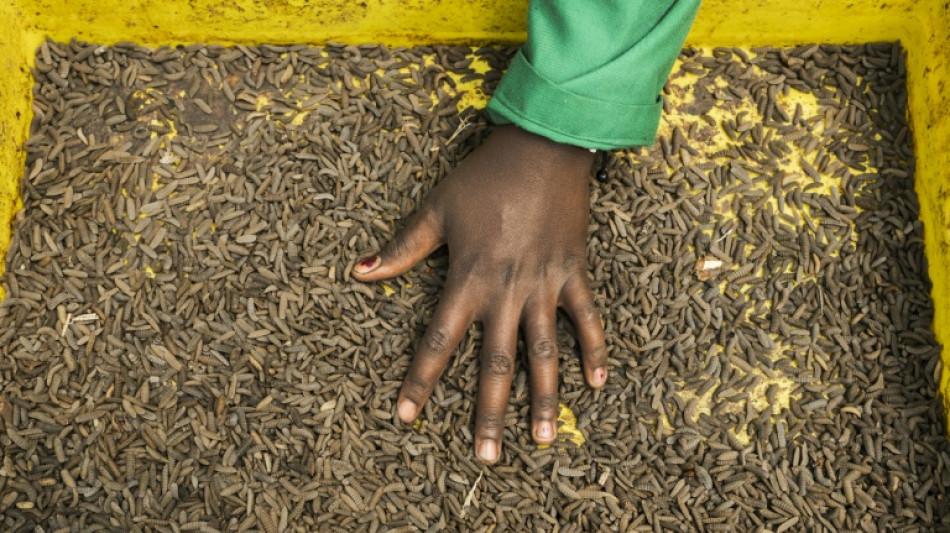
Kenyan farmers turn to bugs as organic demand grows / Photo: Tony KARUMBA - AFP

Kenyan farmers turn to bugs as organic demand grows

Kenyan farmer George Muturi says the stinky wooden shack teeming with redworms has helped rescue his land from the soil degradation caused by chemical fertilisers.

Text size:

Agriculture is vital to east Africa's economy, but a 2025 soil report by the Heinrich Boll Foundation, a German think tank, found that more than 40 percent of the region's soils were degraded -- in part by overuse of chemical fertilisers -- costing more than $65 billion a year in lost productivity.

Fertiliser prices have also increased this year due to the war in the Middle East, driving a search for alternatives.

In Kenya, 32 percent of cropland was classified as strongly acidic in the soil report. Changing climatic conditions and overly intensive farming practices are among the causes, but Muturi says moving away from chemical fertilisers has boosted his harvests at his farm in Lari, about 50 kilometres (30 miles) from the capital, Nairobi.

He switched to "vermicompost" -- using redworms that turn food and crop waste into a natural, nutrient-rich form of fertiliser.

"Vermicomposting was a breakthrough for us... our soil is much better in a way that we can be able to plant and sustain the crop even during dry season," the 31-year-old farmer told AFP during a visit to his farm.

About 70 beds, each filled with at least 5,000 redworms, hold layers of food and crop waste mixed with cow dung that the worms break down over six weeks, to create vermicompost.

Multiple studies have shown that vermicompost can improve soil structure, organic matter and water retention.

Muturi acknowledges that it is some way off being used on an industrial scale, since very large quantities are needed to match the effects of synthetic fertilisers.

But he says he has seen positive results on his vegetables and has started selling the compost to other farmers around the country.

- Circular agriculture -

About 200 kilometres away in Nakuru County, Robert Mwangi has taken a similar approach with the larvae of black soldier flies.

He collects waste from the city's main market and feeds it to the larvae, which break it down into frass, an organic fertiliser. The mature larvae are dried and used as animal feed.

In a nylon structure, a pungent smell hangs over drums of shredded food waste, which are emptied into plastic boxes where the larvae feed for about two weeks before the frass is harvested.

"With conventional fertilisers, the more you use it, the more the productivity of the soil goes down, because (it) creates an acidic environment which is not good for the microbes that are responsible for maintaining and improving the soil fertility," Mwangi said.

"The organic fertiliser is a very good soil amendment so farmers are able to experience increased productivity over time and improved soil fertility which reduces their cost of production," he said, adding that it also helps deal with food waste.

As global and domestic demand for organic food grows, Kenyan farmers are seeking alternatives to chemical fertilisers.

Mwangi processes about 10 tonnes of food waste per week, selling the resulting compost to farmers across the country.

"The demand has overwhelmed what we can produce," Mwangi said.

C.Sramek--TPP