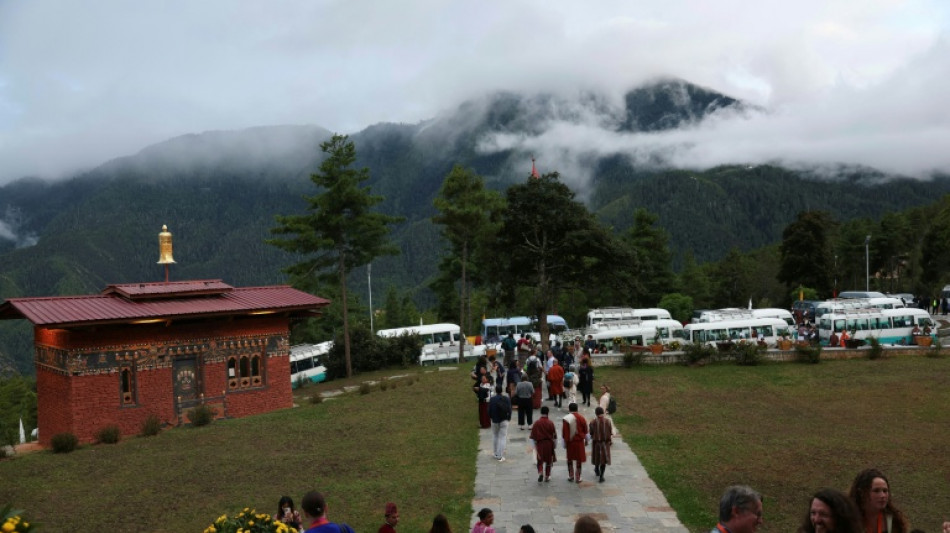
Farming experts tout 'conscious' food systems to fix agriculture woes / Photo: Niharika KULKARNI - AFP
Farmers around the world are struggling with the impact of climate change, financial pressures and depleted soil -- and industry experts say bringing consumers closer to the people who produce their food could provide a solution.
A group of farmers, scientists and development specialists are pushing for "conscious food systems", arguing that many of the problems in today's food production are the result of people being "alienated" from nature and each other.
Current food production systems are "not really fit for purpose," said Andrew Bovarnick, head of food systems at the United Nations Development Programme.
"It's causing huge environmental problems... we have more food in the world, but there are more than ever people who are malnourished and starving," he said.
Bovarnick spent years looking at technical solutions to food production challenges, but believes technology alone cannot solve the problem.
Instead, he and other members of the Global Conscious Food Systems Alliance, meeting in Bhutan this week, want more "mindful" food production focused on protecting the environment, farmers and consumers, rather than maximising profit or output.
The problems in food production are well-documented.
Intensive agriculture, the application of chemicals and extreme weather linked to climate change have degraded up to 40 percent of land globally.
Intensive farming practices themselves contribute to climate change, and farmland is increasingly being abandoned by producers who cannot make ends meet or survive harvests lost to extreme weather.
These are problems farmer Ashish Gupta confronts daily on his smallholding in India's Himachal Pradesh, which he farms as part of a cooperative.
"The markets are very cruel," he told AFP on the sidelines of the conference, lamenting the barriers that smallholders producing organic food face in reaching consumers.
Organic food might look more expensive, but Gupta urged shoppers to consider the environmental and social impacts of industrial agriculture, which can squeeze farmers and harm the soil and water.
His community struggles to survive a single harvest ruined by floods, and sees "the farmers are getting more and more aged, and the newer generation is not interested in farming."
- 'Land in their hearts' -
For Gupta, a conscious food system is about making consumers consider who grew their food and how, building a connection that encourages people to pay fair prices and support sustainable farming.
"We have to adopt certain principles of conscious food systems to make it more mindful, so young people can relate to the connection to the land in their hearts, not just the economics," he said.
"Otherwise, the status quo is maintained, the farmers remain stressed and the next generation is not interested in taking up farming."
So what might a conscious food system look like?
In Bhutan's Paro, several hundred proponents of the idea are practicing everything from walking meditation to mindful eating -- slowing down to appreciate the taste, smell, texture and colours of food.
The group is also discussing examples like a project in Egypt that has moved 50,000 farmers into regenerative agriculture.
Bhutan, with its commitment to maintain forest across 60 percent of its territory and net-negative carbon emissions, offers potential lessons for more environmentally friendly practices, but is also facing challenges.
"We have aging farm labour and we also have the issue of not only rural-urban migration but also seeing out-migration from the country," Bhutan's Agriculture Minister Lyonpo Younten Phuntsho told AFP.
He hopes Bhutan can capitalise on its pristine environment for high-value products that will command a premium because of where they were grown.
But that requires consumers who care about the environment in which their food was produced and the people who grew it.
"We're not saying it's all about just being spiritual and sitting under a tree and meditating," said Bovarnick.
"If we can connect consumers to where their food comes from... I think there's a possibility that they will make different decisions and choose food products that have been grown in a responsible, conscious manner and provide the right prices to farmers."
K.Dudek--TPP