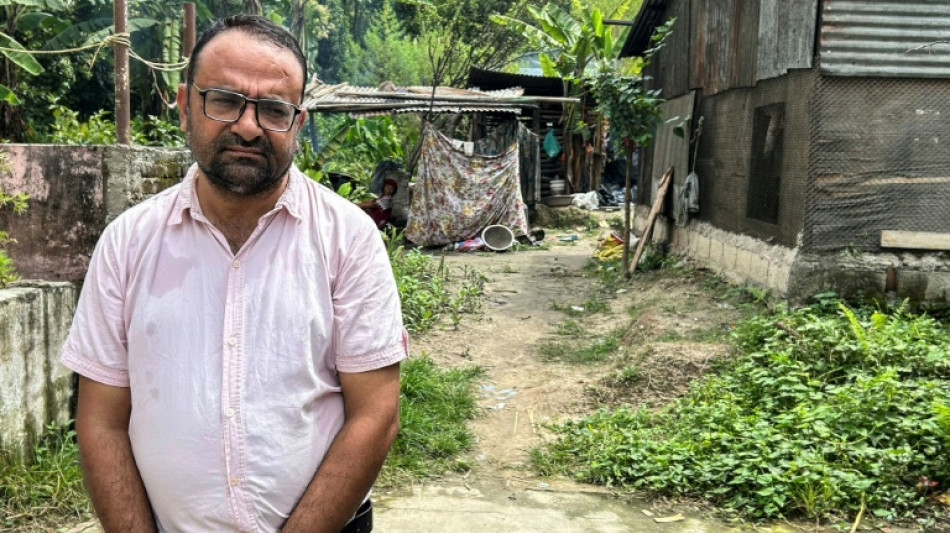
'The flood is coming': How a Nepal principal saved 900 students / Photo: Lucie GODEAU - AFP
Rajendra Dawadi was inside his school near Nepal's Trishuli River with around 900 students last week when a colleague delivered an urgent warning.
"My accountant came to the school and said, 'The flood is coming, the flood is coming'," the school principal told AFP in a recent interview.
Dawadi quickly ordered an evacuation, and teachers hurried hundreds of students from classrooms to higher ground.
Minutes later, the 47-year-old watched the Trishuli Bazaar Secondary School he had run for years collapse into a raging torrent.
"If the information was wrong, we would lose a day of schooling," he recalled of the morning of August 26. "But if it was true, we were going to lose our lives."
Students were panicked, Dawadi said, and one girl fainted.
Bus drivers bringing in other students were asked to turn back, including one driver who had just entered school grounds.
But the timely evacuation saved some 900 lives.
Now, standing above the scarred banks of the river in Nuwakot district more than a week after the disaster, Dawadi described himself simply as "a principal without a school".
The tsunami-like wall of water, ice and debris unleashed by a massive glacial and rock collapse along the Nepal-China border killed at least 1,362 people and has left more than 5,500 missing across the two countries.
Five students died in the flooding outside the school, as well as a teacher and a security staff member, Dawadi said.
The staff member, who left the school after him, "had probably wanted to close the gate", he said.
- 'Nothing left' -
Authorities in Trishuli Bazaar had not provided an evacuation plan, Dawadi said.
Some residents tried to cross the bridge but were swept away. The others took refuge on higher ground.
"When I looked back, the school was standing there like the finest of buildings, and in five minutes, everything collapsed," Dawadi recalled.
"It's also the school where I studied. There was nothing left."
Santoshi Dotel, 17, was in accounting class when the evacuation order came. At first, she struggled to comprehend the danger.
"We never would have thought the flood could reach such a scale," she said.
She initially went down to the river with her friend to try to cross and reach her family home.
Then the water surged.
"The bridge was swept away," she said. "I started to cry because I thought I would never get home and that there was nothing we could do."
Her friend pulled her up a hillside as the flood roared below.
Twisting her phone in her hands, Santoshi broke down into tears as she recalled the anguish of not knowing for hours whether her parents had survived.
It was only four days later that a helicopter finally reunited her with her family.
"I found my mother as I stepped out of the helicopter," she said. "She hugged me and started to cry. My mind just stopped working."
Her mother, Durga Dotel, had feared the worst.
"Seeing the river in flood, I had lost all hope that my daughter had survived," she said.
Dawadi said the disaster was "far worse" than the earthquake that hit Nepal in 2015.
"The school had been completely destroyed (after the earthquake), but we rebuilt it," he said.
"This time, we've lost the land and the building. We need a school again. But first, we need somewhere safe to build it."
X.Kadlec--TPP