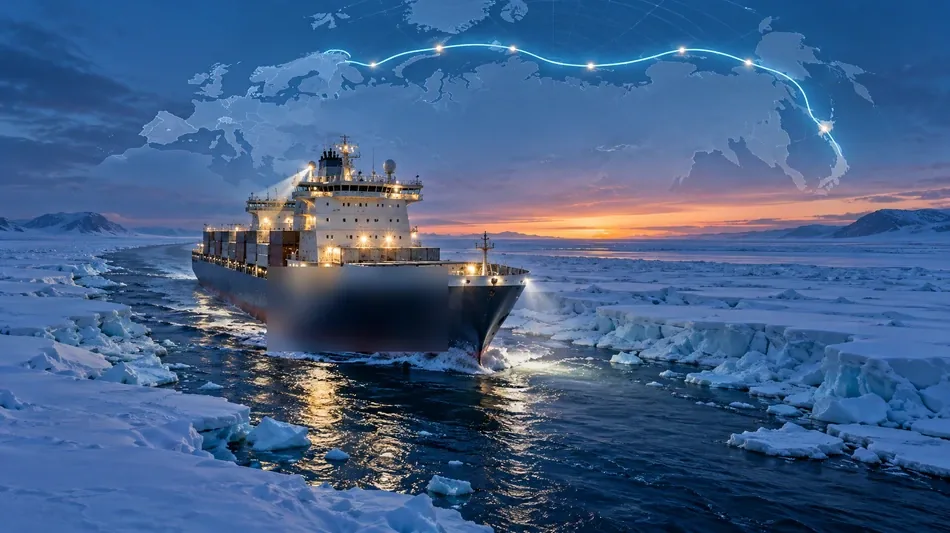
India and Russia plan 2027 pilot voyages on Northern Sea Route
India and Russia intend to run pilot voyages on the Northern Sea Route in 2027 as they assess a shorter Arctic shipping link and expand maritime cooperation.
India and Russia intend to run pilot voyages on the Northern Sea Route in 2027 as they assess a shorter Arctic shipping link and expand maritime cooperation.
The development assumes significance considering the enhanced cooperation between India and Russia to expand the trade in crude oil, LNG, fertilizers and critical minerals notwithstanding attempts by the US to pressurise New Delhi from buying energy commodities from Moscow.
Considered the shortest coastal passage between Western Eurasia and Asia-Pacific, the 5,600 km long NSR runs from the Kara Strait to Cape Dezhnev in the Bering Strait.
Kirill Komarov, the First Deputy Director General for Corporate Development and International Business at Rosatom, said there is “strong interest” among Indian partners in the NSR.
“In 2024, a dedicated working group was established within the framework of the Intergovernmental Commission. Three meetings have been held, the latest on August 13 (2026) in Arkhangelsk, Russia. As a practical step, the latest working group meeting also agreed to organise a pilot voyage between Russian and Indian ports via the NSR in 2027,” he told businessline.
Since 2018, Rosatom has been the infrastructure operator of the NSR. The Russian nuclear behemoth is responsible for developing the passage, including building nuclear icebreakers, ensuring navigational and hydrographic support, maintaining maritime safety systems, organising shipping operations, and guaranteeing reliable navigation, including transit.
Since the Arctic Ocean is covered in ice for most of the year, icebreakers are required for safe navigation. Russia is the only country with a nuclear-powered icebreaker fleet that is operated by Rosatom’s subsidiary Atomflot.
Sources said that India-Russia cargo traffic can potentially reach 5 million tonnes (mt) annually via the NSR and Rosatom is exploring possibilities for mutually beneficial cooperation in this area with Indian partners.
Figures from a 2021 report by the Oxford Institute of Energy Studies (OIES), NSR is an important shortcut between Europe and Asia, providing significant distance and shipping time savings compared with the most often used shipping route from the Atlantic to Asia via the Suez Channel and Indian Ocean. For Russian oil and gas companies, the NSR holds the promise of unlocking the reserves that have been stranded in the Arctic for many years.
The NSR along with the Eastern Maritime Corridor (EMC) can significantly reduce travel time between Chennai and Vladivostok (Russia’s Far East). It will boost supply of coking coal, fertilizers, crude oil and liquefied natural gas (LNG) to India.
For comparison, the present trade route between Mumbai and St Petersburg covers about 8,675 nautical miles (around 16,066 km). Travel time from Russia to India on this route generally takes 35–40 days. Shipping routes from India to Russia principally comprise three main sea corridors that branch out from ports of JNPT, Mundra, Cochin and Chennai to St Petersburg, Novorossiysk and Vladivostok.
The NSR is part of the Trans-Arctic Transport Corridor, a multi-modal connectivity project, that aims to develop the Arctic zone of the Russian Federation and the Far East.
Z.Marek--TPP