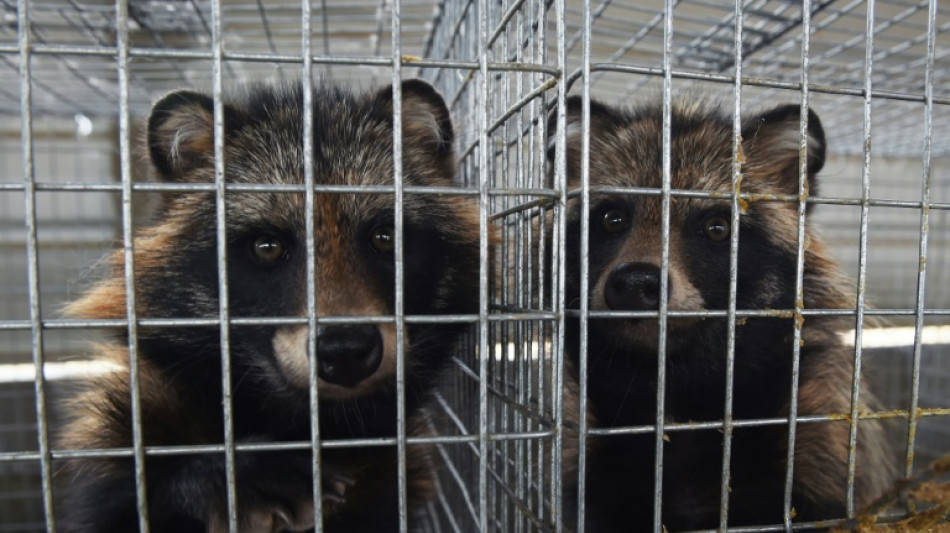
New study reinforces theory Covid emerged at Chinese market / Photo: Greg Baker - AFP/File
A study on the origin of Covid-19 provided new evidence on Thursday supporting the theory that humans first caught the virus from infected animals at a Chinese market in late 2019.
Nearly five years after Covid first emerged, the international community has not been able to determine with certainty exactly where the virus came from.
The first cases were detected in the Chinese city of Wuhan in late 2019, but there have been bitter disputes between proponents of the two main theories.
One is that the virus leaked from a Wuhan lab which studied related viruses, while the other is that people caught Covid from an infected wild animal being sold at a local market.
The scientific community has favoured the latter theory, but the controversy has rumbled on.
The study published in the Cell journal is based on more than 800 samples collected at Wuhan's Huanan Seafood Market, where wild mammals were also believed to have been for sale.
The samples were collected in January 2020 after the market was shuttered, and were not taken directly from animals or people but from the surfaces of stalls selling wildlife, as well as from drains.
From this type of data, which was shared by the Chinese authorities, "we cannot say with certainty whether the animals (at the market) were infected or not," study co-author Florence Debarre told AFP.
However, "our study confirms that there were wild animals at this market at the end of 2019, notably belonging to species such as raccoon dogs and civets," said the evolutionary biologist at France's CNRS research agency.
"And these animals were in the southwest corner of the market, which also happens to be an area where a lot of SARS-CoV-2 virus, which causes Covid-19, was detected."
These small mammals can catch similar viruses to humans, which has made them suspects for serving as an intermediate host between humans and bats, in which SARS-CoV-2 is suspected to have originated.
The presence of these animals at the Huanan market had previously been disputed, despite some photographic evidence and a 2021 study.
- 'Very strong evidence' -
Numerous parts of one stall tested positive for the Covid virus, including "animal carts, a cage, a garbage cart, and a hair/feather removal machine," the study said.
"There was more DNA from mammalian wildlife species in these samples than human DNA," it added.
Mammal DNA was found in the Covid-positive samples from this stall, including from palm civets, bamboo rats and raccoon dogs.
"These data indicate either that the animals present at this stall shed the SARS-CoV-2 detected on the animal equipment or that early unreported human case(s) of Covid-19 shed virus in the exact same location as the detected animals," the study said.
The research also confirms that the "most recent common ancestor" of the Covid virus strain found in the market samples was "genetically identical" to the original pandemic strain.
"This means that the early diversity of the virus is found at the market -- as would be expected if this is the site where it emerged," Debarre explained.
James Wood, an infectious disease epidemiologist at Cambridge University not involved in the research, said the study "provides very strong evidence for wildlife stalls in the Huanan Seafood Market in Wuhan being a hotspot for the emergence of the Covid-19 pandemic."
The research was important because "little or nothing has been done to limit either the live trade in wildlife nor the biodiversity loss or land use changes that are the actual likely drivers of past and future pandemic emergence," he said.
"These aspects are also not included in the draft pandemic treaty" currently being negotiated by countries, he added.
G.Turek--TPP