The Prague Post - ISS astronauts splash down on Earth after first-ever medical evacuation

EUR -
AED 4.262128
AFN 73.114707
ALL 96.198051
AMD 437.516272
ANG 2.077075
AOA 1064.225155
ARS 1642.165959
AUD 1.651078
AWG 2.088992
AZN 1.97275
BAM 1.95635
BBD 2.336537
BDT 141.894778
BGN 1.912178
BHD 0.437778
BIF 3441.034419
BMD 1.160551
BND 1.483555
BOB 8.016461
BRL 6.123879
BSD 1.160056
BTN 106.743685
BWP 15.565778
BYN 3.374636
BYR 22746.804257
BZD 2.333216
CAD 1.587646
CDF 2617.043214
CHF 0.907598
CLF 0.026465
CLP 1044.983355
CNY 8.008036
CNH 8.028333
COP 4412.86842
CRC 545.469785
CUC 1.160551
CUP 30.754608
CVE 109.527023
CZK 24.373435
DJF 206.252944
DKK 7.471728
DOP 68.763005
DZD 151.811334
EGP 57.890392
ERN 17.408269
ETB 180.987466
FJD 2.565952
FKP 0.866661
GBP 0.869718
GEL 3.139293
GGP 0.866661
GHS 12.504954
GIP 0.866661
GMD 84.720419
GNF 10186.736045
GTQ 8.896808
GYD 242.704499
HKD 9.058044
HNL 30.777949
HRK 7.534413
HTG 152.216724
HUF 387.189488
IDR 19619.234726
ILS 3.605084
IMP 0.866661
INR 106.78377
IQD 1520.902397
IRR 1525628.771998
ISK 144.105729
JEP 0.866661
JMD 181.210939
JOD 0.82287
JPY 183.179126
KES 149.862272
KGS 101.489629
KHR 4653.810742
KMF 493.234391
KPW 1044.617324
KRW 1715.529735
KWD 0.356719
KYD 0.966797
KZT 580.34314
LAK 24861.909173
LBP 103927.363624
LKR 359.641944
LRD 212.787428
LSL 19.230425
LTL 3.426806
LVL 0.702006
LYD 7.38092
MAD 10.803281
MDL 20.06916
MGA 4856.906703
MKD 61.581738
MMK 2436.754901
MNT 4142.584902
MOP 9.322161
MRU 46.398973
MUR 54.464761
MVR 17.930576
MWK 2015.877731
MXN 20.525747
MYR 4.573674
MZN 74.165001
NAD 19.230476
NGN 1600.457878
NIO 42.61514
NOK 11.221898
NPR 170.789897
NZD 1.973105
OMR 0.446234
PAB 1.160056
PEN 3.967342
PGK 5.001687
PHP 67.764891
PKR 324.199549
PLN 4.291753
PYG 7488.20176
QAR 4.225798
RON 5.097605
RSD 117.457031
RUB 90.105173
RWF 1692.083704
SAR 4.355516
SBD 9.336846
SCR 15.917925
SDG 698.060184
SEK 10.758559
SGD 1.482796
SHP 0.870714
SLE 28.318093
SLL 24336.178423
SOS 663.236187
SRD 43.626267
STD 24021.067474
STN 24.661714
SVC 10.151203
SYP 128.269903
SZL 19.229796
THB 36.742485
TJS 11.078901
TMT 4.061929
TND 3.368498
TOP 2.794329
TRY 51.031294
TTD 7.860413
TWD 36.846295
TZS 2976.813968
UAH 50.59363
UGX 4315.361808
USD 1.160551
UYU 44.564447
UZS 14158.724814
VES 488.99809
VND 30406.442425
VUV 137.907773
WST 3.15195
XAF 656.158411
XAG 0.014126
XAU 0.000227
XCD 3.136447
XCG 2.09076
XDR 0.809544
XOF 652.230075
XPF 119.331742
YER 276.80423
ZAR 19.177755
ZMK 10446.349285
ZMW 22.18681
ZWL 373.697025
  • RBGPF

    0.1000

    82.5

    +0.12%

  • CMSD

    -0.1100

    23.29

    -0.47%

  • NGG

    -3.1400

    90.74

    -3.46%

  • CMSC

    -0.1350

    23.41

    -0.58%

  • BCE

    0.1700

    26.4

    +0.64%

  • BP

    -0.6100

    38.86

    -1.57%

  • BCC

    -1.8400

    78.75

    -2.34%

  • RELX

    0.2600

    34.94

    +0.74%

  • RIO

    -4.3000

    95.31

    -4.51%

  • GSK

    -1.2200

    57.07

    -2.14%

  • RYCEF

    -0.7300

    17.52

    -4.17%

  • JRI

    -0.1600

    13.03

    -1.23%

  • VOD

    -0.3000

    14.88

    -2.02%

  • AZN

    -1.9700

    201.76

    -0.98%

  • BTI

    -1.7100

    60.41

    -2.83%

ISS astronauts splash down on Earth after first-ever medical evacuation
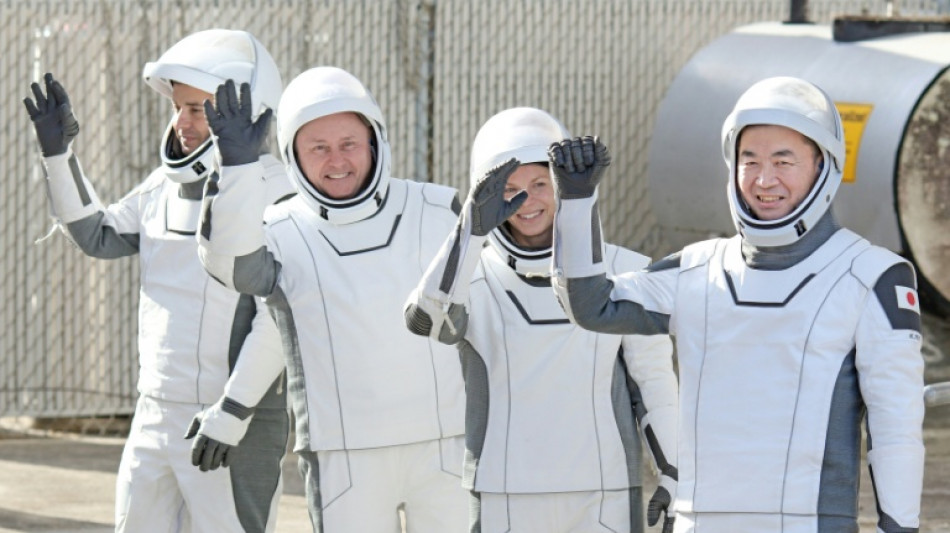
ISS astronauts splash down on Earth after first-ever medical evacuation / Photo: Gregg Newton - AFP/File

ISS astronauts splash down on Earth after first-ever medical evacuation

Four International Space Station crewmembers splashed down in the Pacific Ocean on Thursday, NASA footage showed, after the first ever medical evacuation in the orbital lab's history.

Text size:

A video feed from NASA showed the capsule carrying American astronauts Mike Fincke and Zena Cardman, Russian cosmonaut Oleg Platonov and Japanese astronaut Kimiya Yui land off the coast of San Diego at 12:41 am (0841 GMT).

A health issue prompted their mission to be cut short, after spending five months in space.

The US space agency has declined to disclose any details about the health issue but stressed the return was not an emergency situation.

The affected crewmember "was and continues to be in stable condition," NASA official Rob Navias said Wednesday.

Fincke, the SpaceX Crew-11 pilot, said in a social media post earlier this week: "First and foremost, we are all OK. Everyone on board is stable, safe, and well cared for."

"This was a deliberate decision to allow the right medical evaluations to happen on the ground, where the full range of diagnostic capability exists. It's the right call, even if it's a bit bittersweet."

The Crew-11 quartet arrived at the ISS in early August and had been scheduled to stay onboard the space station until they were rotated out in mid-February with the arrival of the next crew.

James Polk, NASA's chief health and medical officer, said "lingering risk" and a "lingering question as to what that diagnosis is" led to the decision to bring back the crew earlier than originally scheduled.

American astronaut Chris Williams and Russian cosmonauts Sergey Kud-Sverchkov and Sergei Mikaev, who arrived at the station in November aboard a Russian Soyuz spacecraft, remained on the ISS.

The Russian Roscosmos space agency operates alongside NASA on the outpost, and the two agencies take turns transporting a citizen of the other country to and from the orbiter -- one of the few areas of bilateral cooperation that still endure between the United States and Russia.

- Ready for the unexpected -

Continuously inhabited since 2000, the International Space Station seeks to showcase multinational cooperation, bringing together Europe, Japan, the United States and Russia.

Located some 400 kilometers (248.5 miles) above Earth, the ISS functions as a testbed for research that supports deeper space exploration -- including eventual missions to return humans to the Moon and onward to Mars.

The four astronauts who were evacuated had been trained to handle unexpected medical situations, said Amit Kshatriya, a senior NASA official, praising how they have dealt with the situation.

The ISS is set to be decommissioned after 2030, with its orbit gradually lowered until it breaks up in the atmosphere over a remote part of the Pacific Ocean called Point Nemo, a spacecraft graveyard.

J.Marek--TPP