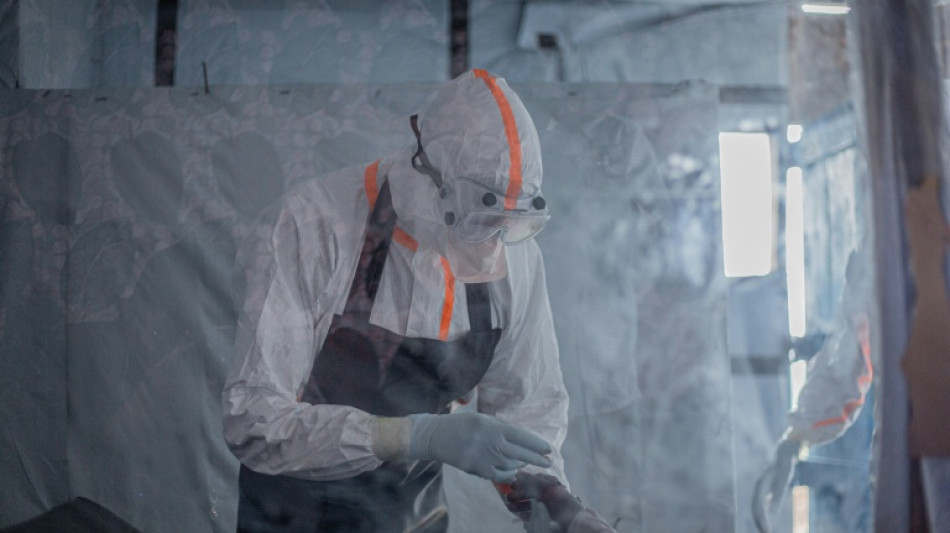
WHO pleads for more support to tackle Ebola outbreak / Photo: BENEDICTION MURHABAZI - AFP
The World Health Organization called Tuesday for more support across to board to combat the Ebola outbreak raging in the Democratic Republic of Congo, which is still outpacing response efforts.
The outbreak is the biggest ever to have hit the DR Congo, despite being declared less than three months ago.
"The outbreak is unfortunately still expanding beyond the capacity of the response," WHO spokesman Tarik Jasarevic told reporters in Geneva.
"We need more support in terms of finances, but also other resources to scale up all areas of response: treatment capacity, field investigation teams, safe burial teams and community workers."
There have been 3,802 confirmed cases of Ebola in the DRC, including 1,707 deaths. A total of 727 patients have recovered, and there are 275 suspected cases under investigation.
A total of 17,000 contacts of cases are being monitored, with more than 80 percent of them receiving daily check-ups.
Though cases have been reported from five provinces, nearly 90 percent are in the northeastern Ituri province, with nearly all the rest in neighbouring North Kivu.
Jasarevic said the response needed to focus on where the virus is spreading now, and where it might go next.
A viral haemorrhagic fever, Ebola spreads through close contact and infected bodily fluids.
The DRC's 17th Ebola outbreak was declared on May 15 after several deaths in Ituri.
The outbreak is driven by the Bundibugyo species of Ebola -- for which there are no proven safe and efficacious treatments for patients, vaccines, or prophylaxis options to stop people exposed to the virus from falling ill.
But various trials are under way of potential therapies, vaccines and post-exposure antiviral drugs.
Vasee Moorthy, who leads the WHO's research and development blueprint arm, said the early indications were promising.
- Vaccine trials -
Moorthy said new data was emerging on whether the Ervebo vaccine, which works against the Zaire species of Ebola, also provided cross-protection against Bundibugyo in animals.
A WHO vaccine advisory group reviewed the data on Friday and will issue recommendations later this week.
The two front-running candidate vaccines are one using the ChAdOx1 platform, being developed by the University of Oxford and the Serum Institute of India, and another being worked on by US pharma firm Moderna using mRNA technology.
The ChAdOx1 jab started a Phase I trial in Britain on July 24, while the Moderna candidate vaccine is set to start Phase I trials in Canada this week, Moorthy said.
They are being tested on ferrets and on monkeys, while at the same time volunteers in Oxford and Canada are being given different doses of the potential vaccine to assess the immune response as well as safety.
Depending on the results, developers will pick the best dose level to take forward to full-scale Phase III human trials.
Two potential treatments are being tested on confirmed Ebola patients in Ituri: the monoclonal antibody MBP134 and the antiviral drug remdesivir, alone and in combination.
Meanwhile a trial is also taking place of the antiviral drug obeldesivir, for people exposed to confirmed Bundibugyo cases.
The trial in Ituri has enrolled more than 25 high-risk contacts "to evaluate whether this oral medicine, given for 10 days, can prevent onset of disease", said Moorthy.
G.Turek--TPP