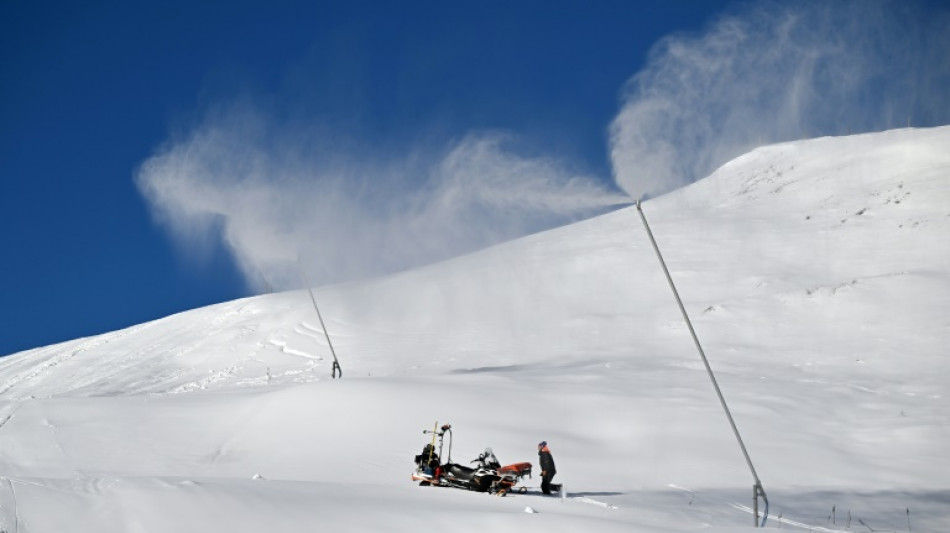
Spiking costs, fading snow squeeze Austrian ski resorts / Photo: KERSTIN JOENSSON - AFP
One of Austria's top ski resorts is making as much artificial snow as possible to lay a thick base on the slopes before its energy bills leap.
Like other spots across the Alps, world-famous Kitzbuehel is being hit by inflation-driven cost hikes, but also warmer winters that are ever less snowy.
"We expect that our power costs will at least double this season," said Anton Bodner, head of the resort's Bergbahn Kitzbuehel company, noting several lower price energy contracts run out by year's end.
"We are talking about millions of euros," he added, while looking over one of the few slopes already open.
The soaring energy bills for Austria's famed ski resorts have translated into pricier tickets, but also shorter hours and reduced service.
"We have no choice but to pass higher power prices on to our customers," Bodner told AFP, adding that they had kept increases below inflation, which stood at 11 percent by October.
Ski resorts like Kitzbuehel will try to save money by trimming opening times, ramping up snowmaking when temperatures are colder and reducing lift capacity to save energy.
Kitzbuehel plans to run its lifts about two hours less per day, opening slightly later and closing earlier.
- Less schnitzel –
But at the end of the day, it's skiers who wind up feeling the pinch and fewer are expected to turn up.
A recently conducted survey was pointing towards significantly fewer holidaymakers this winter season in Austria due to high inflation compared to 2019, said Oliver Fritz, senior economist at the Austrian Institute of Economic Research (WIFO).
"Even if a (winter) vacation is planned, potential guests want to spend less," Fritz said.
Cutting expenses like eating out, shortening holidays or turning to cheaper accommodation or resorts are some of the ways people are dialling back.
"At the restaurant we will only have schnitzel once a week and not twice" like we used to, skiier Klaus Bernert told AFP in Kitzbuehel, which is known for its alpine skiing downhill race.
"Everything has become about 20, 30 percent more expensive. Another 20, 30 percent, and we can no longer afford skiing. Then we would unfortunately have to give up our hobby," the 58-year-old added.
Equipment and season passes for him and another family member "already ate up two to three monthly salaries", he said.
Sabine Huber, a local from a nearby valley, said she expected more and more people to continue to switch to ski touring, a sport where enthusiasts climb the slopes on skis, rendering lift tickets unnecessary.
"I'm lucky that I'm a ski tourer and can practise my sport relatively cheaply. Of course, I know many who are already considering whether or not to buy a ski pass because of high prices," she said.
- Melting profits –
Austria's famous ski resorts are part of its winter tourism industry, which pulled in about 3.9 percent of the country's national GDP in 2019, before the pandemic slashed profits.
Ski resorts are trying to stay optimistic, but it remains to be seen how Alpine tourist destinations across Europe will fare as warming temperatures and inflation threaten their very existence.
"Since 1961, the average annual snow cover duration over the entire area of Austria has decreased by 40 days," said Marc Olefs, head of climate research at Austria's national meteorological and geophysical service ZAMG.
Without measures to cut greenhouse gas-related warming, the duration of natural snow cover at altitudes ranging from 1,500 to 2,500 metres could "decrease by a further 25 percent by 2100", Olefs noted.
And without snowy winters and sub-zero temperatures, both natural and artificial snow will soon be a thing of the past.
"Ski resorts can no longer be operated economically without artificial snow, because the tourism industry simply needs predictability and reliability. With artificial snow, we can guarantee that skiing is possible from the beginning of December until April," said Kitzbuehel's Bodner.
Austria's economy would also suffer considerable damage.
Around 16 of 30 billion euros that the tourism industry generated per year before the pandemic were from the winter season, said Fritz, the economist.
"If Alpine winter tourism is severely affected by climate change, ten billion euros can certainly be regarded as endangered," he said.
V.Nemec--TPP