The Prague Post - Scientists find water inside glass beads on the Moon

EUR -
AED 4.301555
AFN 73.779193
ALL 95.50254
AMD 434.947725
ANG 2.096126
AOA 1075.065432
ARS 1645.082546
AUD 1.630337
AWG 2.109436
AZN 1.994608
BAM 1.958343
BBD 2.358242
BDT 143.985731
BGN 1.953507
BHD 0.441793
BIF 3484.00949
BMD 1.171096
BND 1.495028
BOB 8.090471
BRL 5.857467
BSD 1.17081
BTN 110.635712
BWP 15.835427
BYN 3.303461
BYR 22953.474287
BZD 2.354848
CAD 1.601837
CDF 2719.862066
CHF 0.924341
CLF 0.026513
CLP 1043.587015
CNY 8.007308
CNH 8.00936
COP 4228.919996
CRC 532.586998
CUC 1.171096
CUP 31.034034
CVE 110.55321
CZK 24.353637
DJF 208.127296
DKK 7.471391
DOP 69.387257
DZD 155.154914
EGP 61.875656
ERN 17.566434
ETB 184.301204
FJD 2.59954
FKP 0.864227
GBP 0.866488
GEL 3.156083
GGP 0.864227
GHS 13.046367
GIP 0.864227
GMD 86.067605
GNF 10279.291323
GTQ 8.945539
GYD 244.95807
HKD 9.177584
HNL 31.174087
HRK 7.532518
HTG 153.377846
HUF 363.749909
IDR 20198.998817
ILS 3.461744
IMP 0.864227
INR 110.80872
IQD 1534.135271
IRR 1541161.844741
ISK 143.178241
JEP 0.864227
JMD 184.47954
JOD 0.830277
JPY 186.88871
KES 151.17905
KGS 102.388421
KHR 4696.093159
KMF 493.031138
KPW 1053.981161
KRW 1724.29801
KWD 0.360182
KYD 0.975759
KZT 536.682281
LAK 25699.693433
LBP 104930.167935
LKR 373.211415
LRD 215.188405
LSL 19.36405
LTL 3.457941
LVL 0.708384
LYD 7.430593
MAD 10.839954
MDL 20.250121
MGA 4858.87593
MKD 61.648457
MMK 2459.346894
MNT 4211.675584
MOP 9.451031
MRU 46.843862
MUR 54.784212
MVR 18.093405
MWK 2038.877562
MXN 20.364357
MYR 4.62875
MZN 74.844323
NAD 19.381597
NGN 1604.600006
NIO 42.996808
NOK 10.911244
NPR 177.017339
NZD 1.989475
OMR 0.450263
PAB 1.170815
PEN 4.104394
PGK 5.088118
PHP 71.544577
PKR 326.298528
PLN 4.248325
PYG 7339.467371
QAR 4.256427
RON 5.096138
RSD 117.400013
RUB 88.209772
RWF 1710.385163
SAR 4.392759
SBD 9.399138
SCR 16.400969
SDG 703.245697
SEK 10.859019
SGD 1.494827
SHP 0.874341
SLE 28.83821
SLL 24557.285258
SOS 669.278604
SRD 43.875083
STD 24239.315043
STN 24.885782
SVC 10.245216
SYP 129.463768
SZL 19.382118
THB 38.061004
TJS 10.982661
TMT 4.10469
TND 3.377147
TOP 2.819717
TRY 52.745889
TTD 7.961269
TWD 36.926399
TZS 3053.775937
UAH 51.599359
UGX 4355.618426
USD 1.171096
UYU 46.209607
UZS 14135.124337
VES 566.733541
VND 30856.027577
VUV 138.453487
WST 3.19453
XAF 656.804229
XAG 0.015987
XAU 0.000255
XCD 3.164944
XCG 2.110122
XDR 0.817095
XOF 655.232581
XPF 119.331742
YER 279.482119
ZAR 19.378412
ZMK 10541.265481
ZMW 22.21475
ZWL 377.092314
  • RBGPF

    0.0000

    64

    0%

  • GSK

    0.2500

    54.47

    +0.46%

  • RYCEF

    -0.2000

    15.2

    -1.32%

  • RELX

    -0.3800

    36.01

    -1.06%

  • CMSC

    -0.0300

    22.83

    -0.13%

  • BTI

    1.1500

    58.47

    +1.97%

  • BP

    0.3800

    46.35

    +0.82%

  • RIO

    -1.4600

    98.49

    -1.48%

  • BCE

    -0.0600

    23.5

    -0.26%

  • BCC

    -1.2500

    82.61

    -1.51%

  • NGG

    0.2200

    87.45

    +0.25%

  • AZN

    -0.8300

    186.68

    -0.44%

  • VOD

    -0.0200

    15.49

    -0.13%

  • CMSD

    -0.0600

    23.2

    -0.26%

  • JRI

    -0.0200

    12.81

    -0.16%

Scientists find water inside glass beads on the Moon
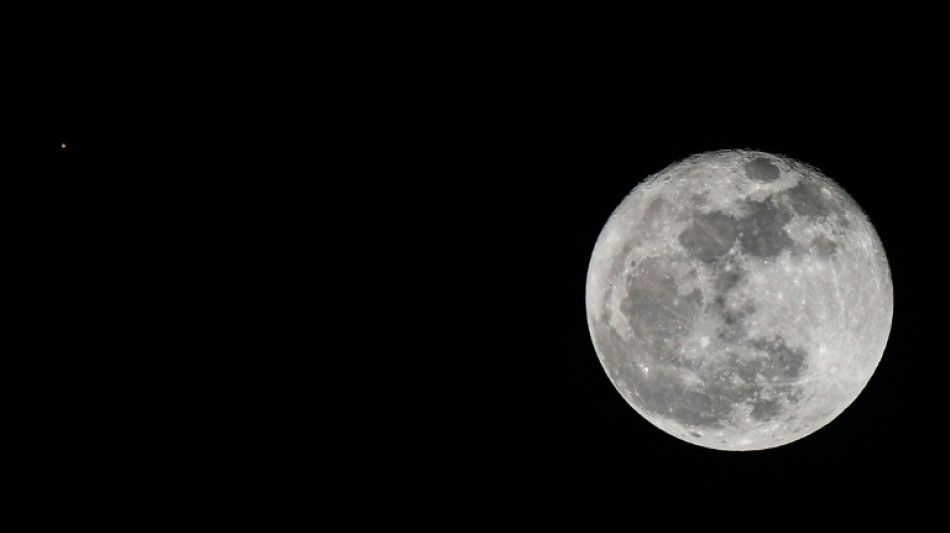
Scientists find water inside glass beads on the Moon / Photo: Luis Acosta - AFP/File

Scientists find water inside glass beads on the Moon

Scientists said Monday they have discovered water inside tiny beads of glass scattered across the Moon, suggesting that one day it could be extracted and used by the "explorers of tomorrow".

Text size:

The Moon was long believed to be dry, but over the last few decades several missions have shown there is water both on the surface and trapped inside minerals.

Mahesh Anand, a professor of planetary science and exploration at the UK's Open University, told AFP that water molecules could be seen "hopping over the lunar surface" when it was sunny.

"But we didn't know where exactly it was coming from," said Anand, a co-author of a new study published in the journal Nature Geoscience.

The study, carried out by a team led by the Chinese Academy of Sciences, said that the glass beads are "probably the dominant reservoir involved in the lunar surface water cycle".

The team polished and analysed 117 glass beads which were scooped up by China's Chang'e-5 spacecraft in December 2020 and brought back to Earth.

The beads are formed by tiny meteorites that bombard the surface of the Moon, which lacks the protection of an atmosphere.

The heat of the impact melts the surface material, which cools into round glass beads around the width of a strand of hair.

As well as finding water in the beads, the scientists detected "a telltale signature of the Sun," Anand said.

Investigating further, they determined that the hydrogen necessary to make up the water was coming from solar wind, which sweeps charged particles across the Solar System.

- 'Sustainable' source of water? -

The other ingredient for water, oxygen, makes up nearly half of the Moon, though it is trapped in rocks and minerals.

This means that solar wind could be equally contributing to water on other bodies in the Solar System lacking an atmosphere, such as Mercury or asteroids, Anand said.

The glass beads may make up around three to five percent of lunar soil, according to the study.

A "back of the envelope" calculation suggested that there could be around a third of a trillion tonnes of water inside all the Moon's glass beads, he added.

And it only takes mild heat of around 100 degrees Celsius (210 Fahrenheit) to liberate the water from the beads, Anand said.

While much more research is needed, he said that heating and processing these materials could supply the "explorers of tomorrow" with water -- or even oxygen -- to help them search "other worlds in a sustainable, responsible manner".

The European Space Agency's robotic drill PROSPECT, scheduled to launch for the Moon in 2025, could be the first to be able to collect and extract water in such a way, Anand said.

NASA's VIPER mission, planned to launch late next year, will head to the Moon's South Pole aiming to analyse water ice.

And in the coming years NASA's Artemis mission plans to return humans to the lunar surface for the first time since 1972.

U.Pospisil--TPP