The Prague Post - India population to surpass China mid-year

EUR -
AED 4.174101
AFN 75.014707
ALL 93.659818
AMD 416.186309
AOA 1043.383324
ARS 1701.382878
AUD 1.631908
AWG 2.048691
AZN 1.935652
BAM 1.954327
BBD 2.293382
BDT 140.564053
BHD 0.429082
BIF 3401.381175
BMD 1.136583
BND 1.468912
BOB 12.815341
BRL 5.815781
BSD 1.138647
BTN 109.149731
BWP 15.633354
BYN 3.266424
BYR 22277.03319
BZD 2.290124
CAD 1.605037
CDF 2568.678471
CHF 0.931087
CLF 0.027161
CLP 1068.968346
CNY 7.690234
CNH 7.693129
COP 3643.84068
CRC 518.209411
CUC 1.136583
CUP 30.119458
CVE 110.181953
CZK 24.161372
DJF 202.76806
DKK 7.475223
DOP 66.250066
DZD 151.670121
EGP 57.661603
ERN 17.04875
ETB 182.083249
FJD 2.537653
FKP 0.853163
GBP 0.855432
GEL 2.978122
GGP 0.853163
GHS 13.25401
GIP 0.853163
GMD 84.107184
GNF 9990.777334
GTQ 8.688451
GYD 238.130515
HKD 8.913371
HNL 30.551393
HRK 7.53464
HTG 148.849772
HUF 360.221932
IDR 20566.475284
ILS 3.48323
IMP 0.853163
INR 108.89889
IQD 1488.924157
IRR 1562944.145828
ISK 142.583868
JEP 0.853163
JMD 180.14422
JOD 0.805871
JPY 186.093928
KES 147.312107
KGS 99.393974
KHR 4599.593863
KMF 492.14044
KRW 1661.582213
KWD 0.352773
KYD 0.948876
KZT 541.077415
LAK 25809.31973
LBP 101967.195961
LKR 382.888038
LRD 206.094661
LSL 19.083094
LTL 3.356036
LVL 0.687508
LYD 7.279861
MAD 10.647489
MDL 20.011741
MGA 4898.674156
MKD 61.478662
MMK 2386.301133
MNT 4082.06367
MOP 9.197287
MRU 45.456338
MUR 53.976172
MVR 17.571848
MWK 1973.108647
MXN 19.864634
MYR 4.646375
MZN 72.63927
NAD 19.082945
NGN 1553.527673
NIO 41.763734
NOK 10.993258
NPR 174.63937
NZD 1.971819
OMR 0.437018
PAB 1.138642
PEN 3.868925
PGK 4.995245
PHP 70.062976
PKR 315.811189
PLN 4.323472
PYG 6885.840245
QAR 4.142279
RON 5.23135
RSD 117.396569
RUB 88.654259
RWF 1665.094573
SAR 4.259901
SBD 9.166144
SCR 15.938257
SDG 682.517999
SEK 11.062149
SGD 1.46942
SLE 27.562012
SOS 650.709542
SRD 42.884437
STD 23524.980096
STN 24.891175
SVC 9.963403
SZL 19.077578
THB 38.262507
TJS 10.509878
TMT 3.989407
TND 3.369934
TRY 53.849727
TTD 7.733103
TWD 36.865083
TZS 3000.572078
UAH 51.139305
UGX 4275.77723
USD 1.136583
UYU 45.725535
UZS 13648.092807
VES 843.210697
VND 29928.51214
VUV 135.35381
WST 3.132788
XAF 655.46296
XAG 0.019876
XAU 0.000281
XCD 3.071674
XCG 2.052135
XDR 0.815193
XOF 651.832844
XPF 119.331742
YER 270.677493
ZAR 19.098754
ZMK 10230.618997
ZMW 21.276431
ZWL 365.979367
  • RBGPF

    0.0000

    66

    0%

  • JRI

    -0.1500

    12.91

    -1.16%

  • CMSC

    0.0250

    21.75

    +0.11%

  • NGG

    -1.0900

    81.21

    -1.34%

  • GSK

    0.6300

    51.98

    +1.21%

  • RYCEF

    0.5600

    18.73

    +2.99%

  • BCC

    0.3800

    78.22

    +0.49%

  • CMSD

    0.0700

    22.05

    +0.32%

  • RIO

    0.7300

    91.95

    +0.79%

  • BCE

    -0.0600

    21.24

    -0.28%

  • RELX

    1.2400

    35.65

    +3.48%

  • VOD

    0.6500

    15.8

    +4.11%

  • AZN

    0.3800

    169.64

    +0.22%

  • BP

    -1.5100

    42.31

    -3.57%

  • BTI

    -0.1400

    60.82

    -0.23%

India population to surpass China mid-year
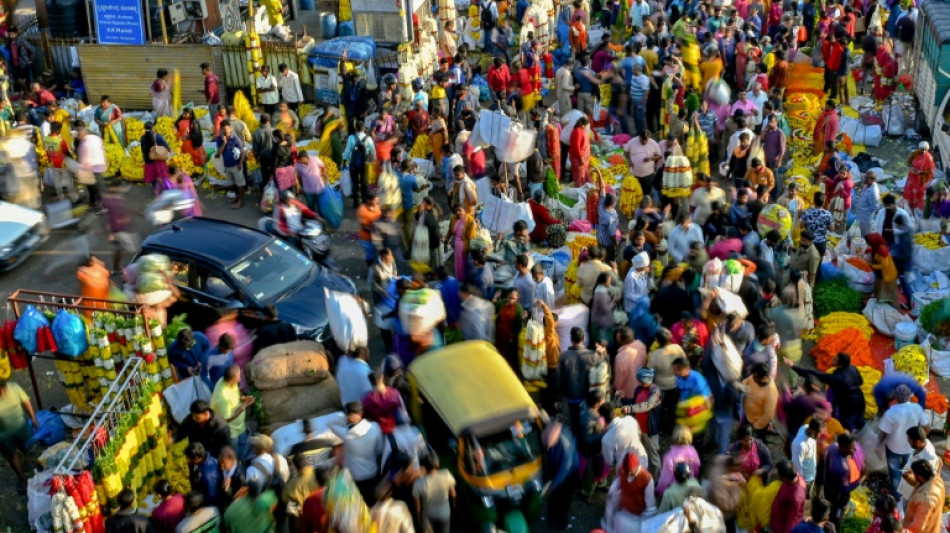
India population to surpass China mid-year / Photo: Manjunath KIRAN - AFP/File

India population to surpass China mid-year

India is set to overtake China as the world's most populous country by mid-year with almost three million more people, UN estimates showed on Wednesday.

Text size:

India's population will be 1.4286 billion compared to China's 1.4257 billion at mid-year, the United Nations Population Fund's State of World Population report showed.

The number of people in China shrank last year for the first time since 1960, when millions starved to death under the disastrous agricultural policies of former leader Mao Zedong.

Many have blamed the slowdown on the soaring cost of living as well as the growing number of women going into the workforce and seeking higher education.

Beijing ended its strict "one-child policy", imposed in the 1980s amid overpopulation fears, in 2016 and started letting couples have three children in 2021.

China faces a looming demographic decline as birth rates plunge and its workforce ages.

Several regions have also announced plans to boost birth rates –- but official efforts have so far failed to reverse the decline.

India has no recent official data on how many people it has because it has not conducted a census since 2011.

India's once in a decade census was due to be held in 2021 but was delayed due to the coronavirus pandemic.

It is now bogged down by logistical hurdles and political reluctance, making it unlikely the massive exercise will begin anytime soon.

Critics say the government is deliberately delaying the census to hide data on contentious issues such as unemployment ahead of national elections next year.

The Indian economy under Prime Minister Narendra Modi is struggling to provide jobs for the millions of young people entering the job market every year.

Half of the population of the Asian giant are under 30.

The country also faces huge challenges providing electricity, food and housing for its growing population, with many of its huge cities already struggling to cope.

According to the Pew Research Centre, India's population has grown by more than one billion people since 1950, the year the UN began gathering population data.

- 8 billion -

The new UN report also estimated that the global population will have hit 8.045 billion by mid-2023.

Other countries, mostly in Europe and Asia, can expect a demographic slump over the coming decades, according to other UN figures published last July which forecast how the world's population will develop between now and 2100.

A different picture is emerging in Africa, where the population is expected to rise from 1.4 to 3.9 billion inhabitants by 2100, with some 38 percent of Earth dwellers living there, against around 18 percent today.

Eight nations of more than 10 million inhabitants, most of them in Europe, saw their populations shrink over the past decade.

Japan is also seeing a decline due to its ageing population, losing more than three million inhabitants between 2011 and 2021.

The population of the entire planet, meanwhile, is only expected to decline in the 2090s, after peaking at 10.4 billion, according to the UN.

G.Kucera--TPP