Belgium learns to share its beaches with sleepy seals / Photo: John THYS - AFP
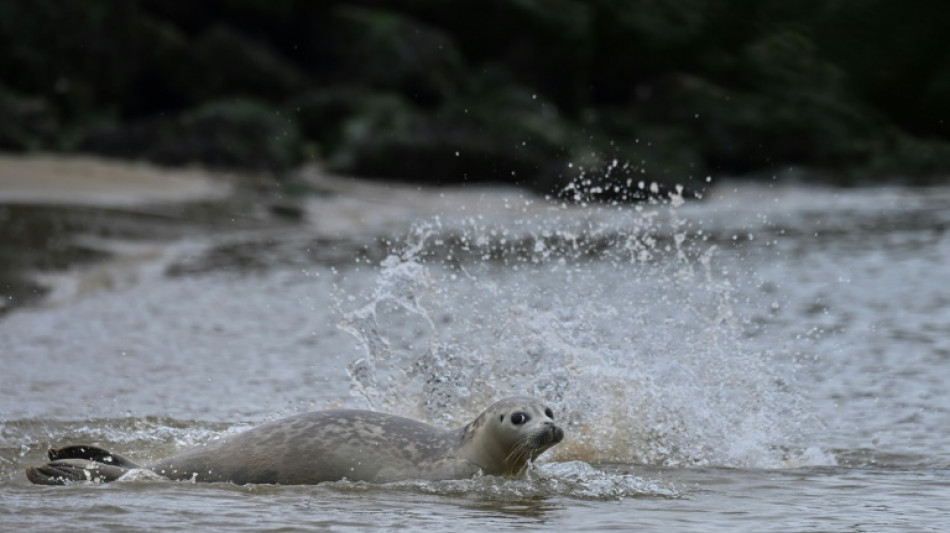
Visitors to Belgium's coast are having to get used to North Sea visitors not seen for a while -- dozens of seals that are using the short sandy coastline as a resting place.
The reason? During the long period of Covid restrictions between early 2020 and early 2022, the sea mammals found the sandy stretches to be calm, without the usual crowds of people.
Now with people returning, and ahead of what could be a bumper summer season, the challenge for Belgian animal protection groups is to educate the public on how to coexist with dozens of seals getting some downtime.
The exact number of the seals using the coast is hard to pin down but is probably between 100 and 200, according to Kelle Moreau, a marine biologist who is spokesman for the Royal Belgian Institute of Natural Sciences.
The two species that waddle up here are grey seals, whose adults can weigh 300 kilogrammes (660 pounds), and common or harbour seals, a smaller mammal that weighs up to 165 kilogrammes.
The beaches, though, are essential for seal pups, which hang back in relative safety on land until they get hungry enough that instinct pushes them to go into the sea to find food.
That is why, Moreau explained, it is vital that humans do not feed them.
"At the start of the lives, the pups have to spend a few days on the beach until they get hungry. If someone feeds them, they won't go into the sea and learn how to hunt," he said.
To keep beachgoers at bay, volunteers rope off areas that seals are using.
In one spot near Belgium's main coastal town of Ostend, a dozen people stand behind a rope fascinated by two seals on the sand.
Around these zones, volunteers with the North Seal Team wearing orange fluorescent vests tell people that dogs have to be kept on a leash.
"We take turns all day long, from seven in the morning to 10 or 11 at night," Inge de Bruycker, founder of the group, tells AFP in between calling out to curious passers-by to be less noisy.
The seals "need to be left alone because they get very stressed very quickly.
"And when you go near them, if they go swimming again they can drown. If they are tired, they can drown."
Keeping dogs away is important, she said, because "seals have bitten some dogs, and dogs have bitten some seals"
"We don't want that happening to people, especially not to children."
- Injured seals -
North Seal Team, created soon after Covid restrictions were imposed in Belgium, worked with Ostend municipal authorities to devise rules for behaviour around beached seals, notably on giving the animals 30 metres (yards) of safe distance.
For the seagoing mammals, the return of people to coastline they had thought deserted is an adjustment.
"The seals became used to coming to rest up on the beaches and people are generally happy when they see them. They want to pet them, take selfies with them," said Moreau, who works for the Belgium natural sciences institute.
Some people have mistakenly thought the seals were inadvertently beached and tried to push them back into the sea. "But these are wild animals!" he said.
In some cases, however, the seals do need direct human care.
That is the role of the Seal Rehabilitation Center.
It is located in the Sea Life Blankenberge aquarium, some 20 kilometres (12 miles) from Ostend.
North Seal Team volunteers contact it through WhatsApp groups when they come across a seal that might need attention.
Increasing numbers of people walking the beaches also get in touch.
"They send us images of the animal and we decide if we need to step in or not," said Steve Vermote, head of Sea Life Blanenberge.
"We are actually having more interventions because some seals are perfectly fine to actually survive in the wild and they might have a minor wound, but we see seals with bigger wounds these days."
Most of the treated animals are released after two months. But some, like a blind female named Lily, are taken in indefinitely.
Last year, the centre treated a dozen grey seals and three harbour seals.
It also gave care to several seals with neck wounds, probably caused by a type of fixed fishing net that is not easy for them to spot.
The Royal Institute of Natural Sciences says those types of nets were the cause of dozens of seal deaths in 2021, which led to Belgium banning them for recreational fishing.
Last year, the remains of 54 seals were counted on Belgian beaches, according to the institute, noting that that was half the number from 2021.
For Moreau, that is an indication that the new ban is working, and that humans and seals are able to find ways to coexist.
X.Vanek--TPP