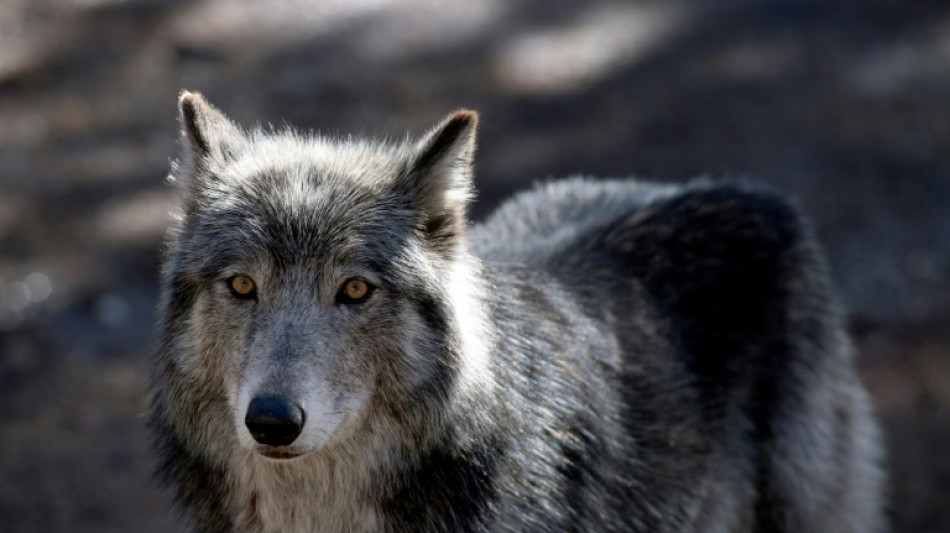
Like dogs, wolves recognize familiar human voices / Photo: Jason Connolly - AFP/File
Here, wolfie, wolfie, wolfie!
Like dogs, wolves recognize and respond to the voices of familiar humans more than strangers, according to a study that has implications both for the story of canine domestication and our broader understanding of the natural world.
Holly Root‑Gutteridge of the University of Lincoln, a co-author of the paper that appeared in Animal Cognition this week, told AFP a longstanding theory held that dogs' ability to distinguish human voices was a consequence of generations of selective breeding.
"So we wanted to look at wolves, because obviously nobody has been selecting so that wolves can recognize human voices," she said.
Root‑Gutteridge and colleagues carried out experiments across five zoos and wildlife parks in Spain, involving a total of 24 gray wolves, both male and female, aged between one and 13.
The team set up speakers and first played the animals the voice of a number of strangers that they would "habituate" to, in other words, get bored of, because they decided it was not salient to them.
Then, they played the wolves the voice of their keeper who would say familiar things to them in Spanish, such as "Hey, what's up wolves?" or "Hello little ones, good morning, how's it going?"
In gestures that would be instantly recognizable to any dog owner, the wolves raised their heads, pricked their ears up, and turned towards the speaker.
To test the effect wasn't random, the researchers went back to playing the wolves recordings of strangers, and found they once more lost interest.
Finally, to make sure the wolves genuinely knew their keepers' voices, rather than just knowing words that the familiar humans would normally say to them, the team mixed things up and had the keepers utter a stream of unfamiliar phrases.
Once more the results held up.
- 'Listening to us' -
The fact that the wolves engaged with disembodied voices played through speakers echoes what's been seen in dogs from the era of gramophones -- as captured in a famous painting entitled "His Master's Voice" -- to today's video doorbells, though it's not yet known whether our pooches enjoy this or it frustrates them.
In terms of implications, Root‑Gutteridge said it was significant that wolves possessed the ability to distinguish between humans despite the fact that our species went our separate evolutionary ways tens of millions of years ago.
Before this, there had been limited study on the topic of how animals differentiate between the vocalizations of other species. Research had shown our close cousins, gorillas listen to people, but that was expected.
Big-brained elephants have also been found to distinguish the gender, age, and ethnicity of humans by their voices, assigning less threat value, for example, to women and children, in addition to being more fearful of the elephant-spearing Maasai than the agrarian Kamba.
Given the new finding, "chances are, lots of species are listening to us and getting to know us as individuals," Root‑Gutteridge said.
And it's not all about us, she said. Dogs could be listening to the neighbors' cats and understanding the difference between one meow or the other, for example.
"If the abilities are that general, it means that animals might be having a lot more cross species interactions than we had thought about before."
K.Pokorny--TPP