The Prague Post - Bangladesh major hub for tiger poaching: study

EUR -
AED 4.300395
AFN 73.771059
ALL 95.492494
AMD 434.89817
ANG 2.095907
AOA 1074.953577
ARS 1644.938934
AUD 1.634616
AWG 2.109216
AZN 1.987981
BAM 1.958138
BBD 2.357996
BDT 143.970693
BGN 1.953303
BHD 0.441779
BIF 3483.645619
BMD 1.170973
BND 1.494872
BOB 8.089626
BRL 5.850417
BSD 1.170688
BTN 110.624157
BWP 15.833773
BYN 3.303116
BYR 22951.07702
BZD 2.354602
CAD 1.60219
CDF 2719.585571
CHF 0.923494
CLF 0.026528
CLP 1044.062825
CNY 8.006471
CNH 8.006964
COP 4232.635282
CRC 532.531374
CUC 1.170973
CUP 31.030793
CVE 110.541334
CZK 24.360698
DJF 208.105235
DKK 7.473618
DOP 69.380325
DZD 155.173427
EGP 61.862199
ERN 17.5646
ETB 184.281899
FJD 2.576488
FKP 0.864136
GBP 0.866514
GEL 3.155807
GGP 0.864136
GHS 13.044631
GIP 0.864136
GMD 86.133089
GNF 10278.215614
GTQ 8.944605
GYD 244.932486
HKD 9.177327
HNL 31.171228
HRK 7.533928
HTG 153.361827
HUF 363.996829
IDR 20276.573963
ILS 3.461361
IMP 0.864136
INR 110.910966
IQD 1533.975046
IRR 1541000.885095
ISK 143.198065
JEP 0.864136
JMD 184.460273
JOD 0.830222
JPY 186.903149
KES 151.176503
KGS 102.377731
KHR 4695.603381
KMF 492.97925
KPW 1053.871083
KRW 1728.280527
KWD 0.36018
KYD 0.975657
KZT 536.626229
LAK 25697.009943
LBP 104850.588697
LKR 373.172437
LRD 215.166524
LSL 19.362015
LTL 3.45758
LVL 0.70831
LYD 7.429809
MAD 10.838821
MDL 20.248006
MGA 4858.368407
MKD 61.641492
MMK 2459.090039
MNT 4211.235716
MOP 9.450044
MRU 46.838679
MUR 54.777669
MVR 18.091763
MWK 2038.664498
MXN 20.372418
MYR 4.626554
MZN 74.836877
NAD 19.379494
NGN 1610.04165
NIO 42.992293
NOK 10.920567
NPR 176.998852
NZD 1.998887
OMR 0.450237
PAB 1.170693
PEN 4.117123
PGK 5.087586
PHP 72.020714
PKR 326.379512
PLN 4.249872
PYG 7338.700835
QAR 4.266148
RON 5.09561
RSD 117.421743
RUB 88.20729
RWF 1710.20653
SAR 4.392081
SBD 9.398156
SCR 16.001437
SDG 703.173879
SEK 10.855111
SGD 1.495093
SHP 0.87425
SLE 28.835202
SLL 24554.720488
SOS 669.207686
SRD 43.870506
STD 24236.783483
STN 24.883183
SVC 10.244146
SYP 129.450246
SZL 19.37966
THB 38.18662
TJS 10.981514
TMT 4.104261
TND 3.376795
TOP 2.819423
TRY 52.775901
TTD 7.960438
TWD 36.947137
TZS 3053.456924
UAH 51.59397
UGX 4355.163524
USD 1.170973
UYU 46.204781
UZS 14133.64802
VES 567.475409
VND 30855.146912
VUV 138.439027
WST 3.194196
XAF 656.735632
XAG 0.015868
XAU 0.000255
XCD 3.164614
XCG 2.109902
XDR 0.817009
XOF 655.16
XPF 119.331742
YER 279.452944
ZAR 19.385053
ZMK 10540.165858
ZMW 22.21243
ZWL 377.05293
  • CMSD

    -0.0600

    23.2

    -0.26%

  • NGG

    0.2200

    87.45

    +0.25%

  • CMSC

    -0.0300

    22.83

    -0.13%

  • JRI

    -0.0200

    12.81

    -0.16%

  • RIO

    -1.4600

    98.49

    -1.48%

  • BCC

    -1.2500

    82.61

    -1.51%

  • BCE

    -0.0600

    23.5

    -0.26%

  • GSK

    0.2500

    54.47

    +0.46%

  • BTI

    1.1500

    58.47

    +1.97%

  • AZN

    -0.8300

    186.68

    -0.44%

  • RBGPF

    -0.5300

    63.47

    -0.84%

  • RYCEF

    -0.1000

    15.3

    -0.65%

  • VOD

    -0.0200

    15.49

    -0.13%

  • RELX

    -0.3800

    36.01

    -1.06%

  • BP

    0.3800

    46.35

    +0.82%

Bangladesh major hub for tiger poaching: study
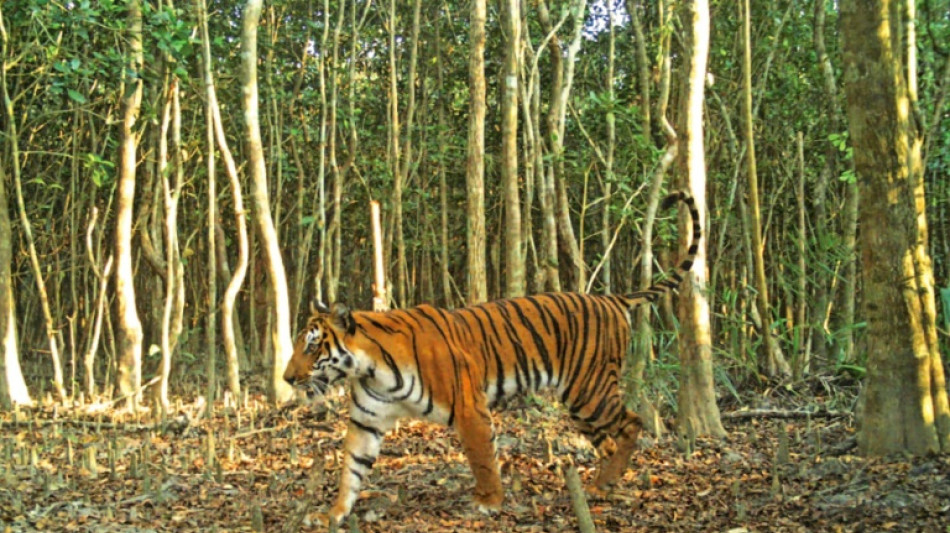
Bangladesh major hub for tiger poaching: study / Photo: Handout - BANGLADESH FOREST DEPARTMENT/AFP/File

Bangladesh major hub for tiger poaching: study

Bangladesh remains a major hub for the poaching of endangered tigers despite government claims of a successful crackdown on pirate groups involved in the trade, according to research published Friday.

Text size:

The vast Sundarbans mangrove forest straddling India and Bangladesh hosts one of the world's largest populations of Bengal tigers.

Their pelts, bones and flesh are bought by black marketeers as part of a broader illegal wildlife trade valued at an estimated $20 billion globally each year.

Research from big cat conservation group Panthera and the Chinese Academy of Sciences said tiger parts harvested in the Sundarbans have been exported to 15 countries, with India and China being the most common destinations.

"Bangladesh plays a much more significant role in the illicit tiger trade than we previously realized," study co-author Rob Pickles said in a statement.

Pirate groups operating in the Sundarbans found a lucrative trade in tiger poaching before a government crackdown starting in 2016.

At least 117 pirates were shot dead and hundreds more were detained, according to official figures, while many others surrendered as part of a government amnesty.

But Panthera's research, published in the Conservation Science and Practice journal, said that the vacuum created by the crackdown had been filled by more than 30 specialist tiger poaching syndicates and opportunistic poachers.

Traders operated through their own logistics companies and in some cases concealed their activities through licenses for legal wildlife trade, the study added.

The research, based partly on interviews with those involved in the wildlife trade, also found that domestic consumption of tiger parts had increased since the crackdown, owing to Bangladesh's burgeoning economy.

Wealthy local buyers were purchasing medicines using tiger parts "as well as large ornamental items for display such as skulls and skins", the study said.

The findings were disputed by Bangladesh's official Sundarbans conservator Abu Naser Mohsin Hossain, who said the crackdown had brought the illicit trade to a standstill.

"We have taken measures to conserve the Bengal tiger population in the Sundarbans," he told AFP.

"No tiger has died from... tiger-human conflict in the past five years. Tiger sightings have increased."

Just 114 Bengal tigers live in Bangladesh's portion of the Sundarbans, according to an official census published in 2019 -- up slightly since a record low four years prior.

An updated population count is due to be published next year.

Poaching is the number one threat to tigers globally, and China is the biggest overall driver of demand, largely for use of their body parts in traditional medicine, according to Panthera.

Y.Havel--TPP