The Prague Post - Key Spanish lagoon dries out due to drought, overexploitation

EUR -
AED 4.182614
AFN 75.167292
ALL 93.902616
AMD 417.452931
AOA 1045.510427
ARS 1708.080292
AUD 1.632807
AWG 2.052867
AZN 1.934662
BAM 1.960456
BBD 2.293638
BDT 140.5839
BHD 0.429418
BIF 3406.074805
BMD 1.1389
BND 1.473193
BOB 12.976821
BRL 5.847793
BSD 1.1388
BTN 109.079596
BWP 15.68719
BYN 3.266744
BYR 22322.439964
BZD 2.29034
CAD 1.606618
CDF 2573.91431
CHF 0.932083
CLF 0.027043
CLP 1064.32451
CNY 7.70591
CNH 7.71078
COP 3650.071993
CRC 518.12833
CUC 1.1389
CUP 30.18085
CVE 110.527514
CZK 24.169792
DJF 202.405585
DKK 7.474959
DOP 66.347582
DZD 151.856354
EGP 57.513425
ERN 17.0835
ETB 183.805055
FJD 2.539462
FKP 0.856083
GBP 0.856971
GEL 2.984175
GGP 0.856083
GHS 13.266509
GIP 0.856083
GMD 84.278841
GNF 9995.740856
GTQ 8.687596
GYD 238.205762
HKD 8.930599
HNL 30.507458
HRK 7.533595
HTG 148.832839
HUF 359.702775
IDR 20606.117666
ILS 3.484584
IMP 0.856083
INR 108.869102
IQD 1491.843273
IRR 1566129.859978
ISK 142.202809
JEP 0.856083
JMD 180.338321
JOD 0.807457
JPY 186.558657
KES 147.544381
KGS 99.597067
KHR 4603.914532
KMF 493.143631
KRW 1654.707165
KWD 0.353708
KYD 0.94895
KZT 544.641185
LAK 25810.301975
LBP 101977.706962
LKR 382.6789
LRD 206.118647
LSL 19.136667
LTL 3.362876
LVL 0.688909
LYD 7.306353
MAD 10.683174
MDL 20.156786
MGA 4880.59188
MKD 61.666192
MMK 2391.889523
MNT 4095.292812
MOP 9.197946
MRU 45.553193
MUR 54.086562
MVR 17.607592
MWK 1974.690081
MXN 19.858589
MYR 4.660351
MZN 72.787059
NAD 19.136752
NGN 1555.043387
NIO 41.909355
NOK 11.051509
NPR 174.527754
NZD 1.967706
OMR 0.437901
PAB 1.138805
PEN 3.87639
PGK 5.021928
PHP 70.016128
PKR 316.324501
PLN 4.32446
PYG 6850.270057
QAR 4.15146
RON 5.229715
RSD 117.390986
RUB 89.6864
RWF 1669.457795
SAR 4.269837
SBD 9.184827
SCR 15.384259
SDG 683.910885
SEK 11.04188
SGD 1.471681
SLE 27.618086
SOS 650.842958
SRD 43.109076
STD 23572.930532
STN 24.55822
SVC 9.964667
SZL 19.139374
THB 38.164723
TJS 10.493824
TMT 3.997539
TND 3.381216
TRY 53.953907
TTD 7.745362
TWD 36.878266
TZS 3014.102283
UAH 51.211933
UGX 4299.192125
USD 1.1389
UYU 45.748658
UZS 13722.59249
VES 844.929468
VND 29992.931451
VUV 135.718863
WST 3.133123
XAF 657.515777
XAG 0.019936
XAU 0.000283
XCD 3.077934
XCG 2.052366
XDR 0.816854
XOF 657.518671
XPF 119.331742
YER 271.228836
ZAR 19.006954
ZMK 10251.494404
ZMW 21.295579
ZWL 366.725335
  • RYCEF

    -0.0700

    18.8

    -0.37%

  • RBGPF

    0.0000

    66

    0%

  • CMSC

    0.1596

    21.88

    +0.73%

  • NGG

    -0.0600

    81.15

    -0.07%

  • VOD

    0.5600

    16.36

    +3.42%

  • RIO

    -0.4200

    91.53

    -0.46%

  • AZN

    1.7300

    171.37

    +1.01%

  • BTI

    1.4100

    62.23

    +2.27%

  • GSK

    1.7300

    53.71

    +3.22%

  • BCE

    0.5700

    21.81

    +2.61%

  • RELX

    2.1550

    37.805

    +5.7%

  • CMSD

    0.0500

    22.1

    +0.23%

  • BCC

    2.0700

    80.29

    +2.58%

  • JRI

    0.0200

    12.93

    +0.15%

  • BP

    -0.5300

    41.78

    -1.27%

Key Spanish lagoon dries out due to drought, overexploitation
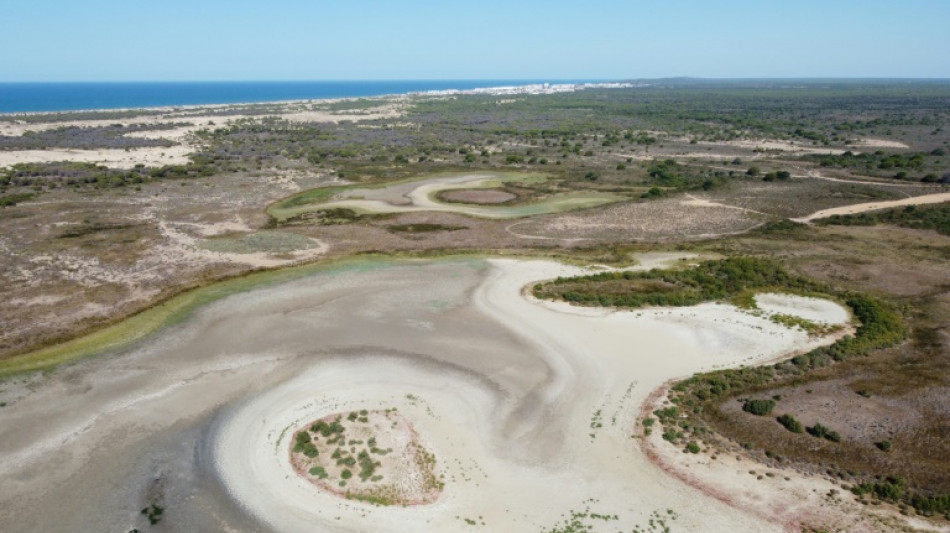
Key Spanish lagoon dries out due to drought, overexploitation / Photo: - - Spanish National Research Council (CSIC)/AFP

Key Spanish lagoon dries out due to drought, overexploitation

The largest permanent lagoon in drought-hit southern Spain's Donana natural park, home of one of Europe's largest wetlands, has completely dried out for the second summer in a row.

Text size:

A huge patch of cracked white earth has replaced the waters of the Santa Olalla lagoon, which usually houses abundant aquatic life and huge colonies of migrating birds.

The lagoon -- which once covered around 45 hectares (110 acres) -- has been shrinking in recent years but this is the first time that it has dried out for two consecutive years, according to the Spanish National Research Council (CSIC).

Scientists blame the lagoon's disappearance on a prolonged drought combined with the overexploitation of aquifers for farming and tourism.

"Recent years have been very dry, which is not rare for a Mediterranean climate," Carmen Diaz Paniagua, a researcher at the Donana Biological Station, told AFP.

Most lagoons in the reserve are temporary, filling with rainwater in winter and then drying out in the summer but a few contain water year-round, providing an important refuge for animal life.

"The real problem is the mismanagement of the aquifers. We don't even know how much water is being extracted because there are many illegal wells," she added.

The Donana national park is surrounded by a sea of greenhouses and the Matalascanas resort town is located less than a kilometre from the northernmost lagoons of the reserve.

"This is not a natural thing happening only because of climate change. It can be reversed, if we can reduce the water extractions the lagoon could resist," said Diaz Paniaga.

Water use restrictions are in place on other parts of Spain but that is not the case in towns near Donana where beaches still operate showers, she added.

The Dona reserve boasts marshlands, scrub woodland and beaches and is home to deer, badgers and endangered species including the Spanish imperial eagle and the Iberian lynx.

But at the Santa Olalla lagoon where wild horses once drank water surrounded by storks and flamingos, they now graze alone on the few tufts of grass they find growing from the cracked earth.

Despite warnings from UNESCO and the European Commission, the conservative regional government of Andalusia where Donana is located is pushing to extend irrigation rights near the park.

A draft law currently making its way through the regional parliament would regularise hundreds of hectares of berry farmland currently irrigated by illegal wells.

Defenders of the proposal argue it will aid those who unfairly missed out during a previous regularisation of farms in the area put in place in 2014 under a Socialist government.

"The water management policy is really not conducive to the conservation of Donana's lagoons," said Diaz Paniagua.

G.Turek--TPP