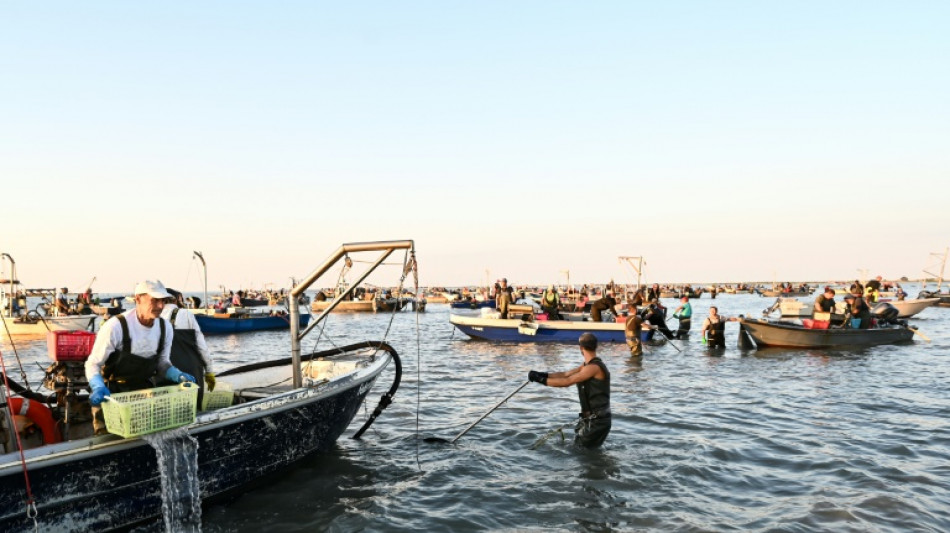
Italy's clam farmers fear blue crab 'invasion' / Photo: Piero CRUCIATTI - AFP
In the shallow waters of the Scardovari lagoon, fishermen catch clams for Italy's beloved spaghetti alle vongole, alongside mussels and oysters. But an invader risks putting them out of business.
The blue crab, native to the North American Atlantic coast, has been present across the Mediterranean for years but in recent months has become a serious problem on Italy's northeastern coast.
"The blue crabs are eating everything. This stretch of lagoon is becoming a desert," said Gianluca Travaglia, a 52-year-old farmer of mussels and clams.
He is the third generation of his family to have a boat on the "Sacca degli Scardovari", an economically important part of the delta where the Po River reaches the Adriatic Sea.
"Every day we fish more of them... I don't know what to do," Travaglia told AFP as he guided his motorboat across the water.
His fellow farmers had the same issue, he added.
"They can't even lower their nets anymore because the crabs swim into the nets and break them."
- 'Critical situation' -
Italy's government allocated 2.9 million euros ($3.2 million) last week to address what Agriculture Minister Francesco Lollobrigida called a "critical situation".
The money will provide "economic incentives" for those catching and disposing of the crabs, which he said lack natural predators in Italian waters.
Business lobby Coldiretti has described the phenomenon as a crab "invasion", driven by warming waters and climate change.
Across the Italian seabed, the crabs are "exterminating clams, mussels, eggs, other fish and molluscs, putting at risk the survival of 3,000 businesses in the Po Delta", Coldiretti said.
From their American origins, the "callinectes sapidus" has spread around the world, likely transported via ballast water from ships.
They have thrived in the Mediterranean Sea, which is warming due to climate change.
For years, fishermen from Albania to France and Spain have grappled with the spread of the blue crab, which is disrupting the natural balance of native populations.
Excellent swimmers and weighing up to one kilogram (2.2 pounds), they eat almost everything, while their sharp, blue-tinted claws are particularly adept at prying open clam shells.
- Crab spaghetti -
In Eraclea, outside Venice, restaurateur Luca Faraon is among a number of cooks seeking to explore how to use this new, tasty resource.
"With the blue crab, you can prepare many foods," said the 58-year-old, as diners tucked into crab spaghetti the chef prepared using garlic, cherry tomatoes and parsley.
"We are still thinking about how to use it as a dessert!" Faraon added.
The crab -- whose Latin name is said to mean "savoury beautiful swimmer" -- is a prized catch in the Chesapeake Bay on the United States' East Coast, where it is known as the Maryland blue crab.
After a meeting with the industry last week, Italian minister Lollobrigida said the problem might be an opportunity, citing potential markets in the United States and China.
"Blue crabs are a great resource," he said, emphasising their high levels of vitamin B12.
- 'Devouring clams' -
Yet Emanuele Rossetti, a biologist with the Polesine fishing consortium, one of Europe's largest shellfish farming associations, is pessimistic.
Clams were the core business of members of his group, and the molluscs cannot exist alongside large numbers of blue crabs, he said.
Although the crabs have been in the lagoon for about 15 years, there has been an "exponential" increase in recent months, Rossetti said.
He warned that the rate at which they were feasting on clams posed an immediate threat.
"I am sure that after December the fishermen of our consortium will no longer have any products to sell."
I.Mala--TPP