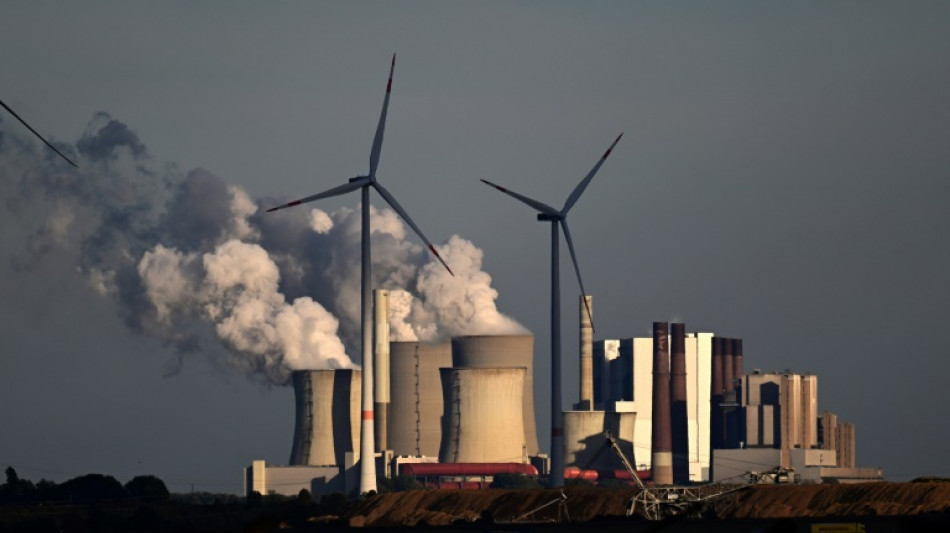
IEA sees 'beginning of the end' of fossil fuel era / Photo: INA FASSBENDER - AFP/File
For the first time, world demand for oil, gas and coal is forecast to peak this decade due to the "spectacular" growth of cleaner energy technologies and electric cars, the International Energy Agency's chief said Tuesday.
The IEA's annual World Energy Outlook, due out next month, will show that "the world is on the cusp of a historic turning point", executive director Fatih Birol wrote in a column in the Financial Times.
The shift will have implications for the battle against climate change as it will bring forward the peak in greenhouse gas emissions, Birol said.
"Fossil fuels will be with us for many years to come –- but looking at our numbers, we may be witnessing the beginning of the end of the fossil fuel era," Birol said in separate comments released by the IEA.
Birol said the change is mostly driven by the "spectacular growth" of clean energy technologies and electric vehicles, along with structural changes in the Chinese economy and the fallout from the energy crisis.
Birol warned, however, that the projected declines in oil, gas and coal demand are "nowhere near steep enough to put the world on a path to limiting global warming" to 1.5 degrees Celsius -- the preferred target under the Paris Agreement.
Meeting this goal "will require significantly stronger and faster policy action by governments", he added.
- UN warning -
The fate of fossil fuels will be at the heart of the debates at the UN's COP28 climate summit in Dubai, a major oil producer, between November 30 and December 12.
In a progress report on Friday, the United Nations warned that the world was "not on track" to meet the long-term goals of the Paris Agreement.
Global greenhouse gas emissions must peak by 2025 and drop sharply thereafter to keep the 1.5C target in view, the report said.
Phasing out fossil fuels whose emissions cannot be captured or compensated is also required to achieve the goal of net-zero carbon emissions by 2050, the UN said.
The IEA already predicted in a report in June that a peak global oil demand was "in sight" before the end of the decade, but it is the first time that it makes such an assessment for coal and gas.
"Our latest projections show that the growth of electric vehicles around the world, especially in China, means oil demand is on course to peak before 2030," Birol said Tuesday.
After staying "stubbornly high" for the past decade, coal demand is set to peak "in the next few years", he said.
And the "Golden Age of Gas" -- first called by the IEA in 2011 -- "is now nearing an end", with demand set to fall in advanced economies later this decade, Birol added.
"This is the result of renewables increasingly outmatching gas for producing electricity, the rise of heat pumps and Europe's accelerated shift away from gas following Russia's invasion of Ukraine," he said.
- Transition 'firmly advancing' -
Simone Tagliapietra, a climate expert and senior fellow at the Bruegel think tank in Brussels, said that the IEA's new projections "illustrate that while still to slow, the global energy transition is firmly advancing".
"As technologies like wind and solar are now cost competitive, the transition moves from being policy-driven to being technology-driven," he said.
"This is a key feature, as it protects the process from political headwinds."
Analysts at Royal Bank of Canada said in a note that the IEA's new projections highlight the "success in pro-renewables legislation".
"Despite this, there is still scope for policymakers to do more to accelerate the energy transition and the phase-out of fossil fuels, with debates continuing across major economies in areas such as renewable returns and affordability," the RBC analysts said.
X.Vanek--TPP