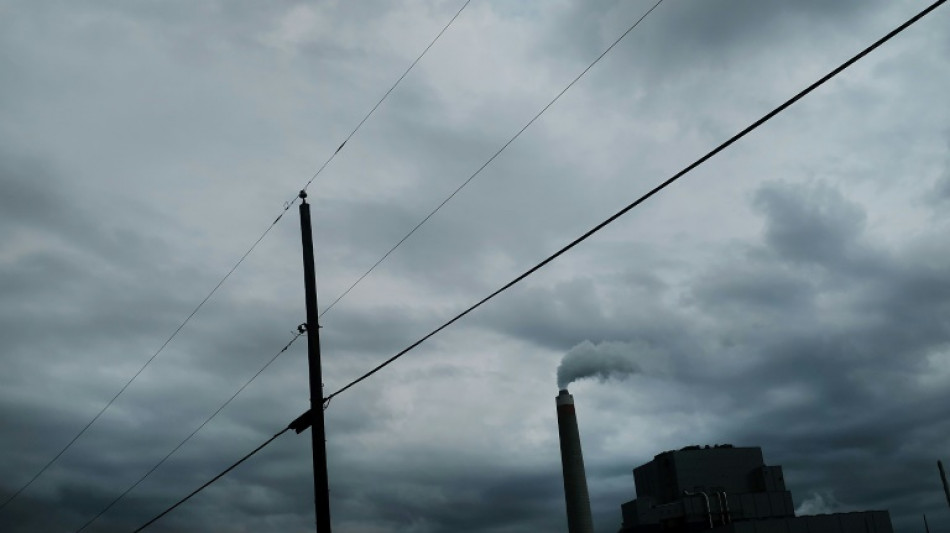
Biden strengthens US soot regulations, angering industry / Photo: SPENCER PLATT - GETTY IMAGES NORTH AMERICA/AFP/File
President Joe Biden's administration on Wednesday announced tough new air quality standards it said were sorely needed to protect the health of vulnerable communities, though industry groups have said the move would devastate domestic manufacturing.
It comes as the Democratic incumbent faces a tough election rematch against the likely Republican candidate Donald Trump, who rolled back dozens of air pollution regulations when he was in office.
The Environmental Protection Agency (EPA)'s new rule concerns fine particulate matter, commonly known as soot, a widespread, deadly pollutant linked to asthma and heart disease, and more.
Under the new standard, levels of PM2.5 (particles that are 2.5 micrometers in diameter and smaller) would not be permitted to exceed an average annual level of 9 micrograms per cubic meter, down from the current 12 micrograms per cubic meter and more stringent than current as well as proposed European Union regulations.
"Today's action is a critical step forward to better protect workers, families and communities from the dangerous and costly impacts of fine particle pollution," EPA chief Michael Regan told reporters on a press call.
Vehicles, smokestacks and fires are common sources of fine particles, which also form when gases emitted by car engines, power plants and industrial processes react in the atmosphere.
The agency estimated the action would prevent up to 4,500 premature deaths and 290,000 lost workdays, and generate up to $46 billion in net health benefits in 2032, the first year that states would be required to meet the new standard.
- Industry critical -
Wednesday's announcement was hailed by environmental and health groups.
"The body of science around this pollution is so robust -- we know it takes people before their time, premature deaths from heart attacks, we know that it gives children and adults asthma and many other sicknesses," said Abbie Dillen, president of the environmental law nonprofit Earthjustice.
"We could not be more grateful on behalf of all of the clients that we've represented over the years," she added.
Industry groups have said the rule would threaten US manufacturing operations, and the issue threatens to become yet another battleground in key swing states in the 2024 presidential election.
"The standards will hinder onshoring, resulting in continued manufacturing abroad -- which is less clean than manufacturing in the US," the National Association of Manufacturers said in a statement when the rule was first mooted a year ago.
The move has also been opposed by the American Forest & Paper Association, with the pulp and paper mills large emitters of air pollution.
But the EPA has disputed the characterizations, calculating that 99 percent of the country's more than 3,100 counties will be in compliance by 2032 because of an overall downward trend in air pollution from other initiatives.
It added states could exclude exceptional circumstances arising from wildfires from the particulate matter they report -- a factor that could be important as climate change makes smoke exposure from forest blazes more common.
I.Mala--TPP