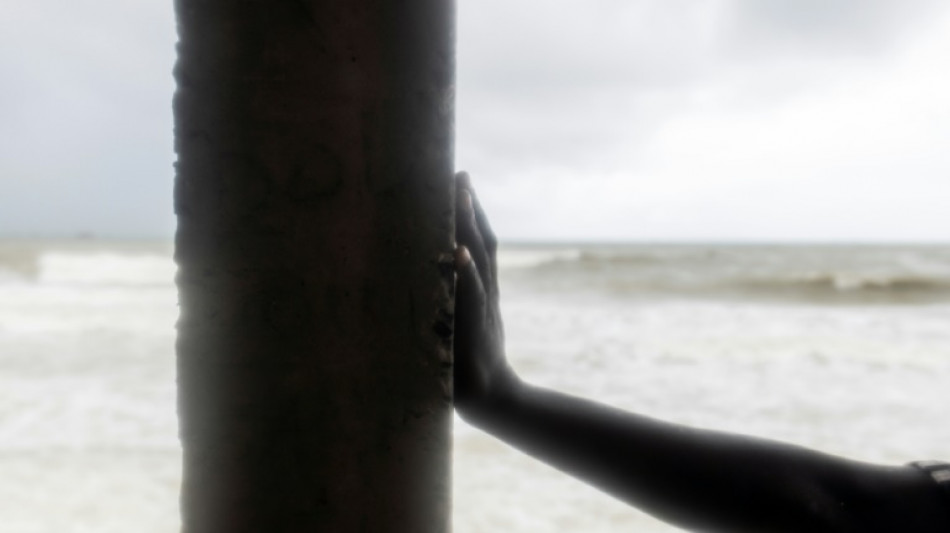
Climate urgency takes back seat in Senegal election / Photo: JOHN WESSELS - AFP/File
Surrounded by lush mangrove forests, Julien Arfang Diatta shows the flooded road leading to his village on Senegal's tiny island of Kailo.
Encroaching water levels caused by climate change drive fears that Kailo and surrounding islands in southern Senegal could disappear in a matter of years.
Yet the 18 candidates running for president on Sunday have largely ignored the country's pressing environmental situation.
During the rainy season from July to November, "the sea gets bigger and bigger and you can't get through," Diatta said.
"And we can no longer farm the rice fields because of the salt water."
Diatta's family has lived on the surrounding Kafountine islands for centuries, but they now fear being forced from their homes.
"The water is advancing and threatening the village. The trees are dying. If this continues, we'll have no choice but to leave, but where will we go?" said Louise Diatta, in her 40s, who wants her children to grow up on her native island.
Like many countries along the West African coast, Senegal is on the front lines of climate change.
Coastal erosion linked to rising sea levels, drought, desertification and flooding have affected large swathes of the population, with some communities in the north already displaced.
Most presidential candidates made some mention of the environment in their manifestos, a marked change from previous years.
But concrete measures to tackle global warming and reduce greenhouse gas emissions were relegated far behind issues such as justice, employment and the renegotiation of hydrocarbon contracts.
Recently discovered reserves of oil and gas have raised hopes of future industrialisation, with production due to begin this year.
- 'Urgent action' -
Senegal's coastline is receding by an average of between one and 1.3 metres a year, according to official figures from 2020.
At this rate, around 6,000 square kilometres (2,300 square miles) of low-lying areas would be flooded by 2100, with a sea level rise of one metre.
But the mayor of the southern town of Kafountine, David Diatta, said the phenomenon in his locality was happening much faster than these projections.
Rising waters are already making startling inroads in the town, which is home to around 40,000 people.
Even at the height of the dry season, the road linking the centre with the quays to reach the Kafountine islands is submerged.
Formerly buried electricity cables and pipes supplying drinking water are now exposed to the rising waves.
A half-collapsed petrol station and a former tourist site have also fallen prey to the advancing sea.
And the dock where hundreds of fishermen, fishmongers and vendors work has begun its descent into the water.
"The situation is very worrying and requires urgent action," the mayor told AFP.
- High stakes -
"If the fishing dock disappears, thousands of jobs will be lost. If the tourist infrastructure disappears, hundreds and thousands of jobs will disappear," Diatta added.
This is a worrying prospect at a local level, in a country where unemployment already stands at 20 percent.
In the historic northern city of Saint-Louis, the government aided by foreign partners in 2019 began constructing a 3.6-kilometre seawall to combat rising water levels.
But further south in Kafountine, Diatta said that local authorities did not have the means to cope, with the thousands of sandbags placed along the coastline offering little protection from the ocean.
"We need real political will on the part of the central government. We're going to take our concerns to whoever is elected president to find solutions," Diatta said.
He decried the government's slow response to the situation and the lack of interest shown by the majority of presidential candidates.
Aissatou Diouf, head of advocacy at the NGO Enda Energie, said that most hopefuls in the race only mentioned environmental issues in an "abstract" way.
"We need to go beyond 'we have to protect the environment,'" she said.
"How can we do this? With what technology? What kind of investment? What kind of financing? What kind of vision?" she said, listing the pressing issues.
"How will the programme fit in with Senegal's international commitments to help limit global warming to 1.5 degrees Celsius?"
Economic and development projects should also include an environmental dimension, Diouf added, given the urgency of the situation and the "enormous" stakes for the Senegalese people.
S.Janousek--TPP