The Prague Post - Norway women bring seaweed to culinary heights in Europe

EUR -
AED 4.297021
AFN 73.701381
ALL 95.402513
AMD 434.241071
ANG 2.093917
AOA 1073.932683
ARS 1632.563026
AUD 1.638657
AWG 2.108676
AZN 1.988026
BAM 1.954633
BBD 2.356993
BDT 143.584292
BGN 1.951449
BHD 0.44167
BIF 3481.508397
BMD 1.169862
BND 1.494302
BOB 8.086173
BRL 5.872007
BSD 1.170201
BTN 110.934781
BWP 15.817491
BYN 3.295133
BYR 22929.289176
BZD 2.353595
CAD 1.600383
CDF 2714.078892
CHF 0.924021
CLF 0.02671
CLP 1051.23342
CNY 7.99887
CNH 8.003187
COP 4240.046719
CRC 532.182333
CUC 1.169862
CUP 31.001335
CVE 110.433944
CZK 24.392772
DJF 208.384722
DKK 7.474697
DOP 69.314082
DZD 155.145875
EGP 62.008399
ERN 17.547925
ETB 184.106986
FJD 2.57972
FKP 0.865839
GBP 0.866944
GEL 3.152727
GGP 0.865839
GHS 13.032313
GIP 0.865839
GMD 85.987077
GNF 10268.479608
GTQ 8.940625
GYD 244.832809
HKD 9.168148
HNL 31.141585
HRK 7.538
HTG 153.268512
HUF 365.220878
IDR 20312.30857
ILS 3.477356
IMP 0.865839
INR 110.83182
IQD 1532.518817
IRR 1539537.987924
ISK 143.600486
JEP 0.865839
JMD 183.500466
JOD 0.829426
JPY 187.352137
KES 150.970964
KGS 102.280191
KHR 4691.14572
KMF 492.511719
KPW 1052.836528
KRW 1736.800314
KWD 0.359965
KYD 0.975214
KZT 542.026457
LAK 25672.615598
LBP 104819.608215
LKR 373.886822
LRD 214.96177
LSL 19.343637
LTL 3.454298
LVL 0.707637
LYD 7.42271
MAD 10.828533
MDL 20.145889
MGA 4853.75659
MKD 61.710764
MMK 2456.685675
MNT 4186.801833
MOP 9.446661
MRU 46.794504
MUR 54.726535
MVR 18.074627
MWK 2036.729175
MXN 20.434466
MYR 4.623879
MZN 74.765619
NAD 19.36168
NGN 1606.2429
NIO 42.951484
NOK 10.871256
NPR 177.495292
NZD 2.002113
OMR 0.449836
PAB 1.170201
PEN 4.11324
PGK 5.082756
PHP 72.096258
PKR 326.069677
PLN 4.256746
PYG 7280.654072
QAR 4.262098
RON 5.100714
RSD 117.42374
RUB 87.726178
RWF 1708.583002
SAR 4.3879
SBD 9.389234
SCR 17.208205
SDG 702.499104
SEK 10.872303
SGD 1.497183
SHP 0.87342
SLE 28.807824
SLL 24531.410279
SOS 668.581498
SRD 43.824202
STD 24213.775097
STN 24.859561
SVC 10.239888
SYP 129.54475
SZL 19.361372
THB 38.296561
TJS 10.970904
TMT 4.100365
TND 3.373589
TOP 2.816746
TRY 52.72538
TTD 7.95725
TWD 36.992232
TZS 3035.791158
UAH 51.579212
UGX 4359.397812
USD 1.169862
UYU 46.5722
UZS 14120.230776
VES 566.936695
VND 30832.874772
VUV 138.479066
WST 3.177199
XAF 655.562883
XAG 0.01628
XAU 0.000257
XCD 3.16161
XCG 2.109041
XDR 0.816234
XOF 654.540519
XPF 119.331742
YER 279.186955
ZAR 19.57512
ZMK 10530.159935
ZMW 22.087815
ZWL 376.694988
  • CMSC

    0.0000

    22.83

    -0%

  • BCC

    -3.2150

    79.395

    -4.05%

  • JRI

    0.0080

    12.818

    +0.06%

  • AZN

    -2.1500

    184.53

    -1.17%

  • NGG

    -1.0600

    86.39

    -1.23%

  • RIO

    -1.6500

    96.84

    -1.7%

  • RYCEF

    -0.3200

    14.88

    -2.15%

  • RBGPF

    -0.5300

    63.47

    -0.84%

  • BCE

    -0.1150

    23.385

    -0.49%

  • GSK

    -2.8300

    51.64

    -5.48%

  • CMSD

    -0.0200

    23.18

    -0.09%

  • VOD

    -0.0550

    15.435

    -0.36%

  • RELX

    -0.2450

    35.765

    -0.69%

  • BP

    0.2650

    46.615

    +0.57%

  • BTI

    -0.6800

    57.79

    -1.18%

Norway women bring seaweed to culinary heights in Europe
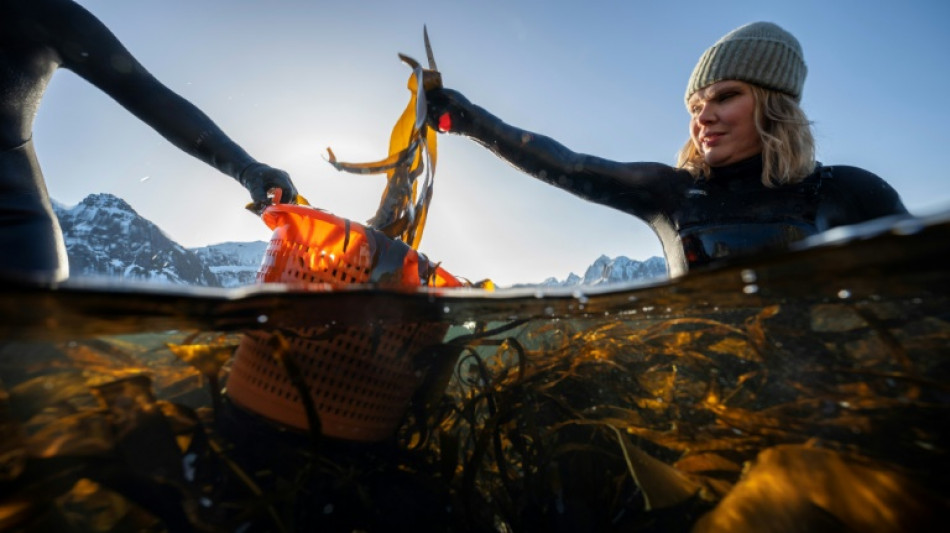
Norway women bring seaweed to culinary heights in Europe / Photo: Olivier MORIN - AFP

Norway women bring seaweed to culinary heights in Europe

In the glacial waters of the Lofoten archipelago in Norway's far north, Angelita Eriksen uses a knife to cut a handful of seaweed that will soon end up in a fancy European eatery.

Text size:

"We have the cleanest and clearest waters in the world. We're very lucky that we have this really important resource growing right outside our doorstep," Eriksen told AFP in a cabin on the shores of the northern Atlantic Ocean where the seaweed is laid out to dry.

"We want to show that to the world."

The daughter of a Norwegian fisherman, Eriksen joined forces with New Zealand-born Tamara Singer, whose Japanese mother served seaweed with almost every meal, to start the company Lofoten Seaweed -- specialising in harvesting and preparing seaweed for the food industry.

With the help of six others, they hand-pick 11 tonnes of seaweed a year, the snow-capped mountains plummeting into the sea behind them in a dramatic tableau.

It's a demanding and "physical job", said Eriksen.

The peak season runs from late April until June, but "we harvest the dulse, the nori and the sea truffle in the winter and fall".

"It can be quite cold, as we can stay out for about an hour along the shore", with lower legs and hands submerged in the chilly water.

By "late May, I'm actually sweating in my suit".

One time, she said, "I took my glove off and the steam was just rising up".

"It's physically hard but at the same time it's very meditative, or therapeutic in a way, to harvest," she says.

- 'Delicate' -

Truffle seaweed, winged kelp, nori, dulse, sugar kelp, oarweed kelp: the pair focus on about 10 types of seaweed, long eaten in Japan and increasingly popular in Europe for their nutritional qualities.

The seaweed is sold locally or shipped to gourmet restaurants in Norway and the rest of Europe.

The two women organise workshops to teach chefs about the different varieties and the qualities of each type.

"Seaweeds are like vegetables, they have their own texture, taste and colours," says Singer.

She said it was a "huge surprise" how many European chefs had little or no knowledge of the different flavours and ways of preparing seaweed.

The duo have worked with Japanese chefs "who know exactly what to do, you don't have to tell them anything".

"It's just so natural for them. It's like giving a piece of fish to a North Norwegian," says Singer.

Some 20 kilometres (12 miles) away, chef Josh Wing has been serving the pair's products in his high-end restaurant Hattvika Lodge for about five years.

He is well versed and does not need to take part in their workshops anymore.

Wing is particularly fond of the dulse, a "very delicate purple seaweed", which he serves with local fish dishes or bread.

It "can provide a physical texture in a dish that you can't get from other products", he tells AFP.

To ensure that their business is sustainable, Eriksen and Singer have mapped and dated their harvest sites, as well as the volumes of each species, for the past four years.

"Our results show that the regrowth in recently-harvested patches is actually faster than anticipated, almost as if a harvest actually stimulates growth," says Singer.

D.Kovar--TPP