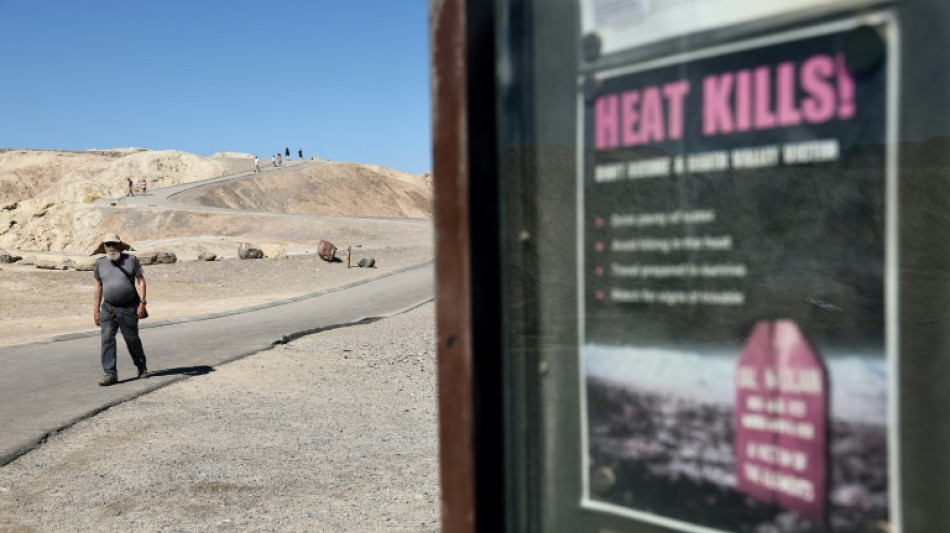
Danger warnings as heatwave hits western US / Photo: MARIO TAMA - GETTY IMAGES NORTH AMERICA/AFP/File
A dangerous heatwave was building over parts of the western United States Tuesday, with forecasters warning of rocketing temperatures in an early taste of a possibly brutal summer for the region.
The mercury was expected to top out at well over 100 degrees Fahrenheit (38 degrees Celsius), with some areas experiencing highs as much as 30 degrees above normal for this time of year.
Southwestern desert areas and California's Central Valley fruit basket were set to be particularly unpleasant, the National Weather Service warned.
"Widespread temperature records are expected to be tied or broken across much of the aforementioned areas," the agency said.
Temperatures in Death Valley were set to hit a deeply uncomfortable 122F on Thursday, while Las Vegas could be baking in 112F heat.
Forecasters issued excessive heat warnings for parts of Nevada, Arizona and California, with the heat expected to spread further inland as the week goes on.
"Little overnight relief will make for dangerous conditions for those without effective cooling and/or adequate hydration," the NWS said.
California's Environmental Protection Agency said certain groups were particularly at risk.
"Extreme heat is an invisible but dangerous consequence of climate change, and California's outdoor workers, seniors and children are particularly vulnerable," it wrote on social media.
Southern Texas was also experiencing sweltering temperatures, with the border city of Rio Grande expected to see highs of 117F later Tuesday.
Forecasters in the United States are watching for the development of a ridge of high pressure that would bring more heat in from Mexico, which has been withering under a punishing heatwave.
Late last month Mexico City -- which sits 7,350 feet (2,240 meters) above sea level and has traditionally enjoyed a temperate climate -- logged its highest ever temperatures.
Officials say dozens of people have died in repeated heatwaves that have scorched the country, with hundreds of others sickened.
Experts say there could be worse to come.
This year is on course to be "the warmest year in history," Francisco Estrada, coordinator of the Climate Change Research Program at the National Autonomous University of Mexico, has warned.
Human-caused climate change is heating up the planet at an alarming rate, the global scientific community agrees.
The world experienced an average of 26 more days of extreme heat over the last 12 months that would probably not have occurred without climate change, a report said last month.
The report, by the Red Cross Red Crescent Climate Centre, the World Weather Attribution scientific network and the nonprofit research organization Climate Central, said 6.3 billion people -- roughly 80 percent of the global population -- experienced at least 31 days of extreme heat last year.
The year 2023 was the hottest on record, according to the European Union's climate monitor, Copernicus.
And 2024 is not shaping up to be any better, with Pakistan, India and China already walloped by extreme temperatures.
G.Turek--TPP