The Prague Post - World's rarest whale washes up on New Zealand beach

EUR -
AED 4.181388
AFN 74.548812
ALL 88.808239
AMD 417.330754
AOA 1045.20509
ARS 1707.561564
AUD 1.632437
AWG 2.049421
AZN 1.935757
BAM 1.959884
BBD 2.292968
BDT 140.542836
BHD 0.429365
BIF 3392.930624
BMD 1.138567
BND 1.472762
BOB 12.973031
BRL 5.850867
BSD 1.138467
BTN 109.047733
BWP 15.682607
BYN 3.26579
BYR 22315.919539
BZD 2.289671
CAD 1.606257
CDF 2590.240832
CHF 0.933136
CLF 0.027045
CLP 1064.424027
CNY 7.709524
CNH 7.709575
COP 3658.057411
CRC 517.976984
CUC 1.138567
CUP 30.172034
CVE 110.72578
CZK 24.172353
DJF 202.346566
DKK 7.475093
DOP 66.321899
DZD 151.840643
EGP 57.498107
ERN 17.07851
ETB 182.409655
FJD 2.539859
FKP 0.855833
GBP 0.856942
GEL 2.98302
GGP 0.855833
GHS 13.252843
GIP 0.855833
GMD 83.693076
GNF 9976.697279
GTQ 8.685058
GYD 238.136182
HKD 8.927546
HNL 30.604949
HRK 7.534471
HTG 148.789365
HUF 359.89487
IDR 20562.525861
ILS 3.483566
IMP 0.855833
INR 108.845613
IQD 1491.523194
IRR 1565672.39039
ISK 142.196032
JEP 0.855833
JMD 180.285644
JOD 0.807289
JPY 186.59182
KES 147.455975
KGS 99.568162
KHR 4599.811608
KMF 492.999735
KRW 1658.448706
KWD 0.35365
KYD 0.948672
KZT 544.482094
LAK 25794.242969
LBP 101958.703993
LKR 382.567118
LRD 206.31071
LSL 19.116872
LTL 3.361893
LVL 0.688708
LYD 7.29249
MAD 10.666151
MDL 20.150898
MGA 4907.22517
MKD 61.500008
MMK 2391.190848
MNT 4094.09657
MOP 9.195259
MRU 45.605332
MUR 54.070244
MVR 17.602131
MWK 1976.55317
MXN 19.851494
MYR 4.655713
MZN 72.765897
NAD 19.116631
NGN 1556.421786
NIO 41.837225
NOK 11.028846
NPR 174.476774
NZD 1.969351
OMR 0.437783
PAB 1.138472
PEN 3.875672
PGK 5.00399
PHP 70.044464
PKR 316.3621
PLN 4.325634
PYG 6848.269081
QAR 4.149506
RON 5.22967
RSD 117.387395
RUB 89.660995
RWF 1668.001129
SAR 4.279747
SBD 9.182144
SCR 15.363761
SDG 683.711527
SEK 11.034061
SGD 1.471638
SLE 27.610513
SOS 650.692124
SRD 43.096484
STD 23566.044837
STN 24.934624
SVC 9.961756
SZL 19.110865
THB 38.187444
TJS 10.490759
TMT 3.996371
TND 3.375892
TRY 53.959667
TTD 7.7431
TWD 36.865672
TZS 3013.217523
UAH 51.196974
UGX 4297.936323
USD 1.138567
UYU 45.735294
UZS 13671.916857
VES 844.682638
VND 29984.170463
VUV 135.67922
WST 3.132208
XAF 657.323716
XAG 0.019901
XAU 0.000283
XCD 3.077035
XCG 2.051766
XDR 0.816616
XOF 652.965086
XPF 119.331742
YER 271.150187
ZAR 19.024378
ZMK 10248.453703
ZMW 21.289359
ZWL 366.618214
  • RBGPF

    0.0000

    66

    0%

  • CMSC

    0.0600

    21.81

    +0.28%

  • CMSD

    0.0700

    22.12

    +0.32%

  • AZN

    2.8400

    172.48

    +1.65%

  • RELX

    2.1100

    37.76

    +5.59%

  • NGG

    -0.3500

    80.86

    -0.43%

  • BCE

    0.5700

    21.81

    +2.61%

  • RIO

    -0.3100

    91.64

    -0.34%

  • RYCEF

    -0.1700

    18.7

    -0.91%

  • GSK

    1.7300

    53.71

    +3.22%

  • BTI

    1.4800

    62.3

    +2.38%

  • JRI

    0.0000

    12.91

    0%

  • VOD

    0.5900

    16.39

    +3.6%

  • BCC

    2.1600

    80.38

    +2.69%

  • BP

    -0.6400

    41.67

    -1.54%

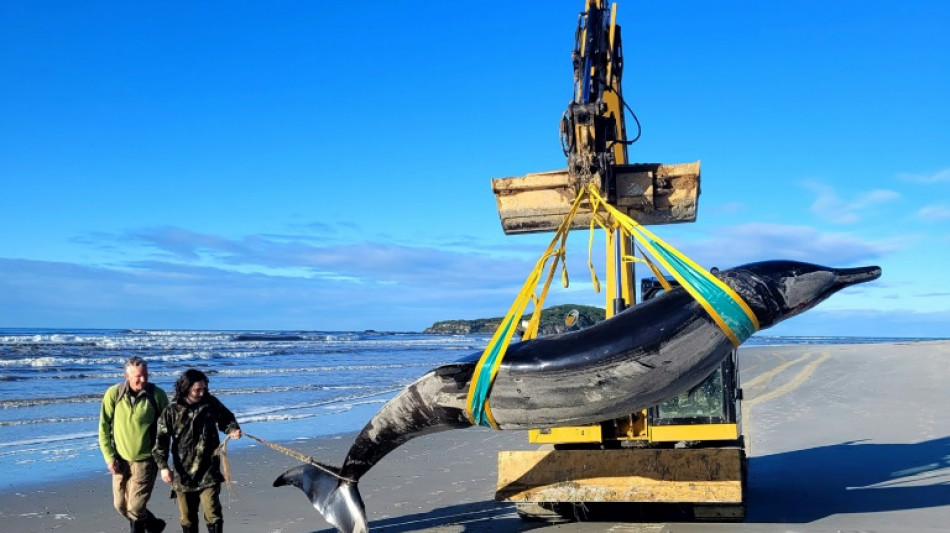
World's rarest whale washes up on New Zealand beach
World's rarest whale washes up on New Zealand beach / Photo: Handout - New Zealand Department of Conservation/AFP

World's rarest whale washes up on New Zealand beach

The body of a spade-toothed whale -- a species so rare it has never been seen alive -- appears to have washed up on a New Zealand beach, scientists say.

Text size:

The remains of the obscure, five-metre (16.4 foot) long, beaked creature were found near a river mouth in southern Otago province on July 4, government researchers said.

It was identified by marine-mammal experts from New Zealand's Department of Conservation and the national museum, Te Papa, as a male spade-toothed whale.

A DNA investigation has been launched to confirm its classification, the scientists said.

"Spade-toothed whales are one of the most poorly known large mammalian species of modern times," said the conservation department's coastal Otago operations manager, Gabe Davies.

"Since the 1800s, only six samples have ever been documented worldwide, and all but one of these was from New Zealand," Davies said in a statement Monday.

"From a scientific and conservation point of view, this is huge."

The find was fresh enough to offer the first opportunity for a spade-toothed whale to be dissected, the conservation department said.

The species is "so rare next to nothing is known about them", it said.

- 'International importance' -

The body of the whale has been placed in cold storage and genetic samples have been sent to the University of Auckland as curators of the New Zealand Cetacean Tissue Archive.

It may take several weeks or months for the DNA to be processed and a final identification confirmed.

"The rarity of the whale means conversations around what to do next will take more time because it is a conversation of international importance," the conservation department said.

The species was first described in 1874 from just a lower jaw and two teeth collected from the Chatham Islands off the east coast of New Zealand.

That sample, along with skeletal remains of two other specimens found in New Zealand and Chile, enabled scientists to confirm a new species.

Marine scientist Vanessa Pirotta said researchers would study the whale's stomach contents, genetics, and how this sample compared to previous ones.

This could shine light on the whales' behaviour, their population and why they are so rare, Pirotta told AFP, describing the discovery as "like hitting the jackpot".

Because so few specimens have been found and there have been no live sightings, little is known about the spade-toothed whale and it is classified as "data deficient" under New Zealand's Threat Classification System.

The first intact specimen was from a mother and calf stranding in Bay of Plenty in 2010, the New Zealand conservation department said.

A further stranding in 2017 in Gisborne added one more specimen to the collection.

P.Svatek--TPP